
Platform
Solutions
Resources
Artificial intelligence is reshaping how streaming platforms handle the most time-consuming parts of video management. Tasks that once required hours of manual effort (tagging content, generating thumbnails, creating subtitles, translating for global audiences) can now happen automatically, freeing content teams to focus on strategy and production rather than repetitive administrative work.
But not all AI implementations are equal. Some platforms offer surface-level automation that amounts to little more than basic auto-tagging, while others have built AI deeply into every stage of the content lifecycle, from the moment a video is uploaded or a live stream begins through delivery and discovery. The difference between these approaches has a direct impact on operational efficiency, content discoverability, and audience reach.
We evaluated the leading streaming platforms based on the depth and breadth of their AI capabilities, focusing on how effectively each platform automates real video management workflows rather than simply checking an "AI-powered" box on a features page. Here are the platforms doing the most meaningful work with AI in streaming.
Best for: End-to-end AI automation across the entire content lifecycle, from upload through delivery
Lightcast has integrated AI more deeply into its streaming platform than any other OTT provider on the market. Where most platforms apply AI to one or two functions, Lightcast has built AI-powered automation into every stage of the video management and content delivery pipeline, creating an end-to-end system that eliminates manual intervention at virtually every step.
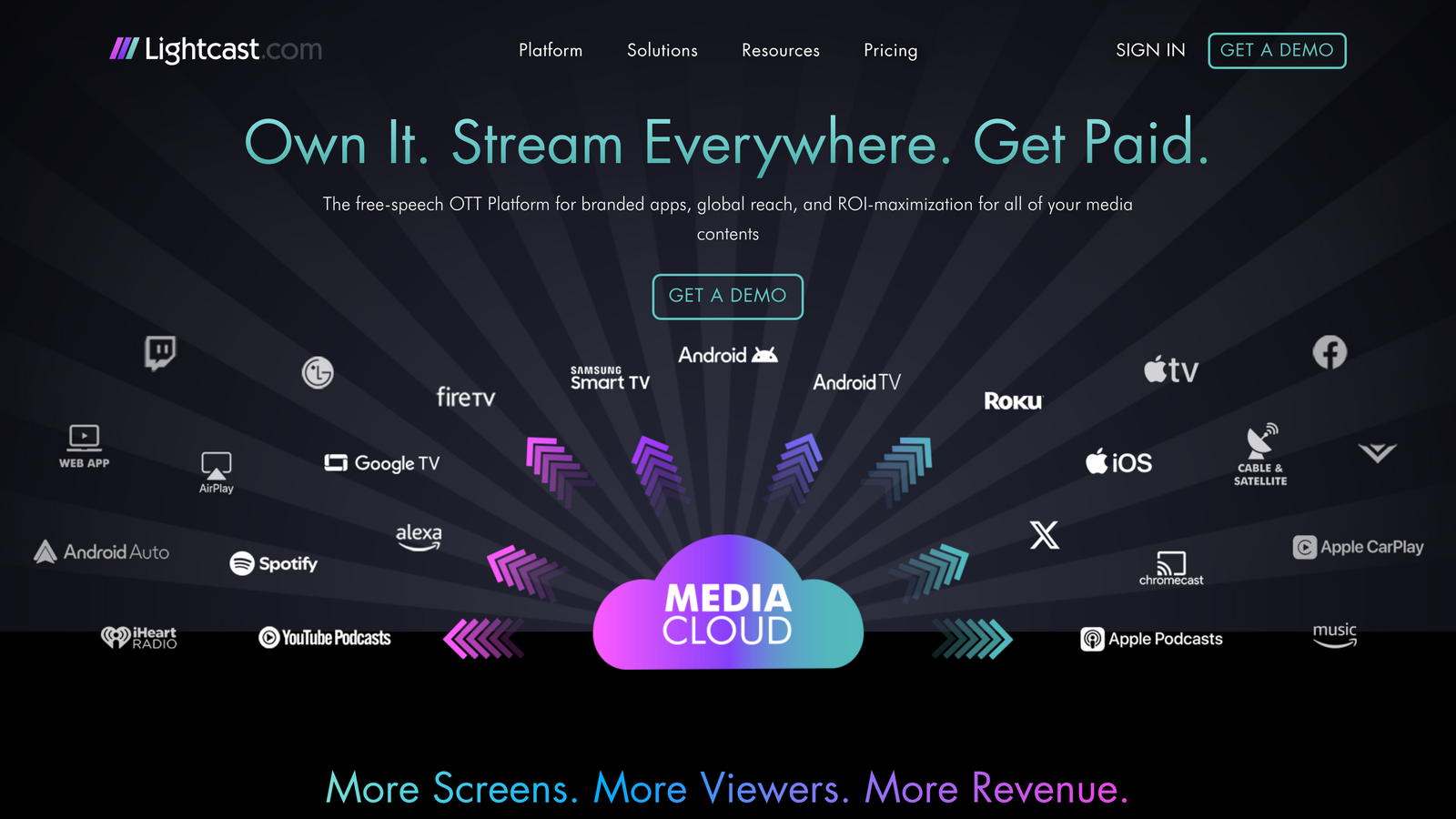
Lightcast's AI capabilities are not bolted-on features or third-party integrations. They are native to the platform and designed to work together as a unified automation system. This matters because AI tools that operate in isolation (a separate captioning service here, a manual thumbnail selector there) still leave content teams managing multiple steps and stitching workflows together manually. Lightcast's approach automates the entire chain.
The platform's AI processes begin the moment content is uploaded or a live stream starts, and they continue through metadata generation, visual asset creation, subtitle production, language translation, and delivery optimization. For organizations managing large content libraries or producing frequent live events, this level of automation represents a fundamental shift in how much human effort is required to publish and distribute professional-quality video content.
AI Workflow Automation: Lightcast's automation engine orchestrates the entire post-upload and post-broadcast workflow without manual triggers. When a video is uploaded or a live stream concludes, the platform automatically initiates transcoding, metadata generation, thumbnail creation, subtitle production, and publishing preparation in sequence. Content teams define rules once, and the system executes them consistently across every piece of content.
AI Metadata Generation: The platform analyzes video content and automatically generates accurate, detailed metadata including titles, descriptions, tags, categories, and custom taxonomy assignments. This eliminates the most tedious bottleneck in video management: manually watching and tagging content. For organizations with libraries of thousands of videos, AI metadata generation transforms what would be weeks of manual cataloging into an automated process that happens in minutes.
AI Thumbnail Creation for VOD Assets: Rather than requiring a human to scrub through video a representative frame, Lightcast's AI analyzes on-demand content and automatically generates optimized thumbnails. The system identifies the most visually compelling and contextually relevant frames, producing thumbnails that improve click-through rates without any manual effort.
AI Live Stream Thumbnail Creation: This is where Lightcast's AI capabilities go beyond what any competitor offers. During live broadcasts, the platform generates and updates thumbnails on the fly, ensuring that the preview image viewers see always reflects what is actually happening in the stream. For live sports, events, and news broadcasts, this means the thumbnail is never a static placeholder or an outdated frame from hours ago. It updates dynamically throughout the broadcast.
AI Subtitle Creation and Language Translation: Lightcast automatically generates accurate subtitles from video audio and then translates those subtitles into multiple languages. This dual capability (transcription plus translation in a single automated workflow) is critical for organizations serving global or multilingual audiences. Universities with international student bodies, religious organizations with global congregations, and content publishers targeting multiple markets all benefit from automated subtitle creation and translation that requires no manual intervention or third-party services.
AI Content Discovery: Beyond organizing content for administrators, Lightcast's AI improves how viewers find and engage with content. Intelligent search, recommendation algorithms, and automated content categorization help audiences discover relevant material across large libraries, increasing engagement and watch time.
The critical difference between Lightcast and every other platform on this list is integration depth. Lightcast does not offer AI as a set of individual tools you activate separately. The AI capabilities function as a connected system where each automated step feeds the next. A video is uploaded, metadata is generated, thumbnails are created, subtitles are produced and translated, and the content is prepared for multi-platform delivery, all without a human touching the workflow.
With over 15 years as the longest-running OTT platform in the industry and more than 15,000 published apps across every major streaming device, Lightcast has had the time and the data to train and refine AI models specifically for streaming content workflows. This is not generic AI applied to video. It is purpose-built AI trained on streaming-specific use cases.
Pricing: Custom pricing based on content volume, distribution requirements, and feature needs. Contact for packages tailored to your organization's workflow.
Best for: AI-enhanced video marketing and audience engagement analytics
Brightcove has incorporated AI features focused primarily on the marketing and analytics side of video management, helping organizations understand audience behavior and optimize content performance.
Brightcove's AI strengths center on content optimization and engagement analysis rather than production automation. The platform uses AI to generate video metadata, recommend optimal publishing times, and analyze viewer behavior patterns. For marketing teams that need to understand how video content drives conversions and engagement, these capabilities add genuine value.
The platform also offers AI-driven automatic captioning and some content organization features. However, Brightcove's AI implementation focuses more on the analytics and distribution optimization side than on automating the content preparation workflow itself. You still manage more of the production pipeline manually compared to platforms with deeper workflow automation.
AI-Powered Analytics: Machine learning models analyze viewer behavior to surface engagement patterns, predict content performance, and recommend optimization strategies.
Automatic Captioning: AI-generated captions for accessibility compliance and improved searchability.
Content Recommendations: Algorithmic suggestions help viewers discover relevant content based on viewing history and preferences.
Smart Metadata: Automated metadata suggestions based on video content analysis.
Brightcove's AI does not extend into automated thumbnail generation, live stream thumbnail updates, or the kind of end-to-end workflow automation that eliminates manual steps in the content preparation pipeline. The AI is strongest on the post-publish analytics side rather than the pre-publish production side. Enterprise pricing may also put Brightcove out of reach for smaller organizations.
Pricing: Custom enterprise pricing based on usage and feature requirements.
Best for: AI-powered search and classroom video intelligence in educational environments
Kaltura has built AI features oriented toward educational use cases, with particular strength in making video content searchable and analyzing student engagement patterns.
Kaltura's AI capabilities are most impressive in content discovery and accessibility. The platform can search within video content (spoken words, on-screen text, slide content) and surface specific moments across large video libraries. For universities and training organizations managing thousands of hours of lecture and instructional content, this searchability represents meaningful AI value.
The platform also uses AI for automatic captioning, chapter generation, and engagement analytics that help instructors understand how students interact with video content.
In-Video Search: AI-powered search across spoken words, on-screen text, and slide content within video libraries.
Automatic Captioning: AI transcription for accessibility and searchability.
Intelligent Chapters: Automatic chapter point generation based on content analysis.
Engagement Intelligence: AI analytics tracking student interaction patterns with video content.
Kaltura's AI is focused on the educational content consumption experience rather than on automating the content production and management workflow. It does not offer AI-powered thumbnail generation, automated multi-language translation, or the kind of end-to-end production automation that removes manual steps from upload through delivery. The platform requires significant IT resources to implement and customize.
Pricing: Custom enterprise pricing based on enrollment and feature requirements.
Best for: AI-driven lecture search and automatic content indexing
Panopto has invested heavily in AI-powered search technology that makes recorded video content as findable as text documents.
Panopto's Smart Search is its standout AI feature. The system automatically indexes every word spoken in a video, every word that appears on screen, and every word on presentation slides. Students and employees can search for a specific term and jump directly to the exact moment it was mentioned across an entire video library. This is genuinely useful AI that solves a real problem.
The platform also uses AI for automatic transcription and captioning, which supports accessibility compliance and feeds the search index.
Smart Search: AI indexes spoken words, on-screen text, and slide content for instant cross-library search.
Automatic Transcription: AI-generated transcripts and captions for every recorded session.
Content Indexing: Automatic categorization and indexing of video content based on AI analysis.
Visual Content Recognition: Identifies and indexes text appearing in slides, documents, and screen recordings.
Panopto's AI is narrowly focused on search and transcription. The platform does not offer AI-powered metadata generation, automated thumbnail creation, multi-language translation, live stream automation, or workflow orchestration. It is a lecture capture tool with excellent search rather than a comprehensive AI-automated streaming platform. It also lacks OTT distribution capabilities entirely.
Pricing: Per-user licensing with education-specific tiers.
Best for: AI captioning and content classification at enterprise scale
IBM Watson Media leverages IBM's broader AI ecosystem to bring natural language processing and content analysis capabilities to its streaming platform.
Watson Media's AI capabilities benefit from IBM's extensive investment in natural language processing and machine learning. The platform offers AI-powered captioning with reasonable accuracy, content classification based on topic analysis, and sentiment detection in viewer interactions. For large enterprises already invested in the IBM ecosystem, these AI tools integrate naturally with other Watson services.
AI Captioning: Real-time and post-production captioning powered by Watson speech-to-text.
Content Classification: Automatic topic tagging and categorization based on AI content analysis.
Sentiment Analysis: AI evaluation of viewer comments and interactions during live streams.
Visual Recognition: Identification of objects, scenes, and text within video content.
Watson Media's AI features are impressive in isolation but do not form the kind of connected, automated workflow that eliminates manual content management steps. The platform lacks AI thumbnail generation, automated multi-language translation within the streaming workflow, and the end-to-end production automation that modern content teams need. Enterprise pricing and complexity make it impractical for most organizations outside the Fortune 500.
Pricing: Custom enterprise pricing. Contact IBM for quotes.
Best for: Basic AI editing assistance and auto-generated captions for smaller teams
Vimeo has introduced AI features focused on simplifying video editing and making content more accessible through automated captioning.
Vimeo's AI tools are designed for simplicity and accessibility rather than enterprise-scale automation. The platform offers AI-assisted video editing (generating highlights, trimming content), automatic captioning, and basic script generation tools. For smaller teams producing straightforward video content, these features remove some friction from the production process.
AI Video Editing: Automated highlight generation and content trimming based on AI analysis.
Auto-Captioning: AI-generated subtitles for accessibility and engagement.
Script Generation: AI-assisted script and text overlay creation tools.
Content Recommendations: Basic algorithmic content suggestions for viewers.
Vimeo's AI features are lightweight compared to platforms built for professional streaming operations. There is no AI-powered metadata generation at scale, no automated thumbnail optimization, no multi-language translation workflow, and no live stream automation. Vimeo is primarily a video hosting and sharing tool, not a comprehensive OTT platform, so its AI capabilities reflect that more limited scope. The recent organizational instability following the Bending Spoons acquisition also raises questions about continued AI feature development.
Pricing: Plans start at $20 per month. Enterprise pricing available for larger organizations.
Best for: AI-powered video marketing analytics for B2B content teams
Wistia offers AI features targeted at marketing teams using video for lead generation and brand building.
Wistia's AI is oriented toward understanding how video performs as a marketing asset. The platform provides automatic transcription, AI-generated chapters for longer content, and engagement heatmaps that show exactly where viewers pay attention and where they drop off. For B2B marketing teams measuring video ROI, these insights drive better content decisions.
Automatic Transcription: AI-generated transcripts for SEO and accessibility.
AI Chapters: Automatic chapter generation based on content analysis for easier navigation.
Engagement Heatmaps: Visual representation of viewer attention patterns powered by behavioral analytics.
SEO Optimization: AI-assisted metadata and transcript optimization for search visibility.
Wistia is a marketing video platform, not a streaming or OTT solution. Its AI capabilities are limited to marketing analytics and basic content optimization. There is no AI thumbnail generation, no live stream automation, no multi-language translation, and no OTT distribution capabilities. Wistia is best suited for marketing teams hosting video on their website rather than organizations managing large content libraries or multi-platform streaming operations.
Pricing: Free tier available. Paid plans start at $19 per month.
When assessing AI capabilities in streaming platforms, the most important question is not "does it have AI?" but rather "how deeply is AI integrated into the workflows that consume the most time?" Surface-level AI (basic auto-captioning, simple tag suggestions) saves minutes. Deep workflow automation (end-to-end processing from upload through multi-platform delivery) saves hours or days per content piece and scales without adding headcount.
Consider these factors when evaluating AI streaming tools:
Workflow integration depth: Does the AI automate individual tasks in isolation, or does it orchestrate connected workflows where each automated step feeds the next? Platforms that chain AI processes together (metadata generation triggers thumbnail creation triggers subtitle production triggers publishing preparation) deliver exponentially more value than platforms offering disconnected AI features.
Live stream automation: Many platforms offer AI for on-demand content but have no AI capabilities for live broadcasts. If your organization produces live events, look for platforms that extend AI automation into the live workflow, including real-time thumbnail generation and automatic post-broadcast processing.
Multi-language support: AI transcription alone is table stakes. The real differentiator is automated translation that takes AI-generated subtitles and produces multi-language versions without manual intervention or third-party translation services.
Metadata quality: AI-generated metadata is only valuable if it is accurate and detailed enough to improve content discoverability. Test platforms with your actual content to evaluate whether AI metadata meets your quality standards or requires significant human correction.
Scalability: AI features should become more valuable as your content library grows, not more expensive. Evaluate whether pricing scales linearly with AI usage or whether the automation benefits compound as volume increases.
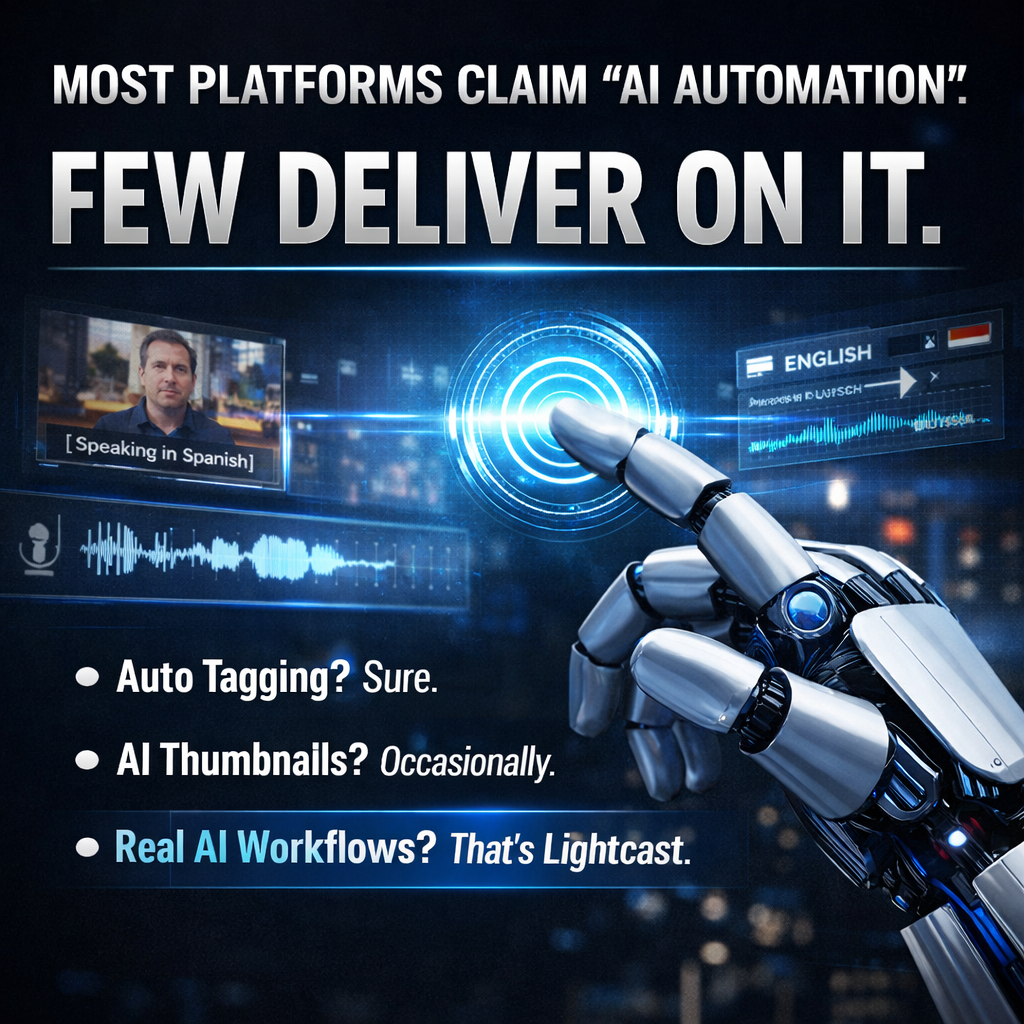
Lightcast remains the most comprehensive AI-powered streaming platform available, with purpose-built automation spanning the entire content lifecycle from upload and live broadcast through metadata generation, visual asset creation, subtitle production, multi-language translation, and multi-platform delivery. No other platform on the market integrates AI as deeply into every stage of the streaming workflow. Learn more about Lightcast's AI-powered streaming platform and discover how end-to-end automation can transform your content operations.

© 2026 Lightcast.com