Platform
Solutions
Resources
Adaptive bitrate streaming (ABR) is a method that delivers video at the best quality a viewer's connection can handle at any given moment, adjusting automatically as that connection changes. The video is encoded at several quality levels at once, and the player switches between them in real time, stepping down to avoid buffering when bandwidth drops and stepping back up when it recovers. This is why a stream can start fast, keep playing through a weak signal, and still look sharp on a strong one. Lightcast delivers adaptive streaming across 70,000+ global CDN nodes to Roku, Fire TV, Apple TV, iOS, Android, and web at once, as part of a platform serving 5,000+ organizations and 12,000+ branded apps.
Every viewer watches on a different connection, and the same connection changes minute to minute. Adaptive bitrate streaming is how modern video keeps playing smoothly across all of that, without the viewer ever touching a quality setting.
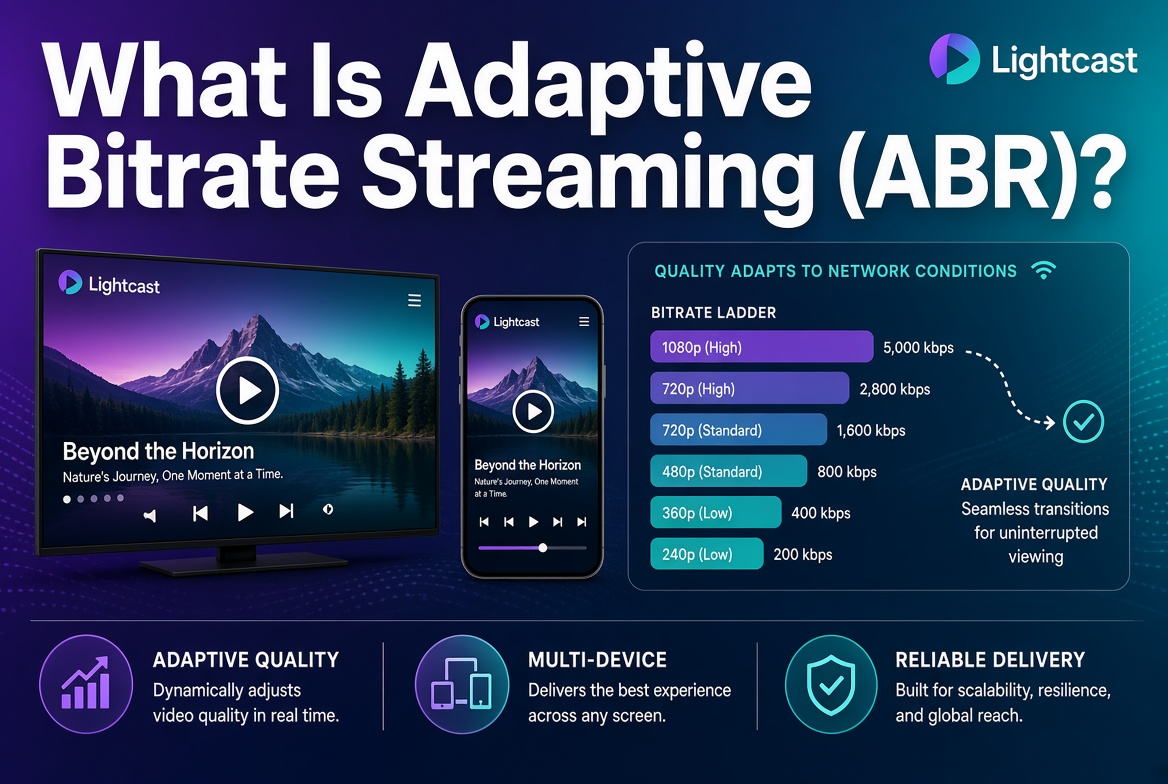
Adaptive bitrate streaming is video delivery that adjusts quality to match each viewer's available bandwidth in real time. Instead of sending one fixed version of a video to everyone, ABR prepares several versions at different quality levels and lets the viewer's player pick the one that fits their connection at that moment. When the connection is strong, the player pulls a high-quality version. When it weakens, the player quietly drops to a lower one to keep playback going. The viewer sees continuous video rather than a spinning buffer icon. It is the standard behind nearly every major streaming service today. For how video delivery works end to end, see our guide on how OTT works.
It works in three steps. First, the source video is encoded into multiple renditions, each at a different bitrate and resolution, from low quality for weak connections up to high definition and beyond. Second, each rendition is cut into short segments, usually a few seconds each. Third, as playback runs, the viewer's player continuously measures available bandwidth and how full its buffer is, then requests the next segment from whichever rendition best fits right now. The switching happens segment by segment, so the stream can move up or down in quality mid-playback without stopping. The encoding step is where the renditions are created, which we cover in our guide on live streaming encoders.
Because it is the difference between a stream people keep watching and one they abandon. Buffering is one of the most common reasons viewers leave a video, and a fixed-quality stream buffers the moment a connection cannot keep up. ABR prevents most of that by trading a little sharpness for uninterrupted playback when needed. It also speeds up startup, since the player can begin on a lower rendition and climb, and it serves every viewer well, from a phone on a weak cellular signal to a smart TV on fast home internet. For live events, where you cannot ask viewers to wait, this matters even more, which ties into our guide on low-latency live streaming.
A fixed, or constant, bitrate stream sends one quality level to every viewer regardless of their connection. If that level is too high for someone's bandwidth, they buffer. If it is too low, everyone with a good connection gets worse quality than they could have had. Adaptive bitrate removes that compromise by giving each viewer the best their connection supports, moment to moment. The cost is more work up front, since you have to encode and store several renditions instead of one, and the delivery is more complex. For most streaming today the tradeoff is clearly worth it, which is why ABR is the default.
HLS and MPEG-DASH are the two main formats that carry adaptive bitrate streaming. Both package the multiple renditions and their segments, along with a manifest file that tells the player which quality levels exist and where to find each segment. The player reads that manifest and makes the real-time switching decisions. HLS, originally from Apple, has the broadest device support, while DASH is an open standard used widely across the industry. In practice a platform often delivers both so every device gets a format it understands. The network that serves all those segments quickly is what keeps ABR smooth, which we cover in our guide on what makes streaming reliable.
A few pieces have to work together.
Multi-rendition encoding. The ability to encode each video into several quality levels, so there is a rendition for every connection.
A fast, broad content network. Segments must arrive quickly from a node near the viewer, or the player cannot sustain higher quality.
Delivery in the right formats. HLS and DASH so every device, from phones to connected TVs, can play the stream.
Reach on every screen. The same adaptive stream should publish to all your platforms, not just one.
Each segment is served from a node close to the viewer, which is what lets adaptive streaming hold higher quality instead of constantly dropping down. Explore the platform on our media cloud OVP and live streaming pages.
Your video publishes to Roku, Fire TV, Apple TV, iOS, Android, and web at once, so each screen receives an adaptive stream in a format it supports.
Adaptive delivery applies to both your live events and your on-demand library, with live converting to on-demand automatically. For the on-demand side, see our guide to the best on-demand video platforms.
Lightcast does not retain, monetize, or share client data, so the audience your content reaches stays yours.
Adaptive bitrate streaming gives every viewer the best quality their connection can handle at any moment, by encoding video into multiple renditions and letting the player switch among them in real time. It is what keeps a stream playing smoothly across weak and strong connections alike, and it is carried by the HLS and DASH formats that run on nearly every device. The tradeoff is more encoding and delivery work, and for modern streaming it is well worth it. Lightcast delivers adaptive streaming across 70,000+ global CDN nodes to every major device, live and on-demand, for 5,000+ organizations and 12,000+ branded apps, and was named Fastest Deployment OTT Platform Provider 2026 by The Silicon Review. To learn more or schedule a demonstration, visit lightcast.com.