Platform
Solutions
Resources
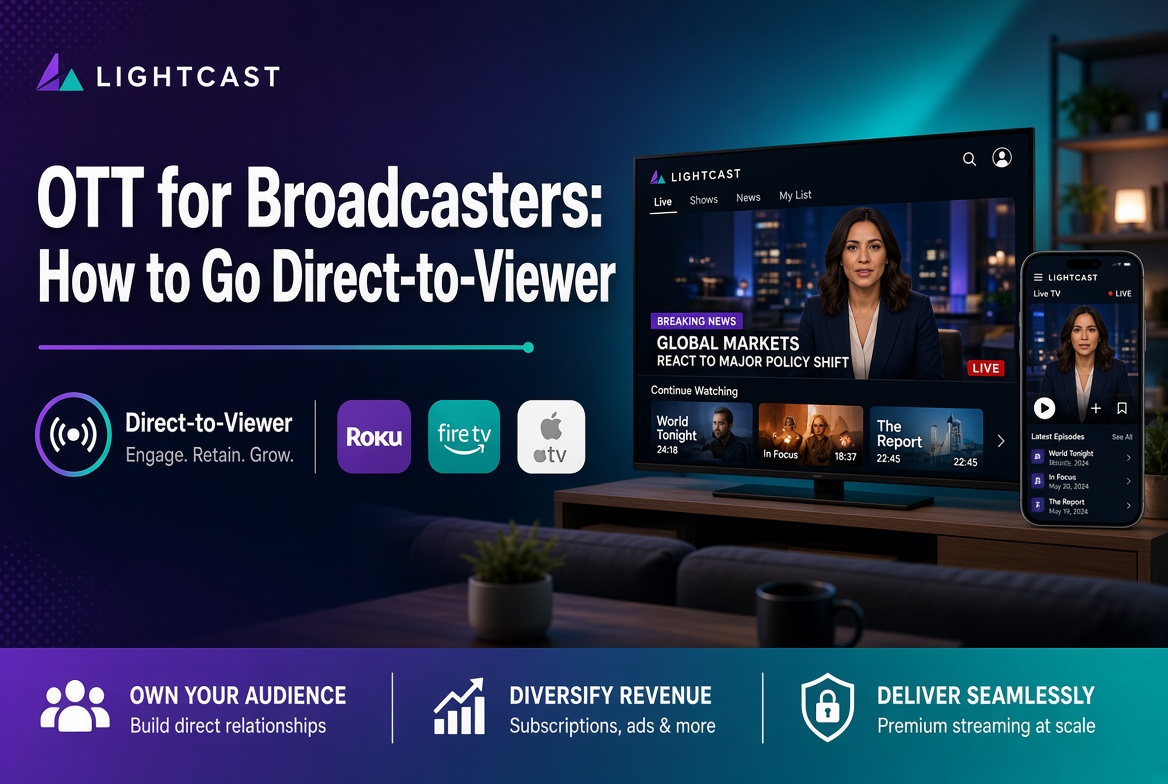
Going direct-to-viewer means a broadcaster reaches its audience through its own branded streaming app, over the internet, instead of depending entirely on cable carriage or a national platform to distribute its content. It is how a television station or network owns the viewer relationship as the audience moves online. The shift is no longer coming, it is here: streaming now accounts for 47 percent of all US television viewing, while cable has fallen to 21.2 percent. Lightcast gives broadcasters a direct-to-viewer platform that runs live and on-demand on one CMS, delivers to Roku, Fire TV, Apple TV, iOS, Android, and web simultaneously across 70,000+ global CDN nodes, and keeps audience data with the broadcaster, serving 5,000+ organizations.
For decades a broadcaster's reach was defined by its signal and its carriage deals. That model is quietly inverting. The viewers are on connected TVs and phones now, and the broadcasters who reach them directly are the ones who stop treating streaming as a secondary channel.
Because the audience already moved, and the numbers are stark. Nielsen data puts streaming at 47 percent of total US television usage as of early 2026, up from under 29 percent five years earlier, while cable has dropped from 35.6 percent to 21.2 percent in the same window. Streaming is now more than double cable and is the single largest way Americans watch television.
For a broadcaster, that is both a threat and an opening. Relying on carriage means renting access to your own audience through a distributor whose share is shrinking. A direct-to-viewer app puts you where the viewers actually are, under your own brand. For the vertical view, see our guide on OTT platforms for broadcasters.
It means owning the full chain from your content to the viewer: a branded app on every device, your live channel and an on-demand library in one place, and a direct relationship with the audience rather than one mediated by a cable operator. Instead of your programming being one tile in someone else's guide, it is your app, your brand, and your data.
Practically, that is a live feed that mirrors your broadcast, plus on-demand archives of news, shows, and local coverage that viewers can watch on their schedule. For the live foundation, see our pillar on live video broadcasting for content publishers.
The same shift that moved viewers also moved the money, and broadcasters have several levers. An ad-supported tier, including a FAST channel, monetizes reach and follows the ad dollars flowing off linear TV. A subscription unlocks premium or archive content for committed viewers. Pay-per-view fits special events and marquee local programming. Most broadcasters blend these rather than pick one, capturing the casual viewer, the loyal subscriber, and the advertiser at once. For the advertising side specifically, see our post on OTT advertising platforms.
Four things matter most for an operation that runs a live channel and a growing library.
Live delivery at scale. A broadcaster's audience arrives in large, simultaneous waves, so the platform has to hold up at peak concurrency across a real CDN.
Every device, one build. Reaching viewers means Roku, Fire TV, Apple TV, and mobile at the same time, under your brand.
Flexible monetization. Advertising, subscription, and pay-per-view should run natively, so your revenue model is not a separate integration. See our OTT platform buyer's guide.
Audience data ownership. The direct relationship with viewers is the entire point of going direct, so that data should stay with the broadcaster.
Run your live feed and your on-demand archive from a single system, with automatic live-to-VOD so broadcasts become library assets without manual re-uploading.
Content streams across 70,000+ global CDN nodes to Roku, Fire TV, Apple TV, iOS, Android, and web simultaneously, so a large audience arriving at once stays smooth.
Advertising, subscription, and pay-per-view run natively on the platform, so a broadcaster can build the revenue mix its audience responds to without stitching vendors together.
Lightcast does not retain, monetize, or share client data, so the viewer relationship you go direct to build stays yours. Explore the platform on our media cloud OVP and live streaming pages.
Going direct-to-viewer lets a broadcaster reach its audience where it actually watches, on its own branded app, as streaming overtakes cable at 47 percent of US television viewing versus 21 percent. It means owning the live channel, the on-demand library, the monetization, and the audience data, rather than renting access through a shrinking distributor. Lightcast delivers all of it on one CMS across every major device, for 5,000+ organizations and 12,000+ branded apps, and was named Fastest Deployment OTT Platform Provider 2026 by The Silicon Review. To learn more or schedule a demonstration, visit lightcast.com.