Platform
Solutions
Resources
Broadcasting a live event reliably means the stream starts fast, never buffers, and holds up when your whole audience arrives at once, whether that is a worship service, a concert, a conference keynote, or a championship game. The stakes are concrete: viewers begin abandoning a stream after about two seconds of startup delay, and every additional second raises the abandonment rate by roughly six percentage points. Lightcast delivers live events across 70,000+ global CDN nodes to Roku, Fire TV, Apple TV, iOS, Android, and web simultaneously, for 5,000+ organizations, so the stream holds under load. Reliability is not luck. It is a checklist you run before you go live.
A recorded video that stutters is annoying. A live event that fails is unrecoverable, because there is no second take. The moment happens once, and if the stream drops during it, the moment is gone for everyone who could not watch. That is why live reliability deserves its own preparation.
Because viewers leave fast, and they remember. Research on streaming quality found that audiences start abandoning a stream once startup delay passes about two seconds, and each additional second of delay pushes the abandonment rate up by roughly 5.8 percentage points. Buffering mid-stream is worse: for a 90-minute live event, a single percentage point of extra buffering cut viewer engagement by more than three minutes. And a viewer who hits a playback failure is measurably less likely to come back to the same source at all.
For a live event, that math is brutal, because everyone is watching the same moment at the same time. A failure does not affect one viewer, it affects all of them at once. For the broader setup, see our pillar on live video broadcasting for content publishers.
Most live failures trace back to a few causes. The encoder or upload bandwidth cannot sustain the bitrate, so the stream degrades or drops. The delivery relies on too few servers, so a surge of concurrent viewers overwhelms it. The stream is not tested across devices, so it plays on a laptop but breaks on a living-room TV. Or there is no backup path, so a single point of failure takes down the whole broadcast.
Every one of these is preventable with preparation and the right infrastructure. The common thread is scale: a stream that works for ten test viewers can still collapse for ten thousand real ones if it is not built to distribute.
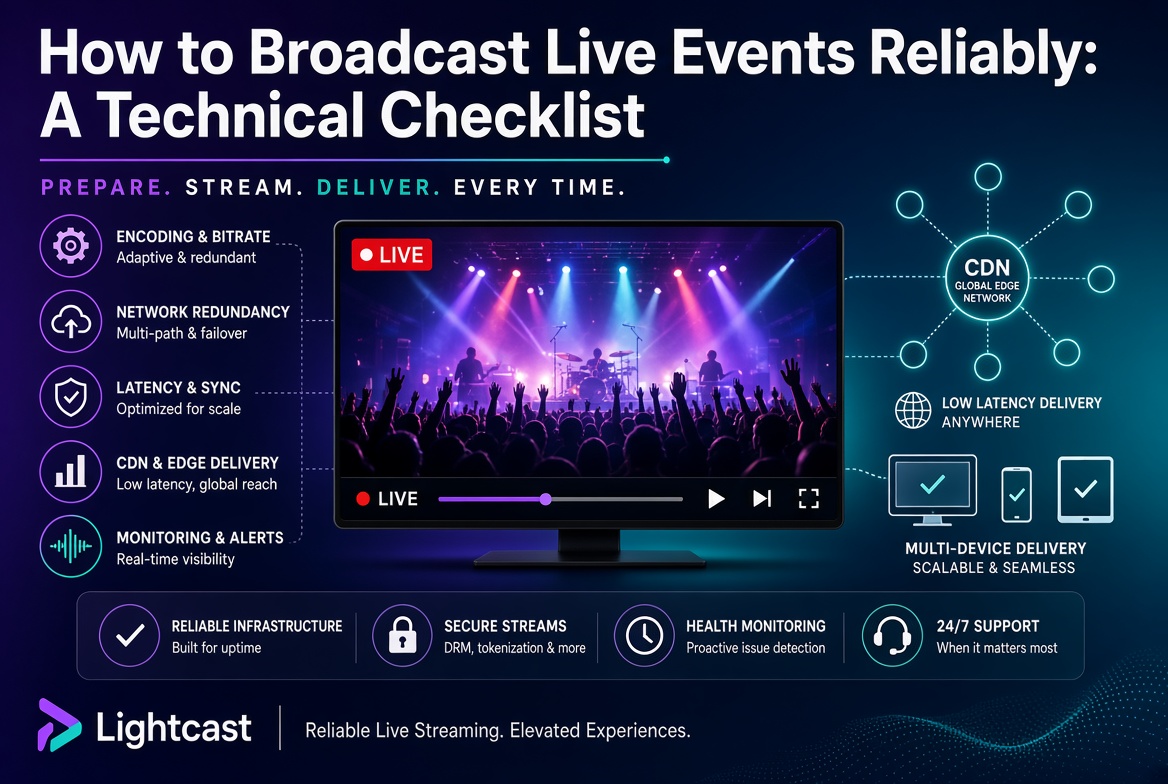
Run this before any live broadcast, whatever the event.
Confirm redundant encoding. Have a backup encoder or stream path so a single hardware failure does not end the broadcast.
Test your upload bandwidth with headroom. Your connection should comfortably exceed the bitrate you are sending, not just meet it, so a dip does not drop the stream.
Deliver through a real CDN at scale. Distribute across many edge nodes so concurrent viewers are served locally, not funneled through one strained server.
Test on every device. Verify playback on Roku, Fire TV, Apple TV, phones, and the web before the event, not during it.
Monitor in real time. Watch the stream health live so you can react to a problem in the moment. Our post on real-time content control for streaming platforms covers how.
Live events are uniquely demanding because the audience does not trickle in, it arrives all at once at start time. A worship service at the top of the hour, a concert at showtime, a keynote at nine sharp: everyone hits play together. Your platform has to be built to absorb that spike, which is a distribution problem. Serving thousands of simultaneous viewers means delivering from edge nodes close to each of them, not from a single origin. Performing arts and faith organizations, which often have their largest audiences of the year on a single date, feel this most acutely. See our guides for performing arts organizations and churches and faith organizations.
Live streams deliver across 70,000+ global CDN nodes, so a rush of concurrent viewers at start time is served from the edge rather than choking a single origin.
Content plays on Roku, Fire TV, Apple TV, iOS, Android, and web at the same time, so you are not discovering a device problem live.
Monitor and manage the stream across every platform at once while it is live, so a problem is something you fix in the moment rather than watch unfold.
The event becomes an on-demand replay the moment it ends, so anyone who missed the live window still gets the moment. Explore our commercial live streaming capabilities to see it in action.
Reliable live broadcasting comes down to preparation, because viewers abandon a stream within seconds and a live failure cannot be undone. Confirm redundant encoding, test bandwidth with headroom, deliver through a real CDN, verify every device, and monitor in real time. Above all, build for the peak-concurrency spike, since a live audience arrives all at once. Lightcast delivers live events across 70,000+ global CDN nodes to every major device simultaneously, for 5,000+ organizations and 12,000+ branded apps, and was named Fastest Deployment OTT Platform Provider 2026 by The Silicon Review. To learn more or schedule a demonstration, visit lightcast.com.