Platform
Solutions
Resources
You build your own streaming service by choosing a video platform that handles hosting, delivery, apps, and monetization, then loading your content and launching under your own brand, rather than engineering the whole system from scratch. The fastest path for most organizations is a white-label OTT platform, which supplies the technology while you keep the brand, the audience, and the revenue relationship. Lightcast has launched 12,000+ branded apps for 5,000+ organizations, delivering to Roku, Fire TV, Apple TV, iOS, Android, and web from one CMS across 70,000+ global CDN nodes, and was named Fastest Deployment OTT Platform Provider 2026 by The Silicon Review. That last point matters, because with the right platform a streaming service is a launch, not a multi-year build.
Almost anyone can create a streaming service now. The question is whether you build the plumbing yourself or stand on a platform that already has it. For most organizations, the second path gets you to launch far faster.
Yes, and you have two real routes. You can engineer everything in-house, from the video encoding and delivery to native apps on every device, or you can use a platform that provides that infrastructure and launch your own branded service on top of it. The end result looks the same to the viewer: your app, your name, your content, on their TV and their phone. The difference is how much your organization has to build and maintain to get there. For most content owners, the platform route is what makes a streaming service realistic.
A complete streaming service has several moving parts, and each one is a project on its own if you build it yourself.
Video hosting and encoding. Your content has to be stored and transcoded into the formats and bitrates every device expects.
Content delivery. A content delivery network moves video to viewers reliably, which is what keeps streams from buffering at scale.
Apps on every device. A modern service needs apps for Roku, Fire TV, Apple TV, iOS, Android, and the web, each built and certified separately. See our pillar on smart TV app development for content publishers.
Monetization. Subscriptions, pay-per-view, advertising, or donor-supported access, with billing that works inside the apps. See our pillar on video content monetization for content publishers.
A CMS to run it all. One system to manage live and on-demand content, publish across devices, and control the experience.
This is the central decision, and for most organizations the tradeoff favors a platform. Building from scratch gives you total control, but it also means developing and maintaining apps across five device families, running the delivery infrastructure, handling certification, and staffing all of it indefinitely. That is a serious, ongoing engineering commitment.
A white-label platform gives you the same branded result without owning the engineering. The provider runs the technology and stays invisible to the viewer, so the app, the name, and the audience are yours. You get to launch in a fraction of the time and focus your team on content and audience rather than software. For the full explanation of that model, see our guide on what a white-label streaming platform is, and for how to weigh providers, our OTT platform buyer's guide.
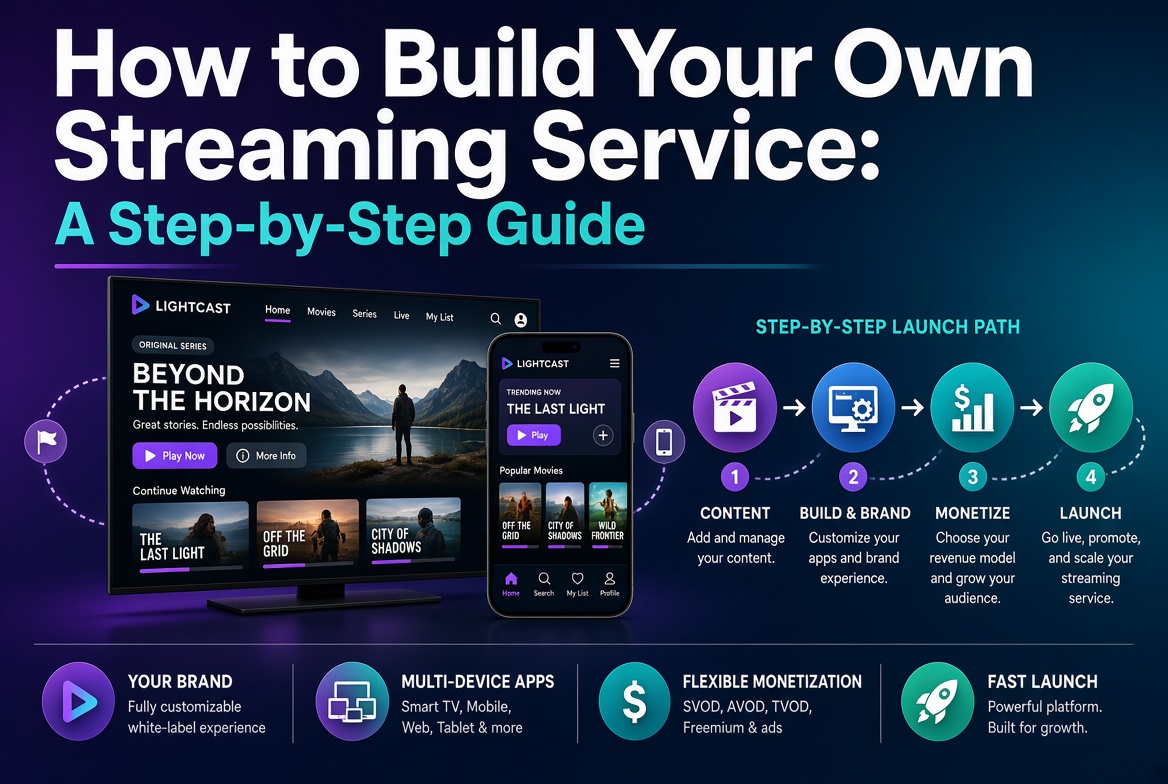
On a white-label platform, the path is straightforward.
1. Define your content and model. Decide what you are streaming, live, on-demand, or both, and how you will fund it, whether subscriptions, pay-per-view, ads, or supporter access.
2. Choose your platform. Select a provider that delivers to every device you need, supports your monetization model, and lets you own your audience data.
3. Brand your apps. Your logo, name, and design go on the apps and the web player, so the service is unmistakably yours.
4. Load and organize your content. Upload your library and set up live events, with events converting to on-demand automatically. See our guide to the best on-demand video platforms.
5. Launch and manage. Publish across Roku, Fire TV, Apple TV, mobile, and web at once, then manage everything from a single CMS.
Building from scratch is usually measured in quarters or years, because each device app and every piece of infrastructure has to be developed, tested, and certified. A white-label platform compresses that dramatically, since the apps and delivery already exist and your work is branding, loading content, and configuring monetization. Deployment speed is a real differentiator here, and it is why Lightcast was named Fastest Deployment OTT Platform Provider 2026 by The Silicon Review. For the operational side of running the service once it is live, see our pillar on live video broadcasting for content publishers.
Lightcast supplies the hosting, delivery, apps, and monetization, and you launch under your own name. More than 12,000 branded apps have been built this way, so the model is proven at scale.
Publish to Roku, Fire TV, Apple TV, iOS, Android, and web simultaneously across 70,000+ global CDN nodes, with live and on-demand managed together and events converting to on-demand automatically.
Run subscriptions, pay-per-view, advertising, and donor-supported access inside your branded apps, so you can match the model to your content and audience.
Lightcast does not retain, monetize, or share client data, so the audience your service builds stays yours. Explore the platform on our media cloud OVP and live streaming pages.
Building your own streaming service comes down to one choice: engineer the whole system yourself, or launch your own branded service on a platform that already has the infrastructure. For most organizations, a white-label OTT platform is the faster, more sustainable path, giving you branded apps on every device, built-in monetization, and full ownership of your audience data, without a multi-year build. Lightcast delivers all of it, across 5,000+ organizations and 12,000+ branded apps, and was named Fastest Deployment OTT Platform Provider 2026 by The Silicon Review. To learn more or schedule a demonstration, visit lightcast.com.