Platform
Solutions
Resources
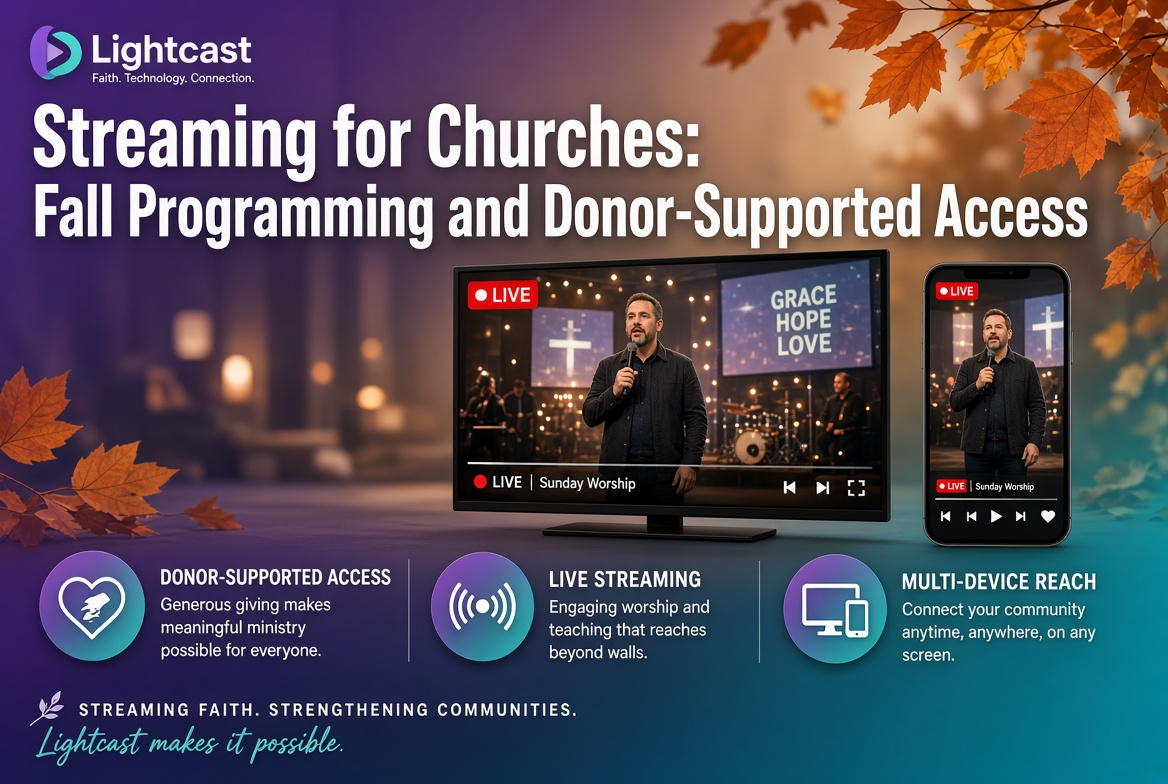
Church streaming is how a congregation extends worship, sermons, and ministry beyond the building, to members who are traveling, homebound, or scattered across the country. Unlike commercial streaming, churches rarely put worship behind a paywall. They fund it through donor-supported access, where the content stays open and giving sustains it. In 2026, 75 percent of churches offer streaming and roughly 300 million people watch church streams. Lightcast runs live and on-demand faith content on a single platform with native donor-supported access, delivers to Roku, Fire TV, Apple TV, iOS, Android, and web simultaneously across 70,000+ global CDN nodes, and does not retain, monetize, or share congregation data, serving thousands of faith organizations among 5,000+ total.
Fall is a church's second start of the year. Summer scatters the congregation, then September brings everyone back and every ministry relaunches at once. Streaming is how you keep the people who cannot be in the room connected to all of it.
Because a congregation is no longer defined by who can drive to the building on Sunday. Three quarters of churches now stream, and the audience is enormous, with hundreds of millions watching worship online. A member who moves away, a family traveling, an elderly member who cannot attend, a seeker not ready to walk in the door: streaming keeps all of them connected.
Fall concentrates the need. Small groups restart, youth programming returns, sermon series launch, and the calendar fills toward the holidays. Getting the platform right before that wave, rather than during it, is the difference between a smooth season and a scramble. For the fuller picture, see our guide on OTT platforms for churches and faith organizations.
Far more than the Sunday service. Live worship reaches members wherever they are. A sermon library becomes an on-demand archive people return to and share. Bible studies and small-group teaching extend midweek. Youth and children's programming reaches families at home. And special services, from baptisms to holiday gatherings, often draw the largest online audiences of the year, including people who would never attend in person.
Each of these is either a live moment or an on-demand asset, and running both from one place keeps the whole ministry consistent. For the live side, see our pillar on live video broadcasting for content publishers, and for the sermon archive, our guide to the best on-demand video platforms.
Through donor-supported access, which is a fundamentally different model than subscriptions or ads. Worship stays open to everyone, and the people who are able give to sustain it. This fits how congregations already operate, and the data shows the model works: digital giving rose 57 percent among Protestant churches, and 64 percent of churches now accept giving through their websites.
The pattern underneath is worth understanding. Recurring donors make up only about 22 percent of a typical church's donor base, but they generate roughly 41 percent of total giving. A platform that keeps content open and makes consistent giving easy is supporting the small group of committed donors who carry most of the load. This is why native donor-supported access matters more to a church than a subscription paywall ever could. For how the models compare, see our pillar on video content monetization for content publishers.
Four things matter most for a ministry.
Live and on-demand together. Sunday services and the sermon archive should run from one system, not separate tools.
Donor-supported access, not just subscriptions. The platform should keep content open and support giving, rather than forcing a paywall onto worship.
Every device. Members watch on the living-room TV and the phone, so the platform should publish to Roku, Fire TV, Apple TV, and mobile at once.
Data stewardship. Information about your congregation should stay with the church, not a vendor. See our commercial live streaming page for the platform detail.
Giving-based access is built in, so worship stays open and the platform supports the recurring donors who sustain the ministry, without a subscription paywall.
Sunday services stream live and convert to on-demand automatically, so the sermon archive builds itself with no re-uploading.
Content publishes to Roku, Fire TV, Apple TV, iOS, Android, and web simultaneously across 70,000+ global CDN nodes, so the homebound member and the traveling family watch the same way.
Lightcast does not retain, monetize, or share client data, so information about your members stays with the ministry. Explore the platform on our media cloud OVP page.
Church streaming extends worship and ministry to everyone who cannot be in the room, and fall is when the whole calendar relaunches at once. Unlike commercial models, churches keep content open and fund it through donor-supported access, which fits how giving already works, since a committed minority of recurring donors carries most of the load. Lightcast delivers live and on-demand faith content on one CMS with native donor-supported access and full data ownership, serving thousands of faith organizations among 5,000+ total, and was named Fastest Deployment OTT Platform Provider 2026 by The Silicon Review. To learn more or schedule a demonstration, visit lightcast.com.