Platform
Solutions
Resources
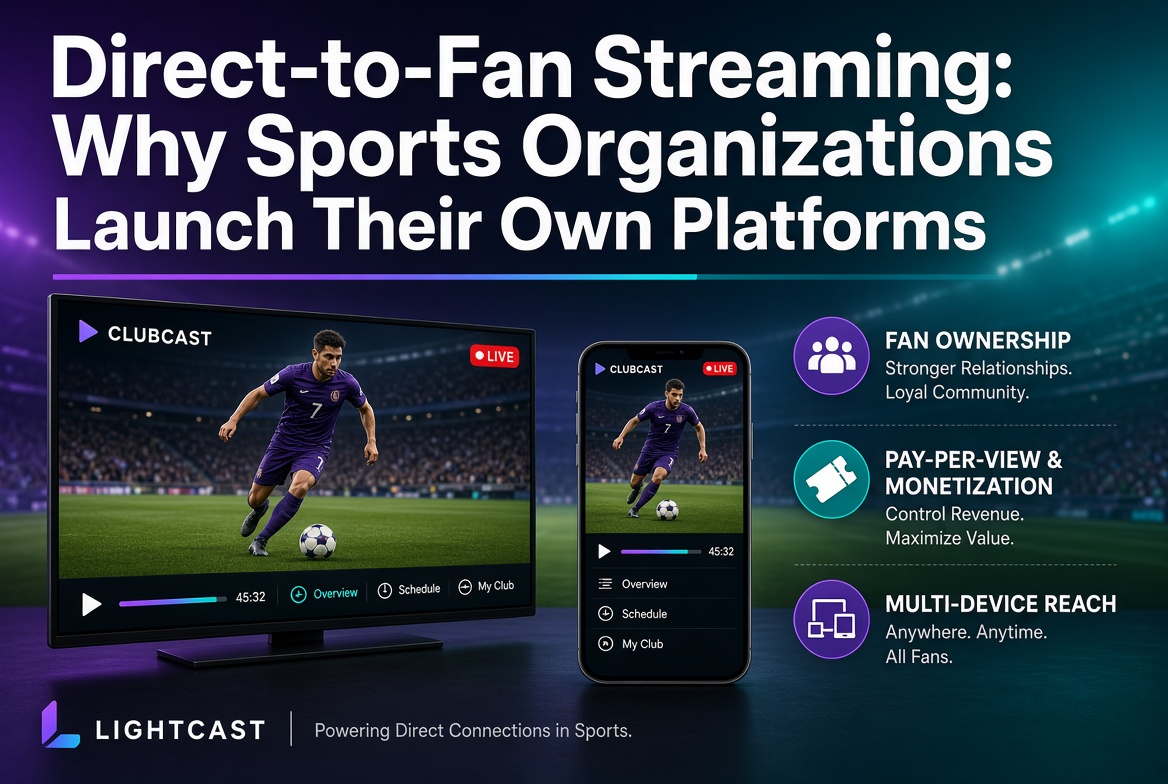
Direct-to-fan streaming is when a sports organization delivers its games and content straight to fans through its own branded platform, rather than only through a broadcaster or cable network. The organization owns the app, the fan relationship, and the data, and earns directly through subscriptions, pay-per-view, and sponsorship. It is a fast-growing model: the sports streaming platform market is projected to grow from about $42.5 billion in 2026 to $101.6 billion by 2033. Lightcast gives sports organizations a branded platform that streams live and on-demand to Roku, Fire TV, Apple TV, iOS, Android, and web from one CMS across 70,000+ global CDN nodes, with the organization owning its fan data, as part of a platform serving 5,000+ organizations.
For most of the last century, a team's relationship with its fans ran through whoever held the broadcast rights. Direct-to-fan streaming gives that relationship back to the organization, on a screen fans already use.
Direct-to-fan, sometimes called direct-to-consumer or DTC, is a sports organization streaming its content to fans through its own branded service instead of relying solely on a broadcaster. Fans download the team's or league's app, watch on their own devices, and the organization owns every part of that experience, the brand, the schedule, the monetization, and the fan data. It is the same OTT model behind the major streaming services, applied to a team or league's own audience. For the vertical overview, see our guide on OTT platforms for sports organizations.
Because owning the fan relationship is a lasting advantage. A broadcast deal reaches an audience, but the broadcaster holds the relationship and the data. Going direct lets an organization know its fans, reach them anywhere, and build on that connection season after season. It also opens content a traditional broadcast window never had room for, and it fits a market moving quickly toward streaming, with the sports streaming platform market on track to more than double by 2033. For many organizations, especially those whose games never made it onto a major network, direct-to-fan is the first time the full season is available to fans at all. For the live foundation, see our pillar on live sports streaming options.
Far more than the games. Live events are the anchor, but a direct-to-fan platform also carries replays and full-game archives, pre- and post-game shows, behind-the-scenes and training content, youth and development programs, and club or league originals. Each of these deepens the fan relationship between games and gives supporters a reason to keep coming back to your app rather than a highlight on someone else's feed. And because live events convert to on-demand automatically, a single broadcast keeps working as a library asset long after the final whistle. For the broadcast side, see our pillar on live video broadcasting for content publishers.
Through models the organization controls. Subscriptions give fans season-long access to everything. Pay-per-view fits marquee games and events that draw a wider, one-time audience. Sponsorship and advertising work well because a branded platform gives partners real, measurable visibility with an engaged fan base. Most organizations combine these, matching the model to the content, and because it all runs inside their own platform, the revenue and the fan relationship stay with the organization. For the event model, see our guide to OTT pay-per-view.
A few things matter most for live sports.
Reliable live delivery at scale. Game day brings everyone at once, so the platform has to hold up under a large simultaneous audience across a real CDN.
Reach on every device. Fans watch on connected TVs, phones, and the web, so the service should publish to all of them at once, under your brand.
Flexible monetization. Subscriptions, pay-per-view, and sponsorship should all be available, so you can match revenue to each type of content.
Fan data ownership. The relationship with fans is the organization's most valuable asset, so that data should stay with the organization.
Lightcast publishes your branded app to Roku, Fire TV, Apple TV, iOS, Android, and web simultaneously, so fans watch your games as your service, on whatever they already own.
Live events are delivered across 70,000+ global CDN nodes, so a full stadium's worth of fans watching at once gets dependable playback, with events converting to on-demand automatically.
Run subscriptions, pay-per-view, and sponsor-backed content inside your branded platform, so you can build the revenue model that fits your organization.
Lightcast does not retain, monetize, or share client data, so the fan base your platform builds stays yours. Explore the platform on our live streaming and media cloud OVP pages.
Direct-to-fan streaming lets a sports organization deliver its games and content through its own branded platform, owning the fan relationship, the data, and the revenue instead of handing them to a broadcaster. Stream live games, replays, archives, and between-game content, monetize through subscriptions, pay-per-view, and sponsorship, and reach fans on every device. In a sports streaming market heading toward $101.6 billion by 2033, owning the direct connection to fans is the advantage. Lightcast delivers branded direct-to-fan sports streaming on one CMS across 70,000+ global CDN nodes, for 5,000+ organizations and 12,000+ branded apps, and was named Fastest Deployment OTT Platform Provider 2026 by The Silicon Review. To learn more or schedule a demonstration, visit lightcast.com.