Platform
Solutions
Resources
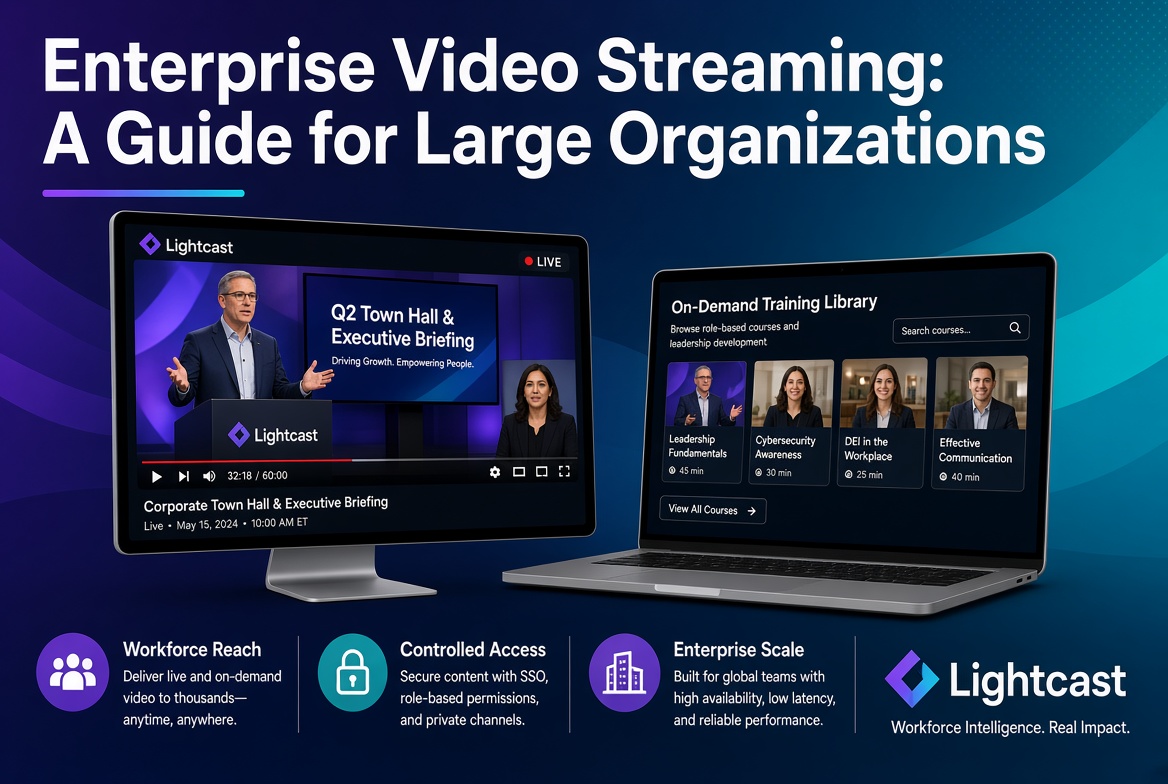
Enterprise video streaming is how a large organization delivers live and on-demand video to a big, distributed audience, employees across locations, members, partners, or customers, on a branded platform it controls. Instead of scattering video across generic tools and consumer sites, the organization runs one branded service that reaches every device, keeps access controlled, and keeps the data in-house. The enterprise video market reflects the demand, projected to grow from about $27.97 billion in 2026 to $42.23 billion by 2031. Lightcast gives enterprises a branded platform that streams live and on-demand from one CMS to Roku, Fire TV, Apple TV, iOS, Android, and web across 70,000+ global CDN nodes, with the organization owning its audience data, as part of a platform serving 5,000+ organizations.
Large organizations produce more video every year, town halls, training, launches, briefings, and most of it ends up spread across tools that were never built to reach a whole workforce or audience reliably. A dedicated platform changes that.
Enterprise video streaming is the delivery of video at organizational scale on a platform built for it, rather than through consumer video sites or ad-hoc meeting tools. The defining traits are reach, control, and ownership: the content reaches a large audience on whatever device they use, the organization controls who can see what, and the brand and data belong to the organization rather than a third party. It is the same OTT technology behind commercial streaming services, applied to an organization's own audience. For the broader platform view, see our OTT platform buyer's guide.
More than the occasional all-hands. Company-wide town halls and executive briefings reach a distributed workforce live. Training and onboarding content gives employees a consistent, on-demand library they can return to. Product launches and announcements can go to customers and partners as a branded event. And customer or member education, from a franchise network to a professional community, turns video into an ongoing relationship. Each of these is a live moment people may need to see now and a recording they will reference later, which is why running live and on-demand together matters. For the live side, see our pillar on live video broadcasting for content publishers, and for the library, our guide to the best on-demand video platforms.
Four capabilities tend to define a platform built for organizational scale.
Reach on every device. A distributed audience watches on phones, laptops, and connected TVs, so the platform should publish to all of them at once.
Controlled access. The organization should decide who can view content, so internal or gated material stays with the intended audience.
Reliability at scale. When thousands watch a town hall at once, the delivery has to hold up, which is a function of the content delivery network behind it.
Data ownership. The audience relationship and viewing data are the organization's asset, and should stay with it rather than a vendor.
The difference is whose brand, control, and data are involved. Posting video to a public consumer site means your content lives under someone else's brand, next to whatever the platform recommends, with the platform holding the audience and the data. An enterprise streaming platform inverts that: the service carries your organization's name, you control access and the experience, and the data stays in-house. For a workforce or a customer base, that control is not cosmetic, it is the difference between running your own channel and renting space on someone else's. See our pillar on real-time content control for streaming platforms.
Through a content delivery network and broad device support. A CDN distributes video across many geographically spread nodes, so a viewer in one region and a viewer in another are both served from close by, which keeps a large simultaneous audience from overwhelming the stream. Pair that with apps on every major device, and an organization can reach people wherever they are, at their desk, at home, or on the road, from a single branded platform. The wider the CDN footprint, the more consistent the experience at scale.
Lightcast publishes your branded service to Roku, Fire TV, Apple TV, iOS, Android, and web simultaneously, so a distributed audience watches on whatever they already use.
Run town halls and events live and let them convert to an on-demand library automatically, so a single broadcast keeps working as a training and reference asset afterward.
Content is delivered across 70,000+ global CDN nodes, so a large, simultaneous audience gets dependable playback wherever they are.
Lightcast does not retain, monetize, or share client data, so your organization keeps its audience relationships and viewing data. Explore the platform on our media cloud OVP and live streaming pages.
Enterprise video streaming lets a large organization deliver live and on-demand video to a distributed audience on a branded platform it controls, rather than scattering it across generic tools. Prioritize reach on every device, controlled access, reliability at scale, and ownership of the audience data. In a market projected to reach $42.23 billion by 2031, the organizations that treat video as owned infrastructure, not a collection of tools, are the ones that get compounding value from it. Lightcast delivers all of it on one CMS across 70,000+ global CDN nodes, for 5,000+ organizations and 12,000+ branded apps, and was named Fastest Deployment OTT Platform Provider 2026 by The Silicon Review. To learn more or schedule a demonstration, visit lightcast.com.