Platform
Solutions
Resources
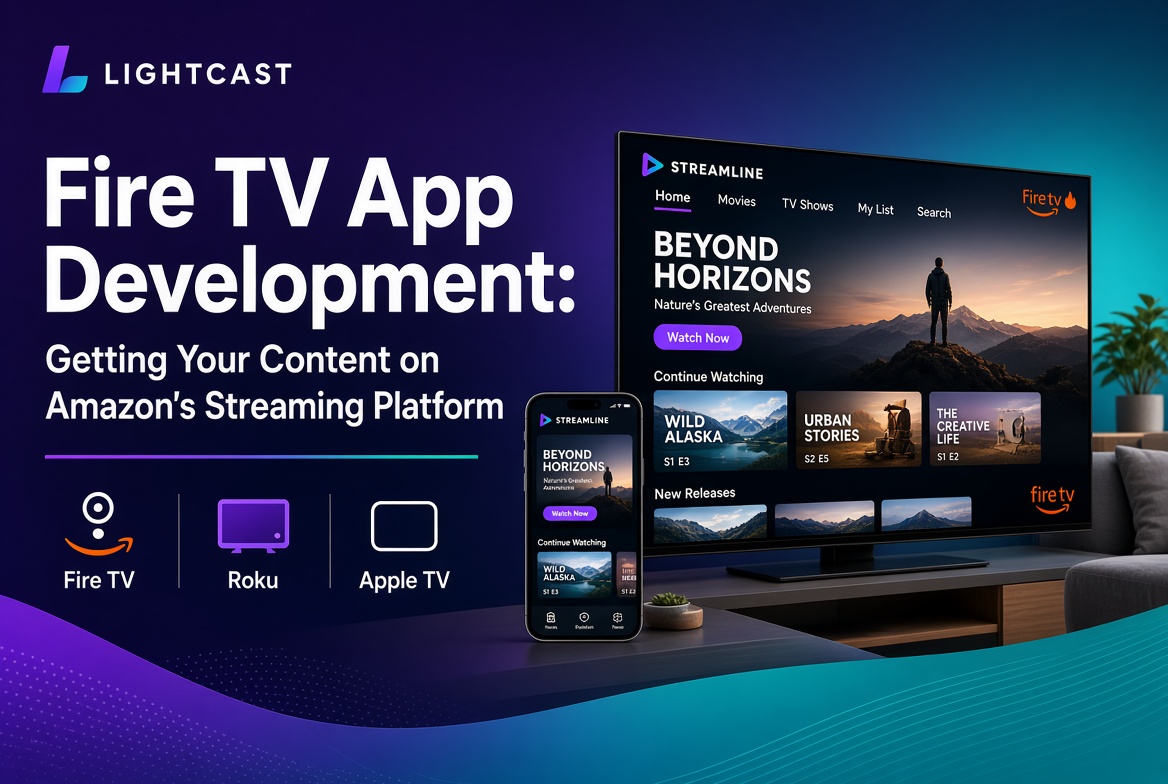
Fire TV app development is the process of building a streaming app for Amazon's Fire TV platform, which runs on Fire OS and distributes apps through the Amazon Appstore. For a content publisher, it is how you reach the roughly half of the connected-TV living room that Amazon holds rather than Roku. Amazon has sold more than 200 million Fire TV devices worldwide, making it one of the two platforms that dominate the living-room screen. The smarter question is usually not how to build a Fire TV app in isolation, but how to ship Fire TV, Roku, Apple TV, and mobile from one build. Lightcast has launched 12,000+ branded apps and publishes to all of them simultaneously across 70,000+ global CDN nodes, for 5,000+ organizations.
If Roku is one half of the living-room duopoly, Fire TV is the other. Building for one and skipping the other means being invisible to a huge share of the exact viewers you are trying to reach. The trap is treating each device as its own separate project.
Because of reach and ecosystem. With more than 200 million devices sold, Fire TV is one of the two platforms, alongside Roku, that most connected-TV viewers use, and the two rarely overlap in a given household. A viewer is usually a Roku home or a Fire TV home, so an app on only one platform is absent from the other's living rooms entirely. Fire TV also sits inside Amazon's broader ecosystem of accounts, commerce, and advertising, which shapes how content is discovered there. For the full smart-TV view, see our pillar on smart TV app development for content publishers.
Technically, they are different worlds. Fire OS is based on Android, so Fire TV apps are built with Android-family tools and distributed through the Amazon Appstore, with Amazon's own certification process. Roku, by contrast, uses its proprietary BrightScript language and SceneGraph framework, covered in our guide to Roku TV app development.
That difference is exactly the problem. Building natively means learning two entirely separate development stacks, passing two certification processes, and maintaining two codebases forever, and that is before you add Apple TV and mobile. Each platform you support the hard way multiplies the engineering, not adds to it.
This is the decision that actually matters. Building device by device gives total control and demands a separate effort for each: Fire TV in one stack, Roku in another, Apple TV in a third, plus ongoing maintenance as each platform changes its rules. Building once on a platform that publishes everywhere gets you a branded app on Fire TV, Roku, Apple TV, and mobile from a single effort, with the certification and updates handled for you.
For most publishers whose business is content rather than software, the second path wins, because the goal is to be on every screen the audience uses, not to run a multi-platform engineering shop. For the decision framework, see our OTT platform buyer's guide.
Four things separate real multi-device coverage from a checkbox.
Fire TV plus every other device from one build. The same effort should land you on Roku, Apple TV, and mobile, not just Amazon.
Native monetization. Subscriptions, pay-per-view, and ads should run inside the app rather than through a separate integration.
Certification and updates handled. Amazon's Appstore review and ongoing Fire OS changes should be the platform's job, not your team's emergency.
Data ownership. The audience your Fire TV app builds should belong to you. For the on-demand experience behind the app, see our guide to the best on-demand video platforms.
Lightcast publishes to Fire TV, Roku, Apple TV, iOS, Android, and web simultaneously, so Amazon's platform is one part of a single rollout rather than a separate project.
With more than 12,000 branded apps shipped, Lightcast handles Amazon Appstore certification, Fire OS updates, and the per-platform quirks at scale.
Subscriptions, pay-per-view, ads, and donor-supported access run natively in your Fire TV app, with no separate billing tool to integrate.
Lightcast does not retain, monetize, or share client data, so the audience your Fire TV app builds stays yours. Explore the platform on our media cloud OVP page.
Fire TV app development gets your content onto Amazon's Fire OS platform and the more than 200 million devices it has sold, the half of the living room Roku does not hold. Built natively, it means a separate stack, store, and codebase from every other device. Built on a platform, Fire TV ships alongside Roku, Apple TV, and mobile from one effort, with certification and updates handled. Lightcast has launched 12,000+ branded apps and publishes across every major device on one CMS with full data ownership, and was named Fastest Deployment OTT Platform Provider 2026 by The Silicon Review. To learn more or schedule a demonstration, visit lightcast.com.