Platform
Solutions
Resources
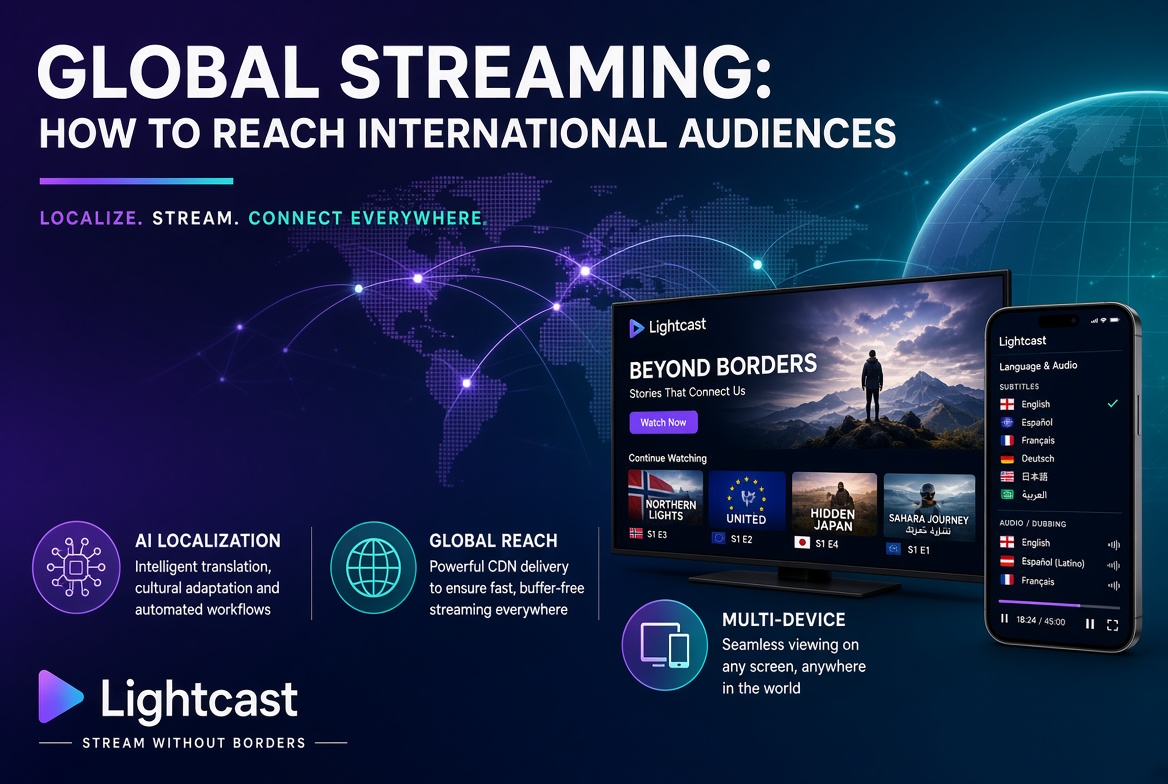
Streaming lets an organization reach a global audience because it travels the open internet, so anyone with a connection can watch, anywhere, with no broadcast territory or distribution deal required. The real barrier to going global is no longer geography, it is language, and that is where localization comes in: subtitles and dubbing make your content watchable for audiences who do not speak its original language. AI has made that affordable, turning what used to be a costly, slow process into something within reach for any publisher. The demand is clear, with the video localization market projected to grow from about $4 billion in 2026 to $7.5 billion by 2035. Lightcast delivers across 70,000+ global CDN nodes and generates subtitles and dubbing with AI, giving organizations a branded path to audiences worldwide, as part of a platform serving 5,000+ organizations.
For most of media history, reaching a viewer in another country meant a distribution deal, a local broadcaster, or a physical presence. Streaming erased that overnight. The question is no longer whether you can reach them, but whether they can understand you.
By traveling the open internet to any connected device, anywhere. Unlike broadcast or cable, which are tied to a territory and a distribution agreement, an OTT service is available wherever there is an internet connection. A university, a ministry, a sports organization, or a media brand can reach supporters and viewers around the world from a single branded platform, without negotiating market by market. Delivery still has to hold up globally, which is a function of the content delivery network behind it. For how that works, see our guide on what makes streaming reliable.
Language, not distance. Once streaming removed geography as a limit, the thing standing between your content and a global audience became whether people can follow it. A viewer in another country can reach your library instantly, but if everything is in a language they do not speak, the reach is theoretical. This is why localization has become the lever for global growth: it turns technical reach into actual viewership. For the broader on-demand experience, see our guide to the best on-demand video platforms.
Through subtitles and dubbing, which make the same content watchable for far more people. Subtitles add a translated text track, letting viewers read along in their own language while keeping the original audio. Dubbing replaces the audio with a translated voice track, which many viewers prefer for immersive, lean-back watching. Offering both lets an audience choose, and each language you add opens a new audience that was previously shut out. Captions also serve viewers watching with the sound off, a large group in any market. For more on that, see our guide on streaming captions and accessibility.
By automating the slowest, most expensive parts. Localization used to mean hiring translators and voice talent for every language, which kept it out of reach for all but the largest producers. AI now generates subtitles and dubbing automatically, producing translated tracks in a fraction of the time and cost, which you can review and refine. That shift is what turns global reach from a theory into a practical plan for a normal-sized organization. For where this fits across streaming, see our guide on how AI is used in OTT.
A few capabilities matter most.
Global delivery. A content delivery network with a broad international footprint, so viewers everywhere get smooth playback from a node near them.
Localization built in. Subtitles and dubbing, ideally AI-assisted, so you can add languages without a prohibitive cost.
Reach on every device. Audiences worldwide watch on connected TVs, phones, and the web, so the service should publish to all of them.
Your brand and your data. The global audience you build should belong to you, under your own brand.
Content is served from a node close to each viewer worldwide, so a global audience gets dependable playback rather than a stream struggling across continents.
Lightcast generates subtitles and dubbing with AI, so you can localize content for new language audiences quickly instead of translating by hand.
Your service publishes to Roku, Fire TV, Apple TV, iOS, Android, and web at once, so viewers anywhere watch on what they already use. Explore the platform on our media cloud OVP and live streaming pages.
Lightcast does not retain, monetize, or share client data, so the worldwide audience your content reaches stays yours.
Streaming gives any organization a path to a global audience, because it reaches anyone with an internet connection rather than a licensed territory. The barrier is no longer geography but language, and localization through subtitles and dubbing is what turns reach into real viewership, now made affordable by AI. In a video localization market heading toward $7.5 billion by 2035, reaching the world is within reach of a normal-sized organization. Lightcast delivers across 70,000+ global CDN nodes with AI subtitles and dubbing, for 5,000+ organizations and 12,000+ branded apps, and was named Fastest Deployment OTT Platform Provider 2026 by The Silicon Review. To learn more or schedule a demonstration, visit lightcast.com.