Platform
Solutions
Resources
OTT works by delivering video over the open internet instead of through a cable or broadcast signal. The content is prepared (encoded into multiple qualities), distributed through a content delivery network so it reaches viewers from a nearby server, and played back inside apps on the viewer's devices, all managed from a central platform that also handles live, on-demand, and monetization. In short, OTT turns any internet connection and any screen into a television. It is now a huge market, with global OTT valued at roughly $503 billion in 2026. Lightcast runs this entire pipeline for organizations, delivering branded apps to Roku, Fire TV, Apple TV, iOS, Android, and web from one CMS across 70,000+ global CDN nodes, serving 5,000+ organizations and 12,000+ branded apps.
OTT feels simple to the viewer: open an app, press play. Behind that tap is a pipeline that takes raw video and gets it to any screen, anywhere, reliably. Understanding it helps explain what actually makes a streaming service good.
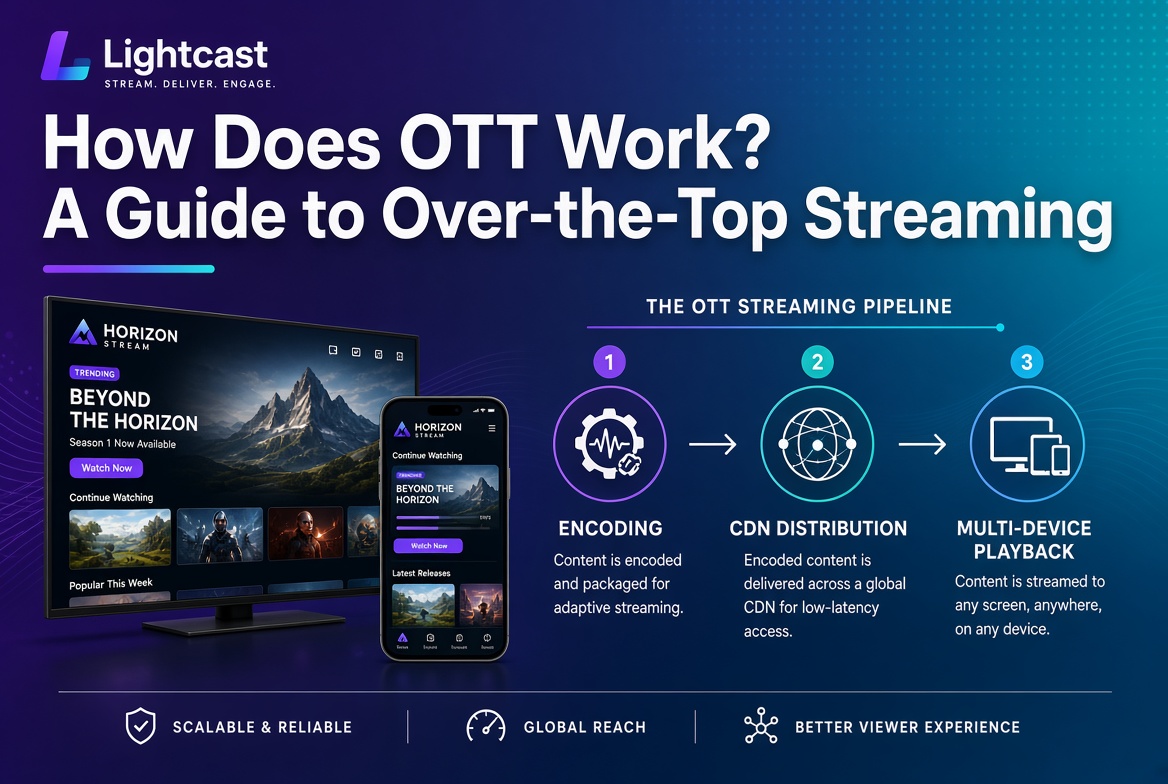
OTT moves video through four stages. First, content is prepared: raw video is encoded into multiple resolutions and formats. Second, it is distributed across a content delivery network so copies sit close to viewers everywhere. Third, it is played back inside apps on the viewer's devices, which pull the right quality for each connection. Fourth, all of it is managed and monetized from a central platform that runs live and on-demand together. Each stage matters, and a weakness in any one of them is what viewers feel as buffering, low quality, or a clunky experience. For the wider definition, see our explainer on what an OTT platform is.
It gets encoded and packaged. Raw video is far too large to stream as-is, so it is compressed and transcoded into several versions at different resolutions and bitrates, from low quality for a weak connection to high definition or 4K for a strong one. This is what enables adaptive bitrate streaming, where the player automatically switches to the version that matches each viewer's connection in the moment, so playback stays smooth instead of stalling. For a live event, this happens in real time as the event is captured. The result is one piece of content ready to look its best on any device and any connection.
Through a content delivery network, or CDN. Rather than every viewer pulling video from one distant origin server, a CDN stores copies across many locations worldwide and serves each viewer from one nearby. That is what keeps streams smooth when a large, geographically spread audience watches at once, especially live. The player app on the viewer's device requests the stream, the nearest CDN node delivers it, and adaptive bitrate keeps the quality matched to the connection. The broader the CDN footprint, the more consistent the experience. For a deeper look, see our guide on what makes streaming reliable.
From a single system that ties the pipeline together. A content management system is where an organization uploads and organizes its library, schedules and runs live events, publishes to every device at once, and applies its business model. Live events can convert to on-demand automatically, so one broadcast becomes a lasting asset. And monetization, subscriptions, pay-per-view, advertising, or donor-supported access, runs inside the same platform, so the way you earn is built into how you publish. For the on-demand side, see our guide to the best on-demand video platforms.
The network and the control. Traditional TV sends a fixed lineup over a managed cable or broadcast connection on a schedule. OTT sends video over the open internet to any device, on demand or live, so the viewer chooses what and when to watch, and a publisher reaches audiences directly rather than through a cable operator. That shift from a closed pipe to the open internet is why a single organization can now run a television-grade service without owning a network. For the managed-network comparison, see our explainer on OTT vs IPTV.
Lightcast prepares your content and delivers it across 70,000+ global CDN nodes with adaptive quality, so viewers get smooth playback whatever their device or connection.
Publish to Roku, Fire TV, Apple TV, iOS, Android, and web simultaneously, with live and on-demand managed together and events converting to on-demand automatically.
Run subscriptions, pay-per-view, advertising, and donor-supported access inside the same branded service, so your business model is part of the pipeline, not a separate tool.
Lightcast does not retain, monetize, or share client data, so the audience your service builds stays yours. Explore the platform on our media cloud OVP and live streaming pages.
OTT works by preparing video through encoding, delivering it over the open internet via a CDN, playing it back in apps on any device, and managing and monetizing it all from a central platform. That pipeline is what turns any screen into a television and lets an organization run a streaming service without owning a network. In a global OTT market worth roughly $503 billion in 2026, the strength of each stage, encoding, delivery, playback, and management, is what separates a smooth service from a frustrating one. Lightcast runs the entire pipeline across 70,000+ global CDN nodes, for 5,000+ organizations and 12,000+ branded apps, and was named Fastest Deployment OTT Platform Provider 2026 by The Silicon Review. To learn more or schedule a demonstration, visit lightcast.com.