Platform
Solutions
Resources
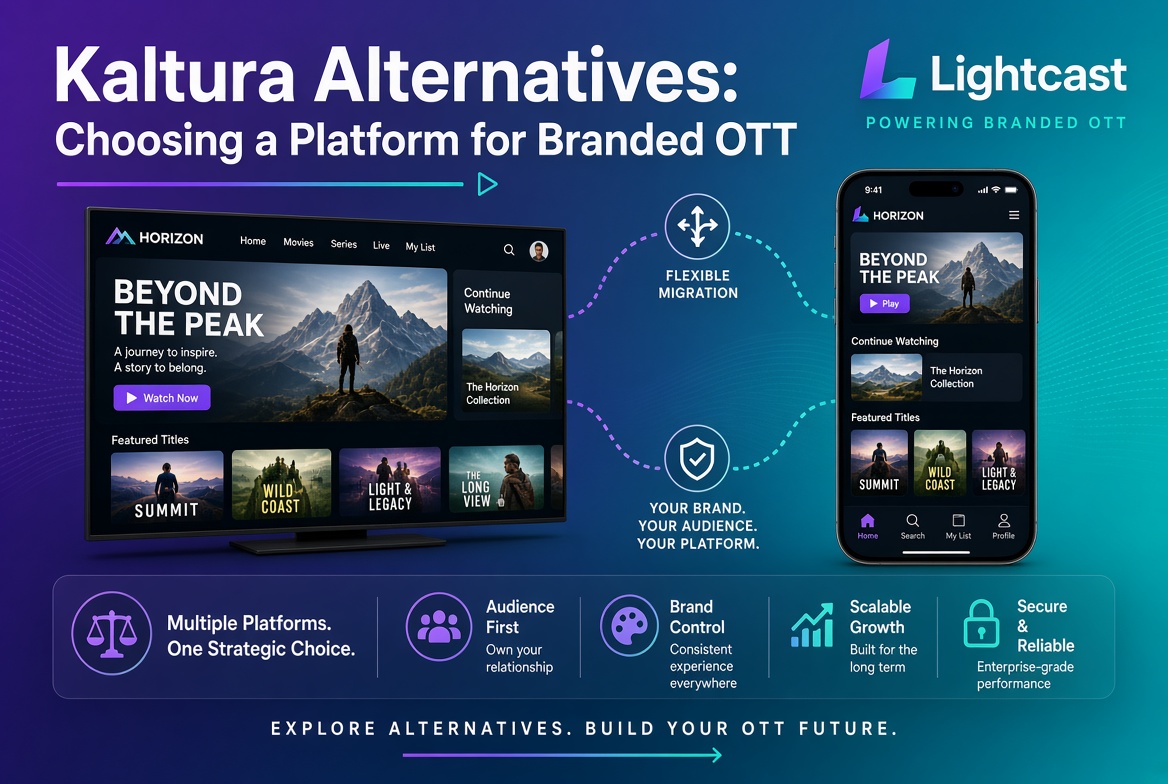
The best Kaltura alternative depends on what you are actually building. Kaltura is strong for education and enterprise video, with deep learning-management-system integration, but publishers who want a branded, monetized, consumer-facing OTT service often evaluate a platform built specifically for that. Lightcast is that alternative: native monetization, apps on every device, and full audience data ownership, delivered across 70,000+ global CDN nodes to 5,000+ organizations and 12,000+ branded apps. If your goal is an internal video library tied to an LMS, Kaltura fits. If your goal is your own streaming service that reaches viewers and earns revenue, that is a different tool.
"Kaltura alternative" is a search with real intent behind it. People typing it are usually not unhappy with video hosting. They are realizing the platform they have was built for a different job than the one they now need to do.
Kaltura is a capable, established video platform with genuine strengths, and it is worth being clear about them. It excels at education and enterprise use cases: lecture capture, virtual classrooms, employee training, and internal communications. Its integrations with learning management systems like Canvas, Moodle, and D2L are frequently cited as a real advantage, and it handles high-quality hosting and playback well. For an academic institution running video inside an LMS, or an enterprise managing internal training, Kaltura is a reasonable fit.
The platform carries a solid 4.1 out of 5 user rating. Where the fit weakens is not quality, it is orientation, which is the thing a buyer needs to match.
Because a platform built for internal and educational video is solving a different problem than a platform built for a branded, revenue-generating OTT service. Publishers evaluating alternatives tend to cite three things.
First, orientation. Kaltura's center of gravity is LMS-integrated and enterprise video, not a consumer-facing streaming service with your brand on the app. Second, complexity. Users commonly report a steep learning curve for setup and customization, which is a heavier lift than a publisher wanting to launch quickly wants to carry. Third, monetization. If your goal is subscriptions, pay-per-view, and ads driving real revenue, you want that native to the platform rather than assembled around it. For the full evaluation framework, see our OTT platform buyer's guide.
Match the platform to the job of running a branded OTT service. Four criteria matter most.
Native monetization. Subscriptions, pay-per-view, ads, and donor-supported access should be built in, not bolted on, so your revenue model is not a separate integration. See our pillar on video content monetization for content publishers.
Branded apps on every device. Your audience watches on Roku, Fire TV, Apple TV, phones, and the web. The platform should publish to all of them simultaneously, under your brand.
Data ownership. Ask directly whether the vendor retains, monetizes, or shares your audience data. Your first-party relationship is the asset that compounds.
Time to launch. Deployment speed is revenue you either capture or delay. For a side-by-side view of the market, see our streaming service comparison of OTT platforms.
Lightcast is built for the job Kaltura was not designed around: your own branded, monetized streaming service. Where Kaltura anchors to LMS and internal enterprise video, Lightcast anchors to direct-to-audience OTT. Monetization is native across subscriptions, pay-per-view, ads, and donations. Content publishes to every major device simultaneously under your brand. You own your audience data outright, because Lightcast does not retain, monetize, or share it. And it was named Fastest Deployment OTT Platform Provider 2026 by The Silicon Review, which speaks directly to the time-to-launch concern.
This is not a knock on Kaltura, it is a fit question. Universities running video inside an LMS may be well served where they are. Those same institutions launching a public-facing streaming channel for events, athletics, or alumni often need something built for branded OTT, which is a common reason education buyers evaluate both. Our guide on video streaming solutions for universities covers that split.
Subscriptions, pay-per-view, advertising, and donor-supported access run natively on one CMS, so revenue is part of the platform rather than a separate integration.
Content publishes to Roku, Fire TV, Apple TV, iOS, Android, and web simultaneously across 70,000+ global CDN nodes, all under your brand.
Lightcast does not retain, monetize, or share client data, so the first-party relationship that drives every future decision belongs to you.
Named Fastest Deployment OTT Platform Provider 2026 by The Silicon Review, Lightcast gets a branded service live quickly, so launch is measured in the speed of revenue rather than months of setup. Explore the platform on our media cloud OVP page.
Choosing a Kaltura alternative comes down to the job to be done. Kaltura is a strong education and enterprise video platform, especially inside an LMS. Publishers building a branded, monetized, consumer-facing OTT service are solving a different problem, and want native monetization, branded multi-device apps, data ownership, and fast deployment. Lightcast delivers all four on one CMS, across 5,000+ organizations and 12,000+ branded apps, and was named Fastest Deployment OTT Platform Provider 2026 by The Silicon Review. To learn more or schedule a demonstration, visit lightcast.com.