Platform
Solutions
Resources
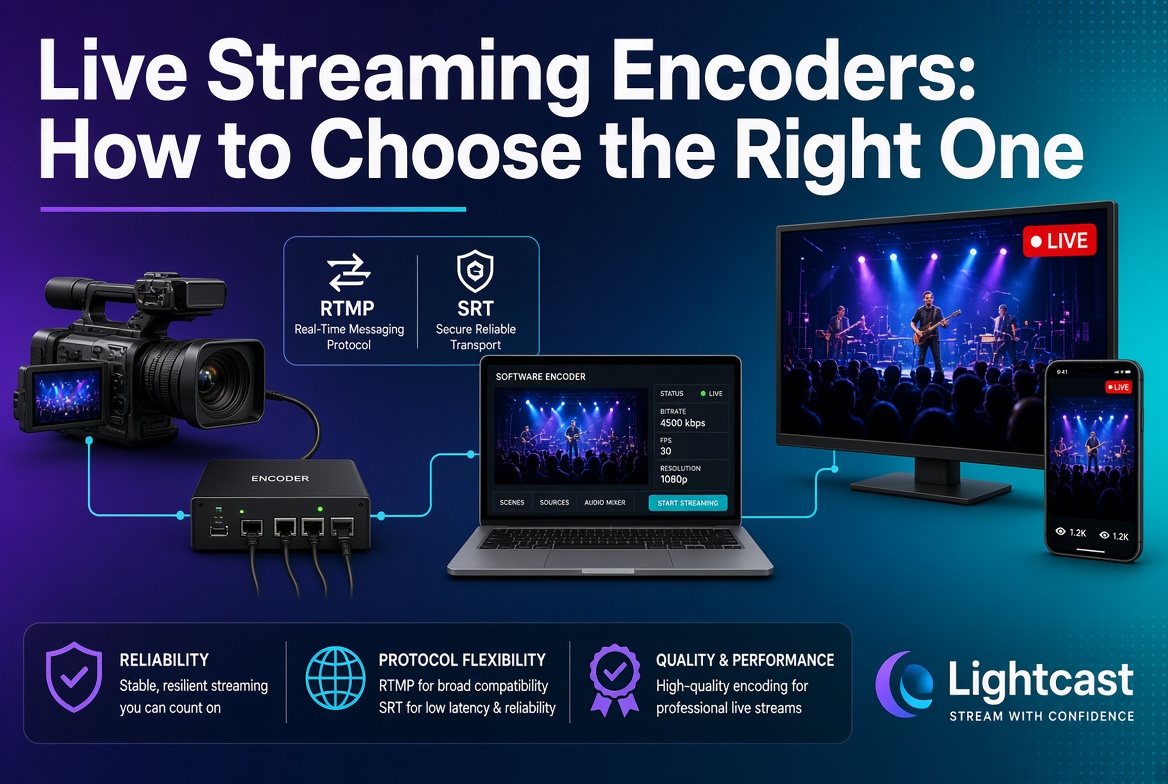
A live streaming encoder is the device or software that compresses your camera's video into a format that can be streamed over the internet. It is the first step in any live broadcast: the encoder captures and compresses the feed, then sends it to your streaming platform, which delivers it to viewers on every device. Choosing one comes down to hardware versus software, the protocol it uses (usually RTMP or SRT), and the reliability your event demands. The encoder gets your signal out the door; the platform is what carries it the rest of the way. Lightcast is that platform, taking your encoded feed and delivering it to Roku, Fire TV, Apple TV, iOS, Android, and web from one CMS across 70,000+ global CDN nodes, for 5,000+ organizations and 12,000+ branded apps.
The encoder is the part of live streaming most people underestimate. Get it right and the broadcast feels effortless. Get it wrong and the best content in the world arrives choppy or not at all.
A live streaming encoder takes the raw signal from your camera and compresses it into a digital stream small enough to send over the internet in real time. Cameras produce far more data than a network can carry, so without an encoder there is nothing to stream. The encoder outputs that compressed feed in a streaming protocol and sends it to your platform, which then handles delivery to viewers. In the pipeline that gets video from a camera to a screen, the encoder is step one. For the full pipeline, see our guide on how OTT works.
Both do the same core job, and the right choice depends on your production. Software encoders run on a computer and are flexible and affordable, which makes them a strong fit for studio setups, webinars, and productions where a reliable computer is already in place. Hardware encoders are dedicated devices built to do one thing well, which makes them more rugged and portable for events, field production, and anywhere you need a setup that just works without a computer behind it. Many organizations keep one of each, software for the studio and hardware for the road. For the broader live setup, see our pillar on live video broadcasting for content publishers.
The right encoder depends on your needs, but a few are widely used and worth knowing.
Software encoders. OBS Studio is the popular free option, flexible and capable for studio and desktop use. vMix and Wirecast are paid tools built for more involved multi-camera productions.
Hardware encoders. Teradek devices are a standard for portable, single-camera field streaming. All-in-one units like the YoloBox line combine encoding, switching, and monitoring in one portable device. For fixed installations, dedicated boxes from makers like Epiphan and Kiloview are common.
The best choice is the one that matches your cameras, your location, and the protocol your platform expects, not the most expensive box on the shelf. For a common use case, see how this fits live sports streaming options.
Two matter most for getting your feed to a platform. RTMP is the long-standing standard, supported almost everywhere, and a safe default for a stable network. SRT is a newer protocol built for unreliable connections like cellular, with error correction and lower latency, which makes it the better choice for field events and contribution over networks you do not fully control. A good encoder supports both, so you can pick per event. These contribution protocols are separate from how the platform then delivers to viewers, which is handled downstream. For the delivery side, see our guide on what makes streaming reliable.
A few factors decide it.
Hardware or software. Match it to your setting, a computer-based studio or a portable, rugged event rig.
Protocol support. Confirm it offers RTMP and, ideally, SRT, so it works with your platform and your network conditions.
Resolution and bitrate. Make sure it outputs the quality you shoot, and that your upload bandwidth is comfortably above your target bitrate.
Reliability for the moment. For a live event that happens once, dependability under real conditions matters more than any single feature.
Point your encoder's feed at Lightcast, and the platform handles the rest, delivering your live stream to Roku, Fire TV, Apple TV, iOS, Android, and web at once, under your brand.
Once your feed arrives, it is delivered from a node close to each viewer, so a large live audience gets dependable playback.
Your encoded live event converts to an on-demand asset automatically, so one broadcast keeps working as a library asset afterward.
Lightcast does not retain, monetize, or share client data, so the audience your broadcasts build stays yours. Explore the platform on our live streaming and media cloud OVP pages.
A live streaming encoder compresses your camera feed and sends it to your platform, and choosing one comes down to hardware versus software, protocol support (RTMP and SRT), output quality, and reliability for the moment that counts. Software encoders like OBS and vMix suit studios, while hardware encoders like Teradek and all-in-one units suit events and field work. The encoder gets your signal out; the platform carries it to viewers. Lightcast takes your encoded feed and delivers it to every device from one CMS across 70,000+ global CDN nodes, for 5,000+ organizations and 12,000+ branded apps, and was named Fastest Deployment OTT Platform Provider 2026 by The Silicon Review. To learn more or schedule a demonstration, visit lightcast.com.