Platform
Solutions
Resources
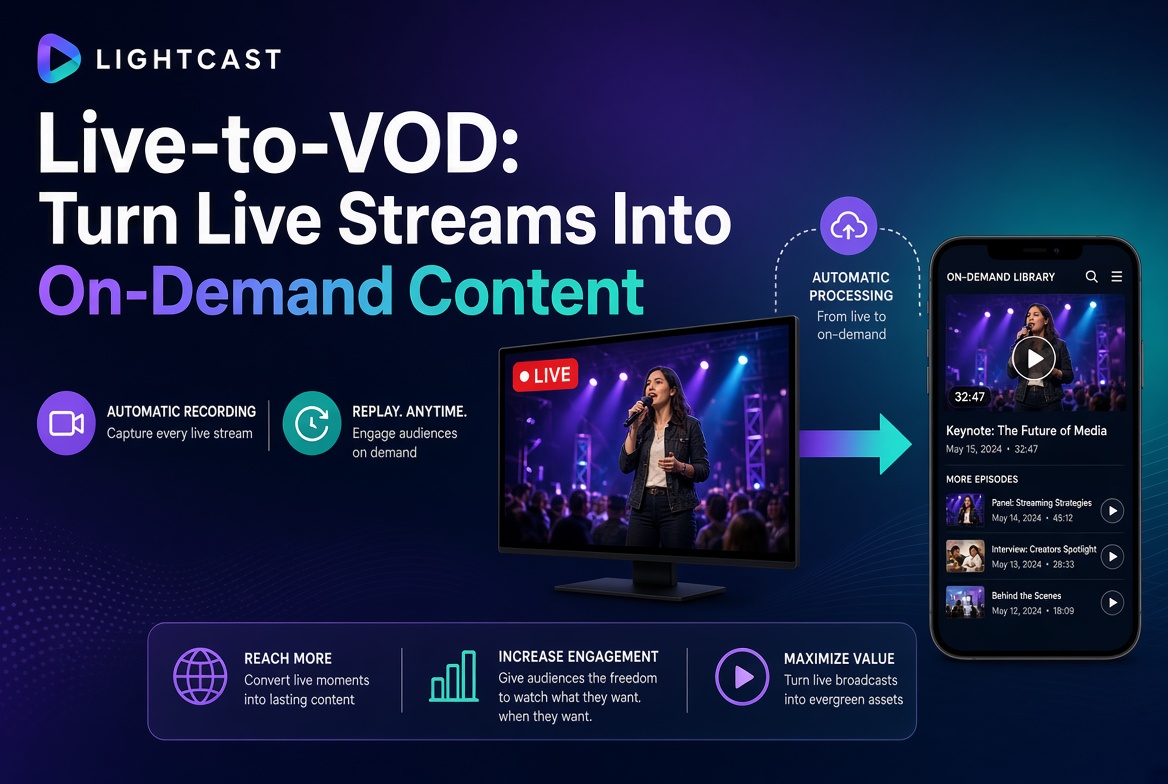
Live-to-VOD is the process of turning a live stream into on-demand video automatically, so the moment a live event ends it becomes a recording viewers can watch anytime. Instead of a one-time broadcast that disappears, each live event becomes a lasting library asset. This matters because a large share of an audience shows up after the fact: across thousands of webinars, roughly 4 in 10 attendees engage with the replay rather than the live session. Lightcast converts live events to on-demand automatically, managing live and recorded content from one CMS and delivering both to Roku, Fire TV, Apple TV, iOS, Android, and web across 70,000+ global CDN nodes, as part of a platform serving 5,000+ organizations.
A live event is expensive to produce and gone in an hour, unless you keep it. Live-to-VOD is how a single broadcast keeps working for months, reaching the people who could not tune in when it happened.
Live-to-VOD, sometimes written live-to-on-demand, is the automatic conversion of a live stream into a video-on-demand asset. As the event streams live, it is being recorded, and when it ends the recording is available on demand without manual editing or re-uploading. The result is that every live moment, a game, a service, a town hall, a class, becomes a permanent piece of content in your library. For the live foundation, see our pillar on live video broadcasting for content publishers.
Because most of your audience is not free at the exact hour you go live. Time zones, work, and everyday life mean a large portion of the people who care about your content will only ever see it later, if they can see it at all. The data bears this out: in an analysis of more than 2,000 webinars, about four in ten attendees engaged with the recording rather than the live session. Without an on-demand version, that audience is simply lost. With one, a single event roughly doubles its reach for no additional production. For the on-demand experience itself, see our guide to the best on-demand video platforms.
The platform records the live stream as it broadcasts, then publishes that recording as an on-demand asset the moment the event ends. Because it is automatic, there is no separate step to export, edit, and re-upload the file, which is where a lot of organizations lose their recordings to friction. The event simply appears in the on-demand library, ready to watch, often within moments of going off air. That reliability is what turns live-to-VOD from a nice idea into a dependable content engine. See our pillar on real-time content control for streaming platforms.
More than let people rewatch. A growing archive of past events becomes a searchable, evergreen library that new audiences can explore on their own time. It can be monetized, through subscriptions, pay-per-view, or ads, so a live event keeps earning after the broadcast. And it compounds: every event you stream adds to a catalog that makes your service more valuable the longer you run it. For turning that library into revenue, see our pillar on video content monetization for content publishers.
A few things separate a real live-to-VOD capability from a manual afterthought.
Automatic conversion. The recording should publish on its own when the event ends, not depend on someone remembering to export and upload it.
One system for live and on-demand. Managing both from a single CMS is what keeps a growing library organized instead of scattered.
Reach on every device. The recording should be available on the same connected TVs, phones, and web the live event reached.
Monetization on the archive. The platform should let you apply subscriptions, pay-per-view, or ads to on-demand content, not just live.
Every live event converts to an on-demand asset automatically when it ends, so the recording is ready without a manual export-and-upload step.
Manage broadcasts and the growing recorded library together from a single system, so the archive stays organized as it compounds.
Recorded events publish to Roku, Fire TV, Apple TV, iOS, Android, and web across 70,000+ global CDN nodes, and can be monetized with subscriptions, pay-per-view, or ads just like any on-demand content.
Lightcast does not retain, monetize, or share client data, so the audience your library builds stays yours. Explore the platform on our live streaming and media cloud OVP pages.
Live-to-VOD turns a one-time live stream into a lasting on-demand asset automatically, so each event keeps reaching viewers long after it airs. It matters because a large share of any audience only watches the replay, which means an on-demand version roughly doubles an event's reach for no extra production. Look for automatic conversion, one system for live and on-demand, reach on every device, and the ability to monetize the archive. Lightcast delivers automatic live-to-VOD on one CMS across 70,000+ global CDN nodes, for 5,000+ organizations and 12,000+ branded apps, and was named Fastest Deployment OTT Platform Provider 2026 by The Silicon Review. To learn more or schedule a demonstration, visit lightcast.com.