Platform
Solutions
Resources
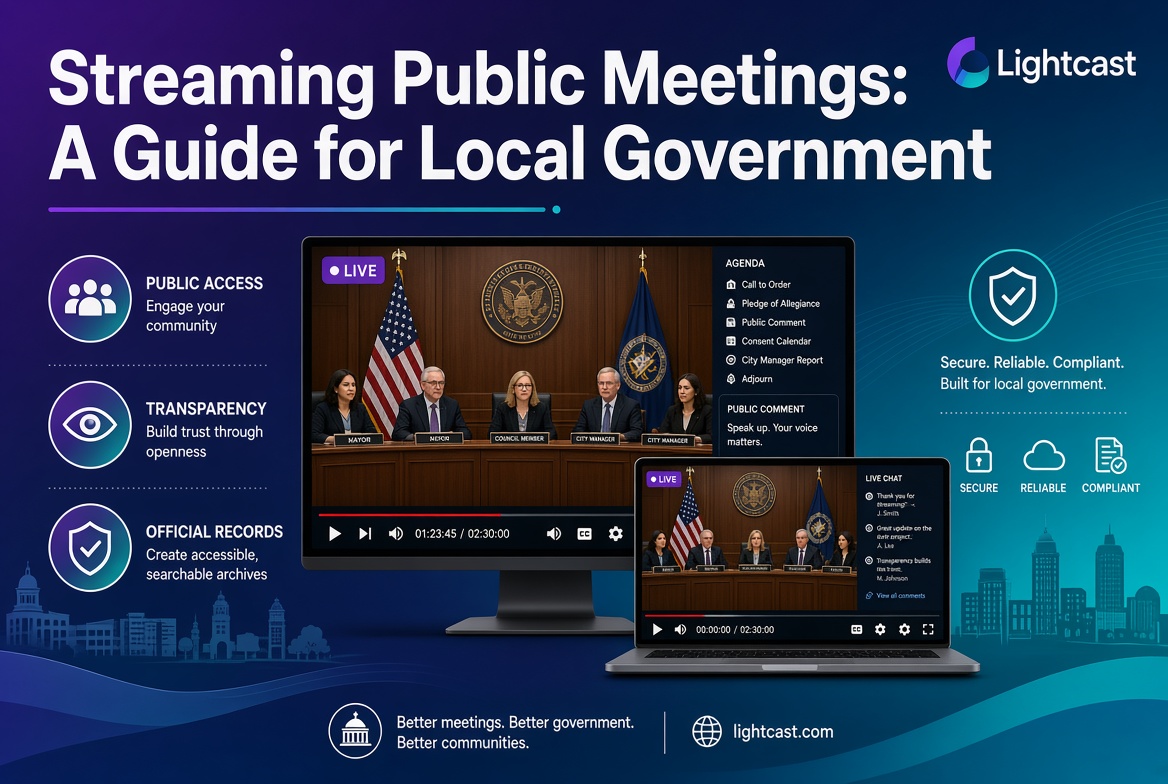
Local governments stream public meetings to meet transparency and open-meeting obligations, reach residents who cannot attend in person, and keep an accessible archive of the public record. It is increasingly a legal requirement, not just a courtesy: Indiana, for example, began requiring counties, cities, towns, townships, and school boards to livestream and archive their meetings in 2025. Lightcast gives government bodies a reliable way to stream live meetings and publish searchable archives, delivered to Roku, Fire TV, Apple TV, iOS, Android, and web across 70,000+ global CDN nodes, with the government retaining full ownership of its data, part of a platform serving 5,000+ organizations. For a public meeting, the streaming has to work the first time, because the meeting only happens once.
A council meeting is a matter of public record, and residents increasingly expect to watch it the way they watch everything else, on the device in their hand. Streaming has moved from a nice-to-have to a baseline expectation, and in a growing number of states, a mandate.
Because transparency is the job, and streaming is how transparency scales. Open-meeting and sunshine laws exist to keep government accountable to the public, and a livestream plus an archive is the most direct way to satisfy both the letter and the spirit of those laws. It also widens participation: a working parent, a homebound resident, or someone across the county can follow a meeting they could never attend in person.
The legal picture is moving quickly. Several states now require some form of meeting livestreaming or recording, and Indiana's 2025 rule extends that to essentially all local government bodies, with archiving included. For the vertical overview, see our guide on streaming platforms for local government.
Four requirements tend to define compliant public-meeting streaming.
Reliable public access. The stream has to be available to any resident, and it has to hold up during the meeting, since there is no second take on the public record.
Accessibility. The Americans with Disabilities Act sets accessibility expectations for public content, and several states specify captioning for livestreams, so accessible delivery is not optional.
An archive and record retention. Meetings must usually be preserved and posted, sometimes within a set window, so an automatic on-demand archive matters as much as the live stream. See our guide to the best on-demand video platforms.
Control over the record. Because this is government data about a public proceeding, the body should retain ownership and control of it, not hand it to a third party.
More than the monthly council meeting. City and county council sessions, school board meetings, planning and zoning hearings, public comment sessions, budget hearings, and emergency or public-safety briefings all benefit from a live stream and a lasting archive. Each is a live moment residents may need to see now, and a record they may need to reference later, which is why running live and on-demand from one place keeps the whole program manageable. For the live foundation, see our pillar on live video broadcasting for content publishers.
A few things matter most for public-sector streaming.
Reliability at meeting time. The platform has to deliver dependably when the meeting starts, across a real CDN, because a dropped public meeting is a compliance and trust problem.
Automatic archiving. Live meetings should convert to an on-demand record automatically, so retention and posting requirements are met without manual work.
Reach on every device. Residents watch on phones, laptops, and connected TVs, so the platform should publish to all of them. See our pillar on real-time content control for streaming platforms.
Data ownership. The government should own and control its meeting records and audience data, not a vendor.
Stream meetings live and let them convert to an on-demand record automatically, so the public archive builds itself and stays available for reference and retention.
Content delivers across 70,000+ global CDN nodes to Roku, Fire TV, Apple TV, iOS, Android, and web simultaneously, so residents can watch dependably from any device.
Manage the stream in real time across every platform at once, so the body stays in control of the public feed throughout the meeting.
Lightcast does not retain, monetize, or share client data, so meeting records and resident data stay under the government's control. Explore the platform on our media cloud OVP and live streaming pages.
Streaming public meetings lets local governments meet transparency and open-meeting obligations, reach every resident, and preserve the public record, and in a growing number of states it is now required. Prioritize reliable public access, accessibility, automatic archiving, multi-device reach, and ownership of the record. Lightcast delivers live meetings and searchable archives on one CMS with full data ownership, across 5,000+ organizations and 12,000+ branded apps, and was named Fastest Deployment OTT Platform Provider 2026 by The Silicon Review. To learn more or schedule a demonstration, visit lightcast.com.