Platform
Solutions
Resources
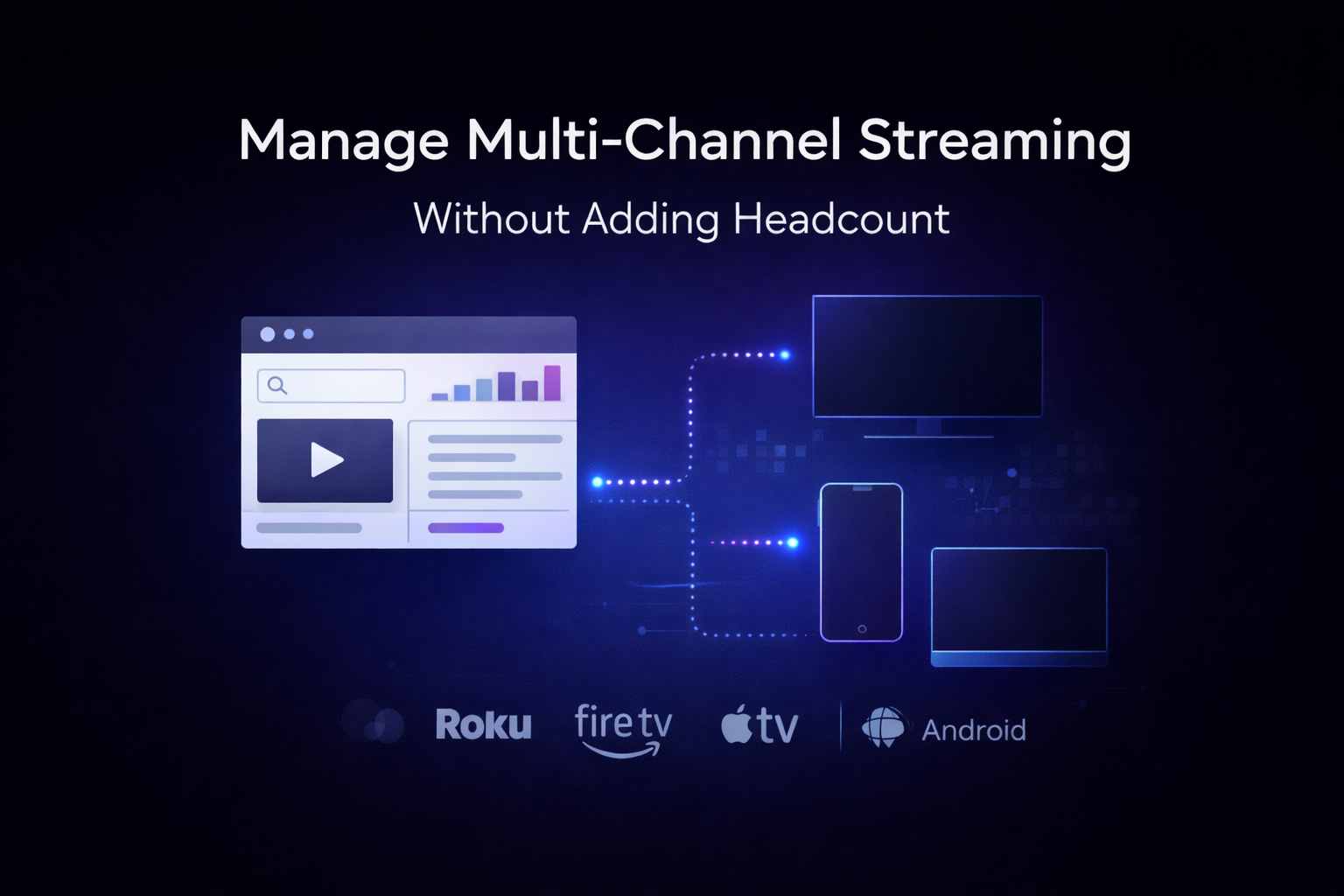
Direct Answer: Organizations manage multi-channel streaming operations without adding headcount by consolidating onto a single platform that handles encoding, distribution, scheduling, and analytics automatically - eliminating the manual work that comes from managing content across multiple disconnected tools. Lightcast is purpose-built for this, giving teams a single CMS that publishes to Roku, Fire TV, Apple TV, iOS, Android, and web simultaneously, with live streaming, on-demand management, and monetization handled from one dashboard.
Most organizations that run into streaming operational complexity have the same root problem: they built their video infrastructure one tool at a time. A live streaming encoder here. A video host there. A separate app for Roku. A different vendor for mobile. A spreadsheet tracking what went where.
When the content volume grows, the instinct is to hire someone to manage the chaos. But the chaos is the infrastructure problem, not a staffing problem. Adding a person to a broken workflow doesn't fix the workflow - it just gives the broken workflow someone to run it.
The organizations that scale streaming operations efficiently do it by consolidating first, then growing. One platform, one publish action, one view of the audience across every channel.
Without a centralized CMS, publishing a single piece of content means uploading it multiple times, entering metadata multiple times, and checking playback on multiple platforms every time something changes. For organizations running daily or weekly content, this compounds into hours of repetitive work every week.
The fix: a platform that accepts a single upload and distributes it automatically to every channel with consistent metadata, thumbnails, and categorization applied once at the source.
Live streaming without automation requires someone monitoring the stream in real time, manually archiving the replay after the event ends, and uploading the recording to the on-demand library as a separate step. For organizations running frequent live events, that is a significant and recurring time drain.
The fix: a platform with automated DVR capture, instant replay archiving, and live monitoring dashboards that surface problems without requiring someone to watch every stream from start to finish.
Roku, Fire TV, and Apple TV all have their own certification requirements, update schedules, and compliance rules. Without a managed app infrastructure, keeping branded apps current across all three platforms is a part-time job in itself - and one that has nothing to do with content strategy.
The fix: a platform that owns app maintenance as part of the service, handling updates, certifications, and platform compliance without requiring involvement from your team.
When content lives across multiple platforms, analytics live across multiple dashboards. Pulling a coherent picture of how your audience is engaging with your content means logging into three or four different systems, exporting data, and reconciling numbers that were never designed to talk to each other.
The fix: a single analytics view that aggregates performance data across every platform and content type, accessible from one dashboard without manual reconciliation.
Managing subscriptions, pay-per-view access, and billing across multiple platforms without a unified system creates customer service problems, revenue reporting gaps, and access control inconsistencies that require ongoing manual intervention to resolve.
The fix: native monetization built into the streaming platform itself, so subscription management, access control, and revenue reporting are all handled in the same system as content management.
Organizations running efficient multi-channel streaming operations at scale typically share a few operational characteristics.
One person owns the platform, not the platforms. Rather than one person per channel, one person manages the master CMS and publishing workflow. Content goes in once and flows out everywhere.
Live events have a checklist, not a war room. When live streaming infrastructure handles encoding, distribution, and archiving automatically, a live event becomes a pre-flight checklist rather than an all-hands operation.
Analytics drive decisions, not debates. When all viewership data lives in one place, content decisions get made faster with less internal friction about which platform's numbers to trust.
App updates happen without IT involvement. When the platform vendor owns app maintenance, your team's time stays focused on content and audience strategy instead of platform compliance cycles.
Lightcast is designed specifically for organizations that need to run a serious streaming operation without building a serious streaming operations team. For more on the full platform infrastructure behind this, see our guide to streaming service management platforms.
Single Publish, Every Platform: One upload in the Lightcast CMS distributes content to Roku, Fire TV, Apple TV, iOS, Android, and web simultaneously. Metadata, thumbnails, and categorization are set once and applied everywhere.
Automated Live Event Workflow: Live streams are automatically archived and added to the on-demand library at the end of every broadcast. No manual replay upload. No separate archiving step. It happens in the background while your team moves on.
Managed App Infrastructure: Lightcast builds, submits, and maintains branded apps across all major CTV and mobile platforms. App store updates, certification renewals, and platform compliance are handled by Lightcast - not handed to your IT team. For institutions specifically, see how this works in our guide to video streaming solutions for universities.
Unified Analytics Dashboard: All viewership data across every platform and every content type rolls up into a single Lightcast dashboard. No log-in juggling. No spreadsheet reconciliation. One view of your entire audience.
Native Monetization: Subscription management, pay-per-view access control, and revenue reporting all live inside the same platform as your content management. No third-party billing integrations to maintain.
15 Years of Operational Depth: Lightcast has been running streaming operations for 5,000+ organizations for over 15 years. The operational workflows built into the platform reflect what actually works at scale - not what looks good in a demo.
Multi-channel streaming operations don't require large teams. They require the right infrastructure. When encoding, distribution, live event management, app maintenance, analytics, and monetization all live in one platform, the operational overhead that used to require multiple people collapses into a workflow one person can manage well.
Lightcast is built for exactly that. Organizations across higher education, media, sports, faith-based sectors, and enterprise use it to run serious streaming operations without the headcount that fragmented infrastructure demands. For a broader look at digital media solutions across verticals, see our overview of digital media solutions for education and business.
To learn more or schedule a demonstration, visit lightcast.com.
Published: March 5, 2026
Category: Streaming Operations
Tags: multi-channel streaming, streaming operations, OTT platform management, streaming automation, content distribution, Lightcast streaming platform