Platform
Solutions
Resources
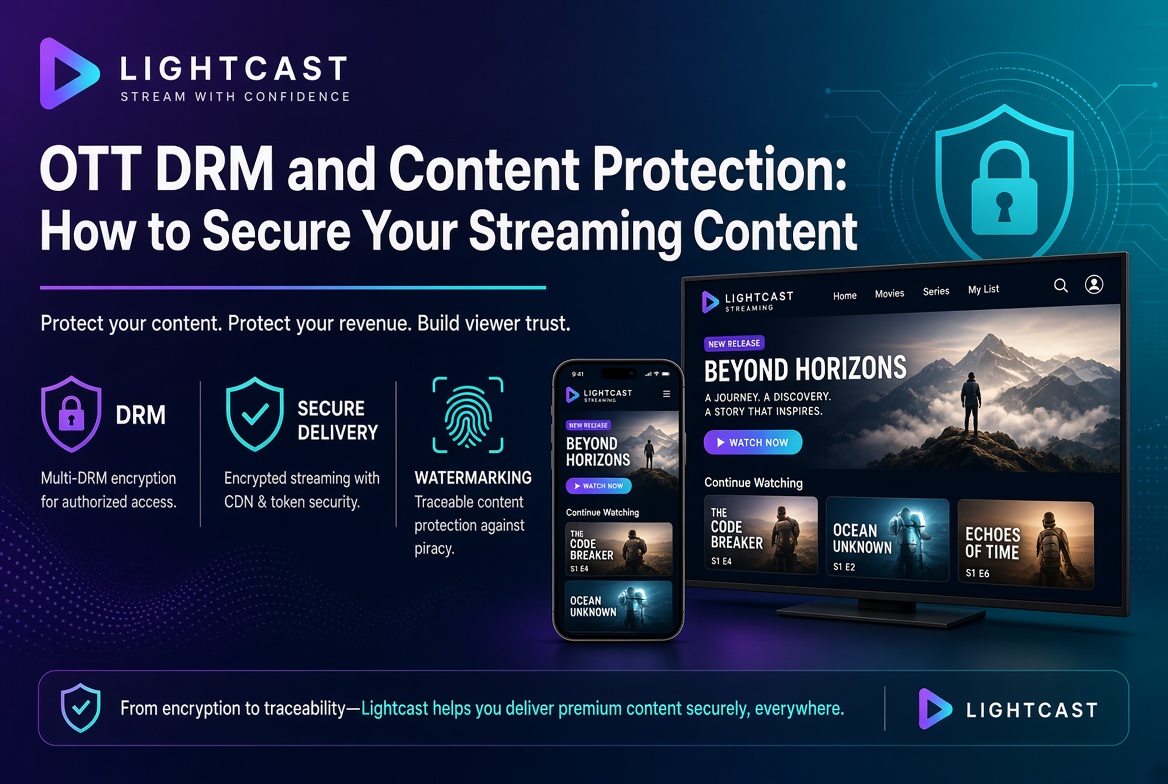
DRM (digital rights management) is the technology that protects OTT streaming content from being copied, redistributed, or pirated, by encrypting the video and controlling who is allowed to decrypt and play it. In OTT, content protection combines DRM with secure delivery, access controls, and often watermarking, so only authorized, paying viewers can watch. It matters because the losses are real: Parks Associates projects US video providers will lose about $113 billion to piracy and password sharing between 2022 and 2027. Lightcast supports DRM and content protection as part of a platform that delivers to Roku, Fire TV, Apple TV, iOS, Android, and web across 70,000+ global CDN nodes, with the publisher owning its audience data, serving 5,000+ organizations and 12,000+ branded apps.
If your content has value, someone will try to take it for free. Content protection is what stands between the library you invested in and an audience watching it somewhere you earn nothing.
DRM, digital rights management, is a system that encrypts your video and grants playback only to authorized devices and viewers. When a viewer presses play, their device requests a license, and the DRM system decides whether to issue the key that unlocks the content. If the request is not authorized, the video stays locked. In practice, OTT relies on a few major DRM systems, Google Widevine, Apple FairPlay, and Microsoft PlayReady, which cover the range of devices and browsers viewers use. For how protection factors into choosing a platform, see our OTT platform buyer's guide.
Because piracy is a large, active drain on streaming revenue, not a fringe problem. Parks Associates projects US video providers will lose roughly $113 billion to piracy and password sharing across 2022 to 2027, and live content is a growing target, with European regulators reporting a sharp rise in live sports piracy. For a publisher, every pirated stream is an audience you are reaching without being paid, and for live events it can undercut the exact moment you are trying to monetize. Protecting content is protecting the business model. For the live context, see our pillar on live video broadcasting for content publishers.
Through encryption and controlled keys. The video is encrypted so the file itself is useless without a decryption key, and the key is issued only to authorized devices through a license request at playback time. Because the major DRM systems each cover different devices, a protected service typically uses more than one to reach every screen, Widevine for Android and Chrome, FairPlay for Apple devices, PlayReady for Windows and many smart TVs. The result is that the content plays seamlessly for legitimate viewers and stays locked for everyone else. For the on-demand library this protects, see our guide to the best on-demand video platforms.
DRM is the core, but strong content protection usually layers in more. Secure delivery over HTTPS keeps the stream encrypted in transit. Token-based access and authentication ensure only logged-in, entitled viewers reach the content. Geoblocking enforces territorial rights. And forensic or visible watermarking can trace a leaked stream back to its source, which is a growing tool against the password-sharing and re-streaming that drive much of the loss. Together these turn a single lock into a layered defense. For why protecting content ties directly to revenue, see our pillar on video content monetization for content publishers.
A few things matter most.
DRM across every device. Protection should cover Roku, Fire TV, Apple TV, mobile, and web, not just some of them, which usually means multi-DRM support.
Secure delivery at scale. The platform should encrypt delivery across its CDN so protection holds up for a large, live audience.
Access and entitlement controls. Only authorized, paying viewers should reach protected content, tied to your subscription or ticketing.
Data and rights ownership. Your content and your audience data should stay with you, not a third party.
Lightcast supports DRM and content protection so your video is encrypted and played only by authorized viewers, across the devices your audience actually uses.
Content is delivered securely at scale, so protection holds up for both an on-demand library and a large live audience.
Protection works alongside subscriptions, pay-per-view, and gated access, so only entitled viewers reach the content and your revenue model stays intact.
Lightcast does not retain, monetize, or share client data, so your content and audience stay yours. Explore the platform on our media cloud OVP and live streaming pages.
DRM protects OTT streaming content by encrypting it and granting playback only to authorized viewers, and strong content protection layers DRM with secure delivery, access controls, geoblocking, and watermarking. It matters because piracy and password sharing drain billions from streaming revenue, with live content increasingly targeted. Look for multi-DRM coverage across every device, secure delivery at scale, entitlement controls tied to your monetization, and ownership of your content and data. Lightcast supports DRM and content protection across 70,000+ global CDN nodes, for 5,000+ organizations and 12,000+ branded apps, and was named Fastest Deployment OTT Platform Provider 2026 by The Silicon Review. To learn more or schedule a demonstration, visit lightcast.com.