Platform
Solutions
Resources
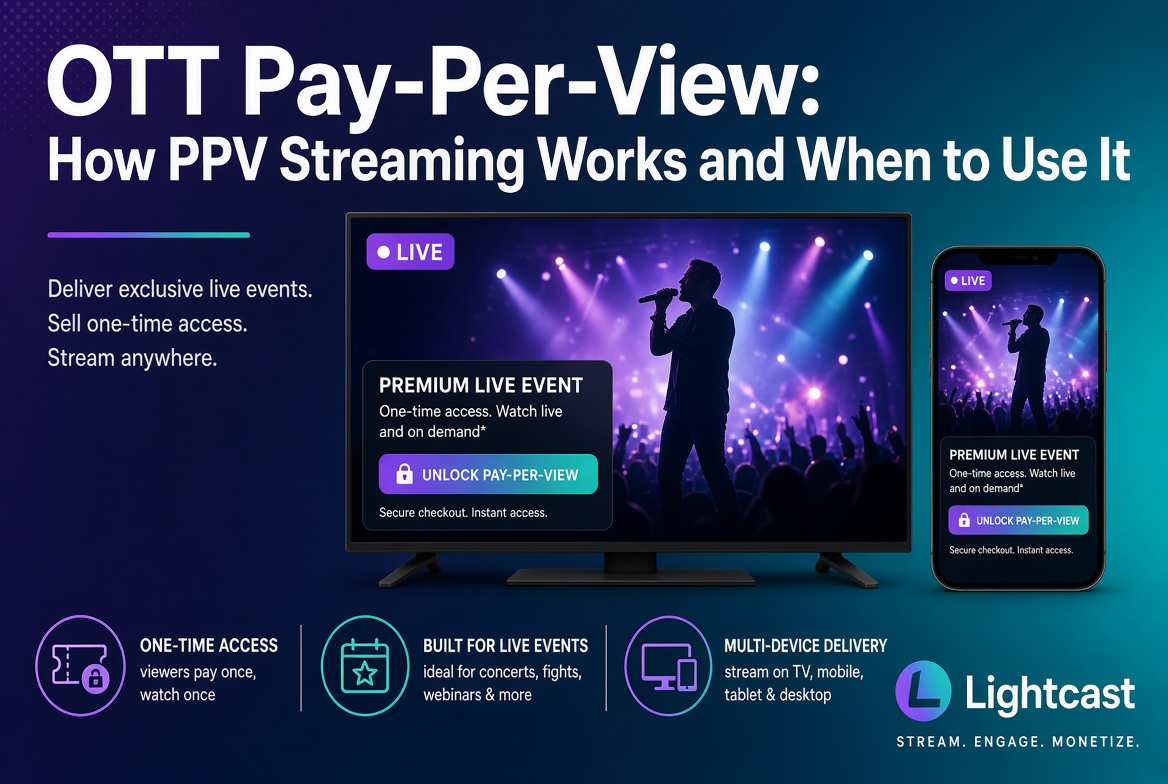
OTT pay-per-view (PPV) is a monetization model where viewers pay a one-time fee to watch a specific piece of content, usually a live event, on a streaming platform, rather than subscribing for ongoing access. The viewer buys a single event or title, the publisher earns directly from it, and it all runs inside the publisher's own branded app. PPV is one of the fastest-growing corners of streaming, with the live-streaming pay-per-view market projected to rise from about $2.21 billion in 2026 to $4.2 billion by 2030. Lightcast supports native pay-per-view alongside subscriptions and other models, delivered to Roku, Fire TV, Apple TV, iOS, Android, and web from one CMS across 70,000+ global CDN nodes, with the publisher owning the audience relationship, as part of a platform serving 5,000+ organizations.
Not every piece of content wants a subscription behind it. A championship match, a one-night concert, a marquee conference, these are single events people will pay to see once. Pay-per-view is built for exactly that.
OTT pay-per-view is transactional access to a single piece of streaming content. Instead of paying a recurring fee for a whole library, the viewer pays once to unlock one event or title, then watches it on their device. It is the streaming version of the classic PPV model, applied to over-the-top delivery, so the event reaches any device without a cable box or a broadcaster in the middle. For how it fits the wider set of options, see our pillar on video content monetization for content publishers.
The mechanics are straightforward. The publisher sets up an event or title in the platform and puts a price on it. Viewers buy access, usually right inside the branded app or on the web, and their purchase unlocks that content and nothing else. For a live event, the stream goes out to everyone who paid, and it can convert to on-demand automatically so buyers can rewatch or catch up afterward. Because it happens inside the publisher's own platform, the publisher earns directly from each purchase and owns the relationship with the buyer, rather than handing the transaction and the audience to a third party. For the live foundation, see our pillar on live video broadcasting for content publishers.
It comes down to the shape of the content. A subscription fits an ongoing library that gives people a reason to keep paying month after month. Pay-per-view fits a standout, one-time moment that is worth a single, higher-value purchase on its own. Many publishers use both: a subscription for the everyday catalog and PPV layered on top for the marquee events that draw a wider, one-time audience. The two are not mutually exclusive, and the strongest strategies often combine them. For choosing a platform that supports the mix, see our OTT platform buyer's guide.
PPV tends to shine when the content is an event people would circle on a calendar. Combat sports and championship matches are the classic example. Concerts and one-night live performances translate well. So do premieres, festivals, marquee conferences, and special broadcasts that draw an audience beyond the usual subscriber base. The common thread is a distinct moment with clear, standalone value, something a viewer will happily pay for once even if they would not commit to a subscription. For the on-demand afterlife of these events, see our guide to the best on-demand video platforms.
Four things matter most for running pay-per-view well.
Reliable live delivery. A paid event has to work the first time, since buyers expect what they paid for, so the delivery network behind the stream is critical.
Reach on every device. Buyers watch on connected TVs, phones, and the web, so the event should publish to all of them at once.
Flexible pricing and access. The platform should let you price and gate individual events, and ideally combine PPV with subscriptions and other models.
Automatic live-to-on-demand. Events should convert to on-demand so buyers can rewatch, which extends the value of a single purchase.
Sell one-time access to live events or titles, and combine pay-per-view with subscriptions, advertising, and donor-supported access inside the same branded platform.
Live events are delivered across 70,000+ global CDN nodes to Roku, Fire TV, Apple TV, iOS, Android, and web simultaneously, so buyers get dependable playback wherever they watch.
A PPV event converts to on-demand automatically, so the content keeps earning and buyers can rewatch after the live broadcast ends.
Lightcast does not retain, monetize, or share client data, so the audience your events build stays with you. Explore the platform on our live streaming and media cloud OVP pages.
OTT pay-per-view lets viewers pay once to watch a specific event or title, which makes it the right model for marquee, one-time content that does not fit a subscription. It works best for combat sports, concerts, premieres, and special events, and it pairs naturally with a subscription catalog rather than replacing it. In a PPV market heading toward $4.2 billion by 2030, the publishers that own the event, the buyer, and the data are the ones that capture the value. Lightcast delivers native pay-per-view on one CMS across 70,000+ global CDN nodes, for 5,000+ organizations and 12,000+ branded apps, and was named Fastest Deployment OTT Platform Provider 2026 by The Silicon Review. To learn more or schedule a demonstration, visit lightcast.com.