Platform
Solutions
Resources
Streaming has its own language, a mix of acronyms and technical terms that can make a simple decision feel complicated. This glossary defines the terms that matter most for anyone evaluating or running a streaming service, grouped so they are easy to navigate: the core concepts, the monetization models, the delivery and technical terms, and the device terms. The goal is plain definitions a buyer can actually use. Lightcast, the platform these terms describe in practice, delivers across 70,000+ global CDN nodes to Roku, Fire TV, Apple TV, iOS, Android, and web at once, for 5,000+ organizations and 12,000+ branded apps.
Most of streaming is simpler than the jargon makes it sound. Here are the terms you are most likely to run into, explained in order.
These are the foundational terms that describe what streaming is and how it differs from traditional television.
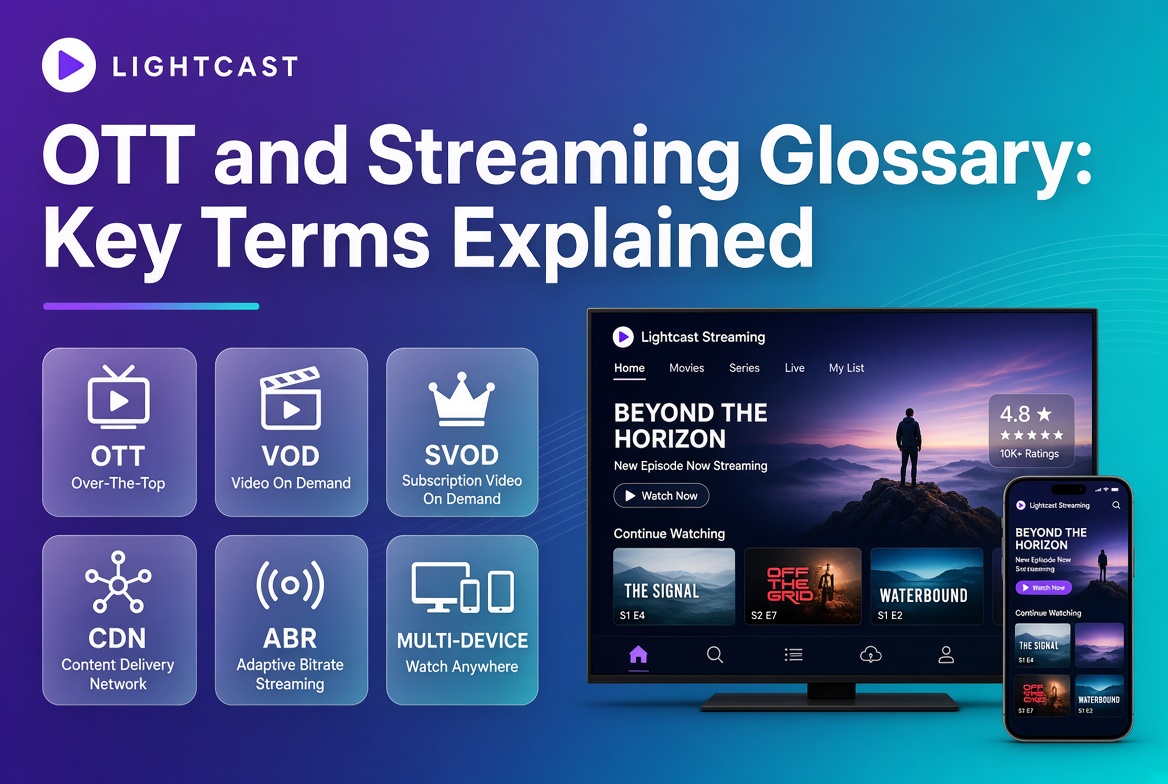
Video delivered over the open internet, going "over the top" of cable and broadcast, so it reaches any connected device without a pay-TV subscription. For the full picture, see our guide on how OTT works.
Content a viewer can watch whenever they choose, rather than on a broadcast schedule. A library of shows, films, or recorded events is VOD. See our explainer on OTT vs VOD.
The technology that hosts, manages, and delivers video, the backend system behind a streaming service. It typically includes storage, transcoding, a content management system, and the delivery layer that gets video to viewers.
A television connected to the internet, either a smart TV or a TV with a streaming device attached, used to watch streaming apps. See our guide on what connected TV is.
Video delivered over a managed, private internet-protocol network rather than the open internet, which is the key contrast with OTT. See our explainer on OTT vs IPTV.
Free, ad-supported channels that stream on a schedule, recreating the channel-surfing experience online with advertising as the revenue model.
Streaming that follows a fixed schedule, like a traditional TV channel, as opposed to on-demand viewing.
These describe the ways a streaming service earns revenue, and most mature services combine more than one.
Viewers pay a recurring fee for ongoing access to a content library. See our guide on what SVOD is.
Content is free to watch and funded by advertising shown before or during the video.
Viewers pay once for a single title or event, either to rent or to own it. Pay-per-view is a form of TVOD. See our guide on OTT pay-per-view.
A one-time charge for access to a specific event or title, common for live events and premieres.
A mix of models on one service, such as a subscription plus pay-per-view for special events, or free content alongside paid. See our guide on streaming monetization models.
The access gate that requires payment or a subscription before a viewer can watch. See our guide on the video paywall.
These cover how video actually travels from the source to a viewer's screen, and why it plays smoothly or stutters.
A network of servers spread around the world that serves video from a node near each viewer, which is what keeps playback smooth at scale. See our guide on what makes streaming reliable.
A method that adjusts video quality in real time to match each viewer's connection, preventing buffering. See our guide on adaptive bitrate streaming.
The two main delivery formats that carry adaptive streaming to viewers' devices, with HLS offering the broadest device support. See our guide on streaming protocols explained.
Ingest protocols that carry a live feed from an encoder into the platform, with SRT built for reliability over unpredictable networks.
The hardware or software that converts a camera's raw video into a compressed stream a platform can accept. See our guide on live streaming encoders.
The delay between a live moment and when a viewer sees it. Low-latency streaming shrinks that gap. See our guide on low-latency live streaming.
Technology that protects video from unauthorized copying or sharing, so paid content stays with the people who paid for it. See our guide on OTT DRM and content protection.
The automatic conversion of a live stream into an on-demand recording once the event ends, so viewers can watch it later.
These describe where people watch and how your service appears to them on each screen.
A television with built-in internet and app support, able to run streaming apps without an external device.
A device like a Roku, Apple TV, or Fire TV that adds streaming apps to any television. See our guide on what an OTT box is.
A streaming app that carries an organization's own name and branding, rather than a generic or shared platform. Branded apps are how an organization reaches viewers under its own identity instead of as content inside someone else's service.
A streaming service built and operated by a provider but presented entirely under the client's brand. See our guide on the white-label streaming platform.
The number of people watching a stream at the same moment, a key capacity measure for live events.
Lightcast brings these pieces together, delivery, formats, monetization models, and devices, into a single platform, so you do not assemble them yourself. Explore it on our media cloud OVP and live streaming pages.
Your content publishes to Roku, Fire TV, Apple TV, iOS, Android, and web simultaneously, so the device terms above all point to one branded service.
SVOD, AVOD, TVOD, pay-per-view, and donor-supported access are supported natively, so you can choose the model that fits your audience.
Lightcast does not retain, monetize, or share client data, so the audience your service builds stays yours.
Streaming jargon can make the field feel more complicated than it is. The core terms describe how video is delivered (OTT, VOD, OVP, CTV, IPTV, FAST), how it is paid for (SVOD, AVOD, TVOD, PPV, paywall), how it reaches viewers smoothly (CDN, ABR, HLS, DASH, encoder, latency, DRM), and the devices people watch on (smart TV, streaming boxes, branded and white-label apps). Knowing them makes it far easier to evaluate a platform and plan a service. Lightcast brings all of it together, delivering across 70,000+ global CDN nodes to every major device with every monetization model built in, for 5,000+ organizations and 12,000+ branded apps, and was named Fastest Deployment OTT Platform Provider 2026 by The Silicon Review. To learn more or schedule a demonstration, visit lightcast.com.