Platform
Solutions
Resources
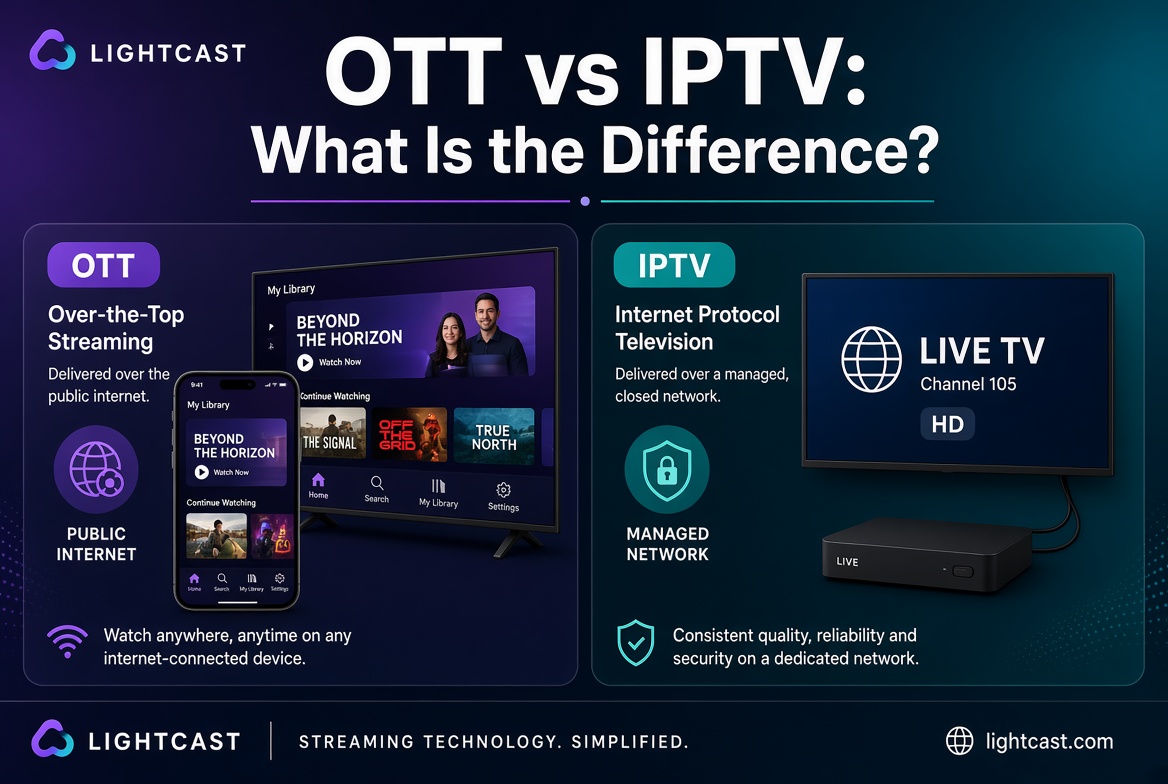
The difference between OTT and IPTV is the network they travel over. OTT, which stands for over-the-top, delivers video across the open public internet to any device, so viewers watch on Roku, Fire TV, Apple TV, phones, and the web without a special box or a single provider's network. IPTV delivers video over a managed, private network, usually the one run by an internet or telecom provider, often to a dedicated set-top box. For most organizations that want to reach their own audience directly, OTT is the model, because it works on the devices people already own. Lightcast is an OTT platform that has launched 12,000+ branded apps for 5,000+ organizations, delivering to every major device from one CMS across 70,000+ global CDN nodes.
Both deliver television over an internet protocol, so the terms get used interchangeably. They are not the same thing. The distinction comes down to whose network carries the video and what the viewer needs to watch it.
IPTV, internet protocol television, delivers video over a managed, closed network rather than the open internet. That network is typically operated by a telecom or cable provider, which controls the path end to end and often supplies a dedicated set-top box to the viewer. Because the provider manages the whole route, IPTV can offer tightly controlled quality of service, which is why it has long been used for provider-delivered TV packages. The tradeoff is reach: the viewer generally has to be on that provider's network and equipment to watch.
OTT, over-the-top, delivers video across the public internet, going "over the top" of any internet connection rather than riding a single provider's managed network. There is no special box required. The viewer watches through an app on a device they already own, a Roku, a Fire TV, an Apple TV, a phone, a tablet, or a web browser. That is what makes OTT the model behind the streaming services people use every day, and the reason a content owner can reach a broad audience without owning any network at all. For the full definition, see our explainer on what an OTT platform is.
Three differences matter most.
The network. IPTV runs on a managed, private network controlled by a provider. OTT runs on the open public internet, so it reaches anyone with a connection.
The device. IPTV often depends on a dedicated set-top box. OTT runs on the connected TVs, phones, and browsers viewers already have.
The reach and control. IPTV gives a provider tight control over its own network but limits the audience to that network. OTT trades that single-network control for the ability to reach almost anyone, on almost any device, which is what most content owners actually want. For how these fit the wider landscape, see our streaming services overview for content publishers.
For most content owners, OTT is the practical choice, because the goal is usually to reach your own audience wherever they are, not to run a network. OTT lets a university, a church, a broadcaster, a sports organization, or a media brand publish a branded app to every major device and reach viewers directly, without asking them to adopt a special box or join a particular provider. IPTV still fits providers that own and manage a network and want to deliver a controlled package across it. The right answer depends on whether you are delivering to a network you control or to an audience you want to reach broadly. For help weighing platforms, see our OTT platform buyer's guide.
This is the common concern, and modern OTT answers it with a content delivery network. A CDN distributes video across many geographically spread nodes, so streams are served from close to the viewer and hold up under load. That is how a well-built OTT service delivers dependable, high-quality playback over the public internet without the closed network IPTV relies on. The more nodes and the broader the footprint, the more consistent the experience. For the on-demand side of delivery, see our guide to the best on-demand video platforms.
Lightcast publishes your branded app to Roku, Fire TV, Apple TV, iOS, Android, and web simultaneously, so viewers watch on the devices they already own, with no set-top box required.
Content is delivered across 70,000+ global CDN nodes, so streams are served from close to the viewer and hold up under demand, the reliability content owners expect.
Manage live events and an on-demand library together, with events converting to on-demand automatically, all from a single system.
Lightcast does not retain, monetize, or share client data, so the audience your service builds stays yours. Explore the platform on our media cloud OVP and live streaming pages.
OTT and IPTV both deliver television over internet protocol, but OTT travels the open public internet to any device while IPTV runs on a provider's managed network, usually to a dedicated box. For content owners who want to reach their own audience directly, OTT is the model, since it works on the connected TVs and phones people already use, with a CDN providing the reliability. Lightcast delivers branded OTT to every major device from one CMS across 70,000+ global CDN nodes, for 5,000+ organizations and 12,000+ branded apps, and was named Fastest Deployment OTT Platform Provider 2026 by The Silicon Review. To learn more or schedule a demonstration, visit lightcast.com.