Platform
Solutions
Resources
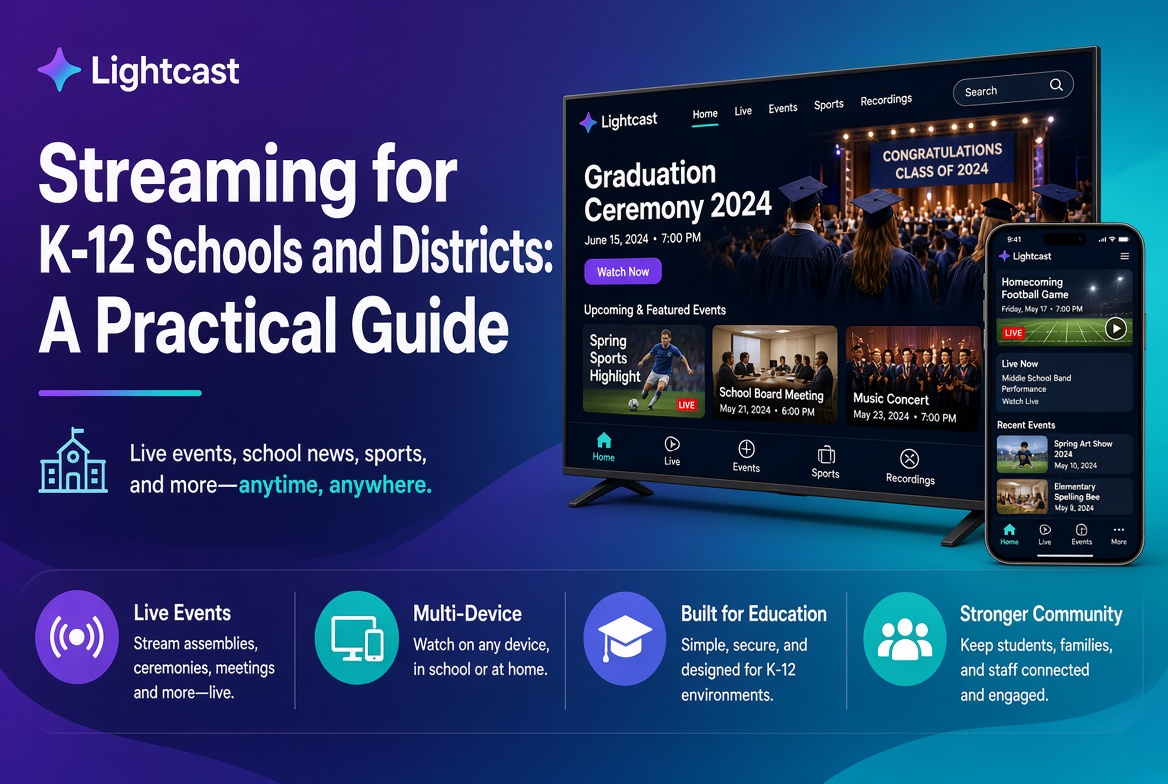
K-12 schools and districts stream video to reach the families, students, and communities who cannot always be there in person, from graduations and sports to board meetings and concerts. A good streaming setup lets a school broadcast a live event to every family, keep a recording available afterward, and reach people on whatever device they own, all under the school's or district's own identity. Lightcast supports exactly this, delivering live and on-demand video to Roku, Fire TV, Apple TV, iOS, Android, and web across 70,000+ global CDN nodes, with automatic live-to-VOD and full data ownership, as part of a platform serving 5,000+ organizations and 12,000+ branded apps.
Schools have more worth sharing than ever, and families who want to watch are more spread out than ever. Streaming is how a district closes that gap, turning events that once reached only the people in the room into something the whole community can see.
Because a school's community reaches well beyond the building. Grandparents in another state want to watch a graduation. A parent working a shift cannot make the afternoon concert. Alumni, deployed family members, and relatives abroad all want to stay connected to a school they cannot visit. Streaming lets a district include all of them, and it serves the people who are present too, by preserving events so they can be watched again. For public bodies like school boards, streaming also supports transparency and access to meetings. Districts that already stream their board meetings often find the same setup carries everything else, from athletics to arts, so one decision made for transparency ends up serving the whole community. For public-meeting streaming in particular, see our guide on streaming for local government, and for the live side generally, our guide on live video broadcasting.
More than most schools realize when they start. The common ones include graduations and award ceremonies, which draw the largest remote audiences, and athletics, from football and basketball to smaller programs that rarely get coverage. Beyond those, schools stream concerts, plays, and arts performances, school board and committee meetings, assemblies and announcements, and district updates for families. Some build an ongoing channel of their own content rather than treating each event as a one-off. The point is that a district generates a steady stream of moments worth sharing across a whole school year, not just a handful. For the sports side, see our guide on live sports streaming options.
Wider and more dispersed than a gymnasium can hold. The core audience is families, including the ones who cannot attend in person because of distance, work, health, or capacity limits in the venue. Around them sits a broader community: alumni, extended family, local residents, and in the case of public meetings, any constituent who wants to stay informed. Reaching all of them means meeting people on the devices they actually use, a phone, a laptop, or the television in the living room, rather than assuming everyone will gather at a computer. A platform that publishes to every screen is what makes that reach real. It also matters for equity. Families without reliable transportation, those balancing multiple jobs, and caregivers who cannot leave home are often the ones most excluded from in-person events, and streaming is frequently the only way they get to take part at all. For a school, that is not a small thing, it is the difference between a community event that includes everyone and one that quietly leaves some families out.
A few things matter more than features for a district.
Reliable live streaming. A graduation happens once, so the stream has to hold up for a large audience at a single, unrepeatable moment.
Reach on every device. Families watch on phones, laptops, and living room TVs, so the stream should reach all of them without extra work.
An automatic recording. Events should become on-demand video right after they end, so anyone who missed the live broadcast can still watch.
Appropriate privacy settings. Schools often need to control who can view certain content, especially anything involving students, so the ability to set the right level of access matters and should be matched to each district's policies.
The simplest path is a platform that handles the whole job rather than stitching together separate tools for each event. That means one place to run the live broadcast, keep the recording, and reach every device, under the school's or district's own brand. A camera and an internet connection feed the platform, the platform delivers the event to families wherever they are, and the recording is ready the moment the event ends. Keeping it on one branded platform also means the district builds a consistent home for its video over time, rather than scattering events across different services and links. Many districts start with a single high-demand event, usually graduation, prove the value to families, and expand from there across sports and the arts once the workflow is familiar. Because one platform covers every event, a small team or even a single staff member can run streaming for a whole district rather than arranging a separate vendor for each occasion. And keeping everything in one branded place means each new event adds to a growing library the community can return to, rather than disappearing once the live broadcast ends. For how that platform is chosen, see our guide on how to choose an OTT platform.
Lightcast delivers live streams across 70,000+ global CDN nodes, so a graduation or a game reaches a large, dispersed audience reliably at the moment it happens. Explore the platform on our live streaming and media cloud OVP pages.
Your streams reach Roku, Fire TV, Apple TV, iOS, Android, and web, carrying the school or district identity, so families watch on whatever screen they have.
Live events convert to on-demand automatically, so a parent who missed the concert or the ceremony can still watch it afterward, and the district builds a library of its own moments.
Lightcast does not retain, monetize, or share client data, which matters for a school community, so the data around your audience stays with the district rather than a third party.
Streaming lets a K-12 school or district reach the families and communities who cannot be in the room, turning graduations, games, concerts, and board meetings into events the whole community can watch, live and afterward. What schools need most is reliable live streaming for unrepeatable moments, reach on every device, automatic recordings, and privacy settings that fit their policies, all in one branded place. Lightcast delivers live and on-demand video across 70,000+ global CDN nodes to every major device, with automatic live-to-VOD and data that stays with the district, as part of a platform serving 5,000+ organizations and 12,000+ branded apps, and was named Fastest Deployment OTT Platform Provider 2026 by The Silicon Review. To learn more or schedule a demonstration, visit lightcast.com.