Platform
Solutions
Resources
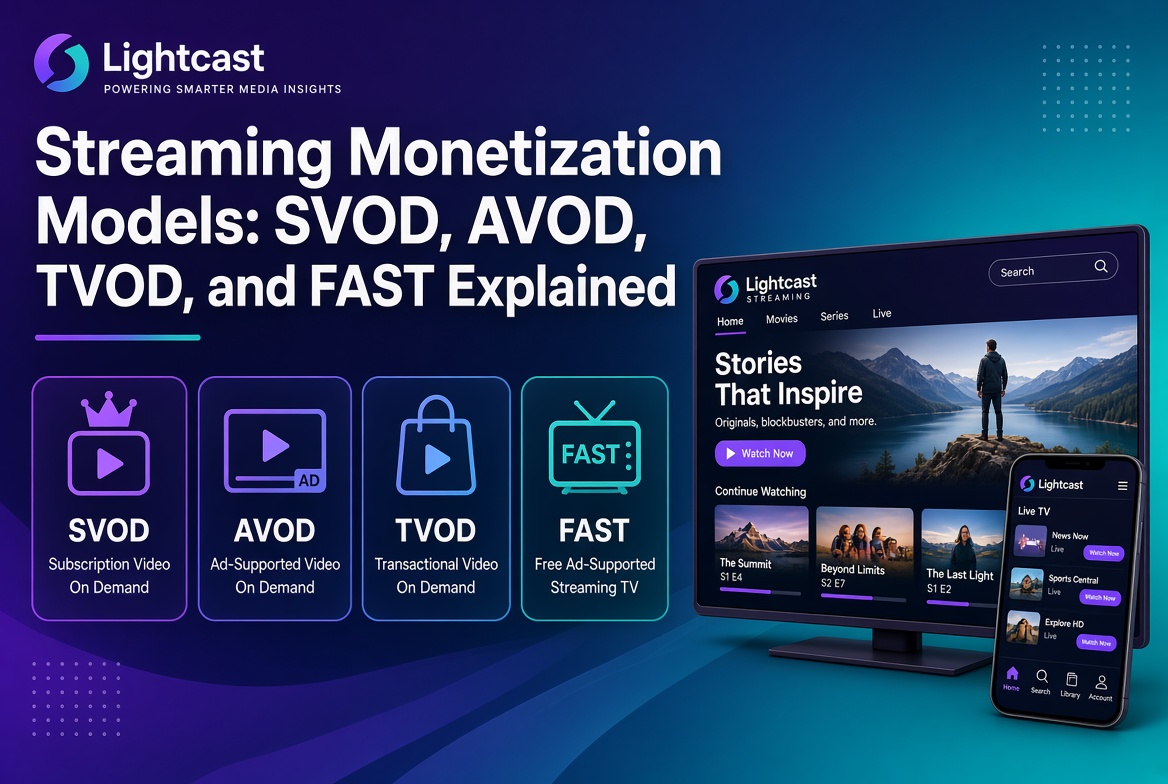
The four main streaming monetization models are SVOD (subscriptions), AVOD (ad-supported), TVOD (transactional or pay-per-view), and FAST (free ad-supported streaming TV channels). Each earns money a different way, and the strongest strategies increasingly combine them rather than betting on one. The shift is real: ad-supported tiers are projected to make up 54 percent of subscription streaming revenue in North America by the end of 2026, according to Ampere Analysis. Lightcast supports every model, subscriptions, advertising, pay-per-view, and donor-supported access, inside one branded platform delivered to Roku, Fire TV, Apple TV, iOS, Android, and web from a single CMS, as part of a platform serving 5,000+ organizations.
How you make money from streaming is as much a strategic choice as what you stream. The right model, or mix of models, depends on your content and your audience, and the trend is clearly toward using more than one.
At a high level, there are four ways to earn from streaming video. SVOD charges a recurring subscription for access to a library. AVOD makes content free to the viewer and earns from advertising. TVOD charges a one-time fee for a specific title or event. And FAST delivers free, ad-supported channels that play on a schedule like traditional TV. Most successful services now blend these, and choosing well starts with understanding what each one does. For the strategic overview, see our pillar on video content monetization for content publishers.
SVOD charges viewers a recurring fee, monthly or annual, for access to a content library. It is the model behind the best-known streaming services, and it works when you have enough ongoing content to justify a continuing payment. Its strength is predictable, recurring revenue and a direct relationship with subscribers. Its challenge is that every subscription competes for a share of a viewer's budget and attention, so the content has to keep earning its place. SVOD fits publishers with a deep, growing catalog that gives people a reason to stay subscribed.
Both make content free to the viewer and earn from advertising, and both are growing quickly as audiences resist stacking up subscriptions. AVOD, ad-supported video on demand, lets viewers watch on-demand content for free with ads. FAST, free ad-supported streaming TV, delivers linear channels that play on a schedule, recreating the lean-back experience of traditional TV with ad breaks. The appeal is reach: free content removes the barrier to entry and builds a large audience an advertiser will pay to access. With ad-supported tiers projected to reach 54 percent of subscription streaming revenue in North America by the end of 2026, this is where much of the growth is heading.
TVOD charges a one-time fee to watch a specific title or event, rather than a subscription for a whole library. Pay-per-view is the live-event form of it. TVOD fits marquee, standalone content, a championship match, a concert, a premiere, that is worth a single higher-value purchase on its own. It pairs naturally with a subscription: the catalog earns recurring revenue while the big events earn transactional revenue on top. For the live-event form, see our guide to OTT pay-per-view.
Increasingly, the answer is not one but several. A publisher might run a subscription for the core library, offer pay-per-view for marquee events, and add an ad-supported or free tier to widen reach. The best mix depends on your content: a deep catalog leans toward subscription, standout events toward transactional, and broad, advertiser-friendly content toward ad-supported. The key is choosing a platform that supports all of them, so you can combine and adjust models without changing systems. For help selecting one, see our OTT platform buyer's guide, and for the on-demand experience underneath, our guide to the best on-demand video platforms.
Run SVOD, AVOD, TVOD, and donor-supported access inside the same branded service, and combine them however your content and audience call for.
Manage a subscription catalog, ad-supported content, and pay-per-view events together, with live events converting to on-demand automatically.
Whatever model you run reaches Roku, Fire TV, Apple TV, iOS, Android, and web simultaneously across 70,000+ global CDN nodes, all under your brand.
Lightcast does not retain, monetize, or share client data, so the audience and revenue relationships you build stay yours. Explore the platform on our media cloud OVP and live streaming pages.
The four streaming monetization models, SVOD, AVOD, TVOD, and FAST, each earn a different way, and the strongest strategies combine them rather than relying on one. Subscriptions suit a deep catalog, transactional and pay-per-view suit marquee events, and ad-supported models are capturing a growing share of revenue as audiences resist subscription overload. Choose the mix that fits your content, and a platform that supports all of it. Lightcast delivers every model on one CMS across 70,000+ global CDN nodes, for 5,000+ organizations and 12,000+ branded apps, and was named Fastest Deployment OTT Platform Provider 2026 by The Silicon Review. To learn more or schedule a demonstration, visit lightcast.com.