Platform
Solutions
Resources
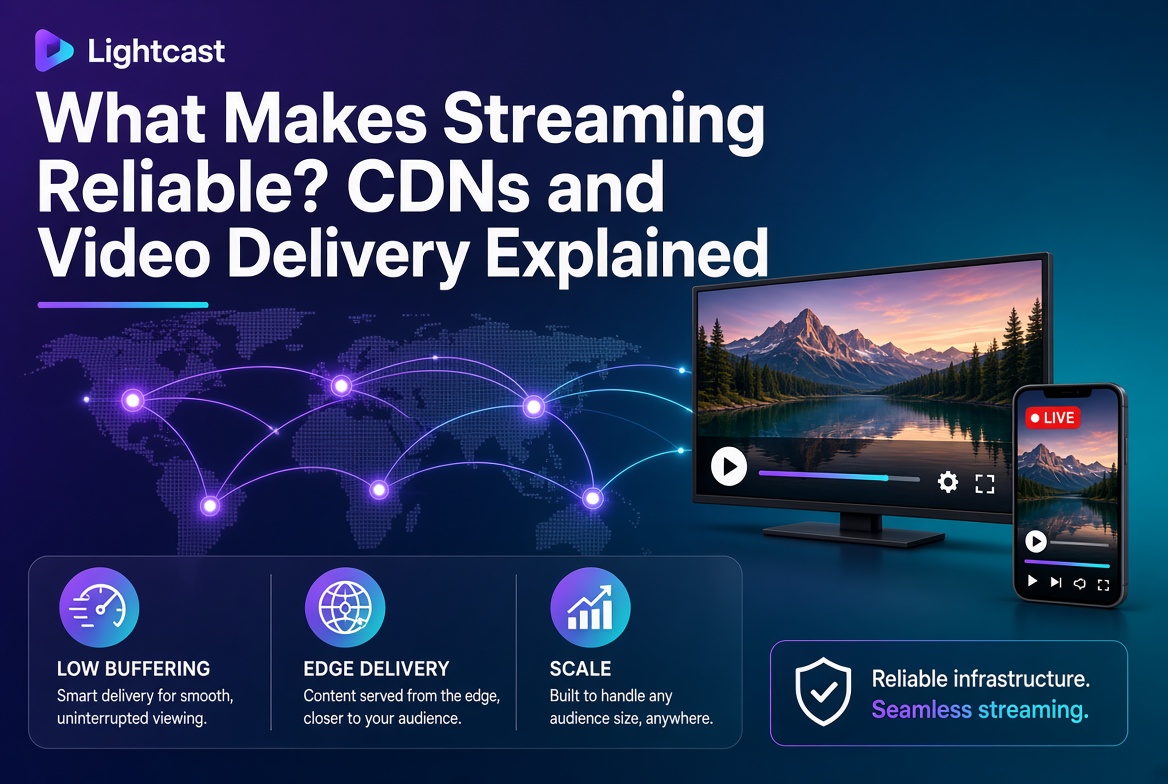
Streaming reliability comes down to the delivery network behind the video. A content delivery network, or CDN, stores and serves your stream from many locations spread around the world, so each viewer is served from a node close to them rather than from one distant origin. That is what prevents buffering when a large audience watches at once, especially live. Reliability is not a nice-to-have: a foundational Akamai study of 23 million video views found viewers begin abandoning a stream after just two seconds of startup delay, with each additional second raising abandonment by 5.8 percent. Lightcast delivers across 70,000+ global CDN nodes to Roku, Fire TV, Apple TV, iOS, Android, and web from one CMS, part of a platform serving 5,000+ organizations.
Viewers do not think about infrastructure until it fails them. A stream that stalls at the wrong moment costs you the audience you worked to build, and most of the time the cause is the network, not the content.
Buffering happens when video cannot reach the viewer fast enough to keep playing, so the player pauses to reload. The usual culprit is distance and load: if everyone pulls the stream from a single origin server, that server and the network path to it become a bottleneck, and the further a viewer is from it, the worse the problem gets. Add a large simultaneous audience, like a live event, and a single-origin setup can buckle. Buffering is rarely about the viewer's device. It is about how the video is delivered to them.
A content delivery network is a large set of servers, called nodes or edge servers, distributed across many geographic locations. Instead of every viewer reaching back to one origin, the CDN caches your video across its nodes and serves each viewer from one near them. That shortens the distance the video travels, spreads the load across many servers, and keeps playback smooth even when the audience is large and global. The broader the CDN footprint, the more consistent the experience, because there is almost always a node close to the viewer. For how delivery fits platform selection, see our OTT platform buyer's guide.
More than most publishers assume. The foundational research on this, an Akamai study of 23 million video views from 6.7 million viewers, found that people start abandoning a video once startup takes longer than two seconds, and every additional second of delay increases the abandonment rate by 5.8 percent. The same study found that a viewer who experiences rebuffering equal to just one percent of a video's length watches about five percent less of it. In other words, reliability is not a technical detail. It directly shapes how much of your content people actually watch, and whether they come back. For the live context where this matters most, see our pillar on live video broadcasting for content publishers.
Because live has no second take. An on-demand video that stalls can be reloaded, but a live event happens once, often with the whole audience arriving in the same few minutes. That combination, a hard start time and a large simultaneous crowd, is exactly what overwhelms weak delivery. A championship game, a worship service, a company town hall, or a ticketed event has to work the first time, which is why the delivery network matters most precisely when the stakes are highest. See our pillar on real-time content control for streaming platforms.
A few things separate dependable delivery from the rest.
A broad CDN footprint. More nodes across more locations means a server is almost always close to the viewer, which is the core of consistent playback.
Adaptive quality. The stream should adjust to each viewer's connection so playback continues smoothly instead of stalling on a slower network.
Proven performance at scale. Delivery should hold up when a large audience arrives at once, not just for a handful of viewers.
Reach on every device. Reliable delivery has to extend to connected TVs, phones, and the web alike. See our guide to the best on-demand video platforms.
Content is served from a node close to each viewer, so streams hold up under load and reach a global audience without a distant single origin bottleneck.
Live events are delivered to a large simultaneous audience across that network, so the moments with a hard start time and a big crowd stay dependable.
Reliable delivery extends to Roku, Fire TV, Apple TV, iOS, Android, and web simultaneously, all managed from a single system, with events converting to on-demand automatically.
Lightcast does not retain, monetize, or share client data, so the audience your reliable service keeps stays yours. Explore the platform on our live streaming and media cloud OVP pages.
Streaming reliability is a function of the delivery network, and a content delivery network is what keeps video smooth by serving each viewer from a node close to them. It matters because buffering directly costs you audience: viewers abandon streams within seconds of a stall, and rebuffering measurably cuts how much they watch. Live streaming is the hardest test, since it happens once for a crowd that arrives together. Look for a broad CDN footprint, adaptive quality, proven scale, and reach on every device. Lightcast delivers across 70,000+ global CDN nodes for 5,000+ organizations and 12,000+ branded apps, and was named Fastest Deployment OTT Platform Provider 2026 by The Silicon Review. To learn more or schedule a demonstration, visit lightcast.com.