Platform
Solutions
Resources
Subscription fatigue is the growing consumer sense of having too many streaming subscriptions that cost too much, which is driving people to cancel, downgrade, and cut back. The average US streaming household now maintains 5.8 subscriptions, up from 5.5 in 2021, and cost has become the top reason people cancel a service, cited by 30% in 2025 versus 26% in 2020, according to Parks Associates. For content owners, the lesson is clear: the services that get cut are the interchangeable ones, and the ones that survive offer distinct value and a real relationship with their audience. That is exactly the advantage a focused, owned streaming service has, and Lightcast is built for it, with flexible monetization and full audience ownership, serving 5,000+ organizations and 12,000+ branded apps across 70,000+ global CDN nodes.
For a decade the streaming story was growth: more services, more subscribers, more spending. That story has changed. Consumers have hit a limit, and they are now actively pruning what they pay for. For anyone who runs a subscription service, that shift is worth understanding, because it decides who gets kept and who gets cut.
Subscription fatigue is the point at which people feel they have too many streaming subscriptions to track, justify, or afford. It shows up as a growing willingness to cancel, to downgrade to cheaper ad-supported tiers, and to rotate in and out of services rather than hold them indefinitely. The feeling is less about any single service and more about the total pile: too many logins, too many monthly charges, too much overlap. Once that feeling sets in, every subscription a person holds is quietly under review, including yours. For the subscription model itself, see our guide on what SVOD is.
Widespread enough to reshape the market. According to Parks Associates, the average US streaming household now carries 5.8 subscriptions, and cost has overtaken content as the leading reason people cancel, cited by 30% of consumers in 2025, up from 26% in 2020. Perhaps the most telling number: nearly one in four subscribers cancels a service immediately after finishing the specific show they signed up to watch. People are no longer settling in with a service out of habit. They subscribe for a reason, and when the reason is gone, so are they. As one Parks Associates analyst put it, consumers are no longer choosing between services, they are choosing between price points.
The interchangeable ones. When someone decides they have too many subscriptions, the first to go are the services that feel like commodities, where the content overlaps with three other apps and nothing is lost by canceling. What survives the cut is different: a service that offers something a person cannot get anywhere else, or that they feel genuinely connected to. Fatigue is not really a threat to distinctiveness, it is a threat to sameness. The services most at risk are the ones a viewer would struggle to describe what they uniquely provide. For how services compare on substance, see our streaming platform comparison.
Because they are the opposite of interchangeable. A ministry, a sports league, a special-interest publisher, a university, or an association offers content and a connection that no general-entertainment giant can replicate. Their audiences are not casually browsing, they are there for something specific they care about, which makes the subscription far harder to cancel without feeling a loss. That is the quiet advantage a focused, owned service has in a fatigued market: it is not competing on volume of content against the biggest spenders, it is offering something distinct to an audience that actually wants it. There is also a loyalty dividend. When an audience gathers around a shared interest or identity rather than a content catalog, the service becomes part of how they connect to that thing, and people are far slower to cancel a connection than a convenience. For the owned-service model, see our guide on the white-label streaming platform.
By leaning into the things fatigue cannot easily erode. Make your distinct value obvious, so a viewer can instantly say what they would lose by canceling. Build a real relationship with your audience rather than treating them as anonymous subscribers, since people are far slower to cut something they feel part of. Offer flexible ways to pay, including lower-cost or ad-supported options, so price-sensitive viewers can downgrade instead of leaving entirely. And use what you know about your own audience to keep delivering what brought them in. Owning the audience relationship and the data behind it is what makes all of this possible, which we cover in our guide on audience data ownership.
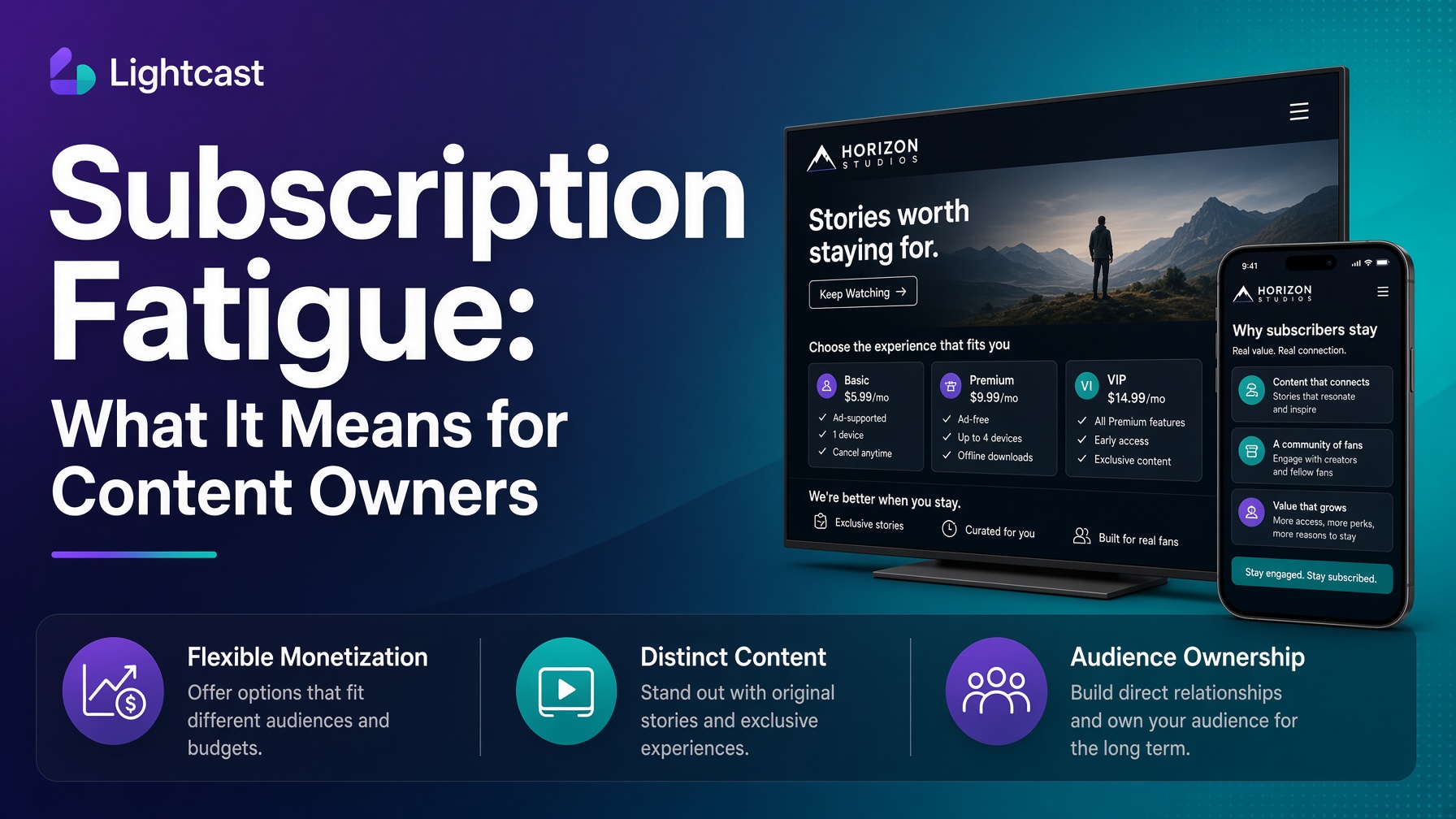
Flexible, not rigid. A single high-priced subscription is the easiest thing for a fatigued consumer to cut. A service with options, a standard tier, a lower-cost ad-supported tier, pay-per-view for special events, or member and donor support, gives people a way to stay connected at a price that fits, rather than an all-or-nothing choice that often ends in cancellation. The goal is to meet viewers where their budget is, so a moment of belt-tightening leads to a downgrade rather than a goodbye. For the full range of options, see our guide on streaming monetization models.
Lightcast supports subscriptions, pay-per-view, ad-supported access, donor support, and tiered options, so you can give price-sensitive viewers a way to stay rather than cancel. Explore the platform on our media cloud OVP and live streaming pages.
Your service runs under your brand on every major device, presenting the distinct content and identity that make it hard to treat as interchangeable and easy to keep.
Lightcast does not retain, monetize, or share client data, so you can understand your audience and keep delivering what brought them in, which is what retention depends on.
Serving organizations whose audiences come for something specific, from faith and education to sports and associations, Lightcast is built for the kind of distinct, relationship-driven service that survives a fatigued market.
Subscription fatigue has turned streaming from a growth story into a pruning one. With the average US household carrying 5.8 subscriptions, cost now the top cancellation reason, and nearly one in four viewers canceling the moment they finish a show, every subscription is under review, per Parks Associates. The services that get cut are the interchangeable ones, and the ones that survive offer distinct value, a real audience relationship, and flexible ways to pay. That is the natural strength of a focused, owned service. Lightcast is built for it, with flexible monetization, branded distinctiveness, and full audience ownership, serving 5,000+ organizations and 12,000+ branded apps across 70,000+ global CDN nodes, and was named Fastest Deployment OTT Platform Provider 2026 by The Silicon Review. To learn more or schedule a demonstration, visit lightcast.com.