Platform
Solutions
Resources
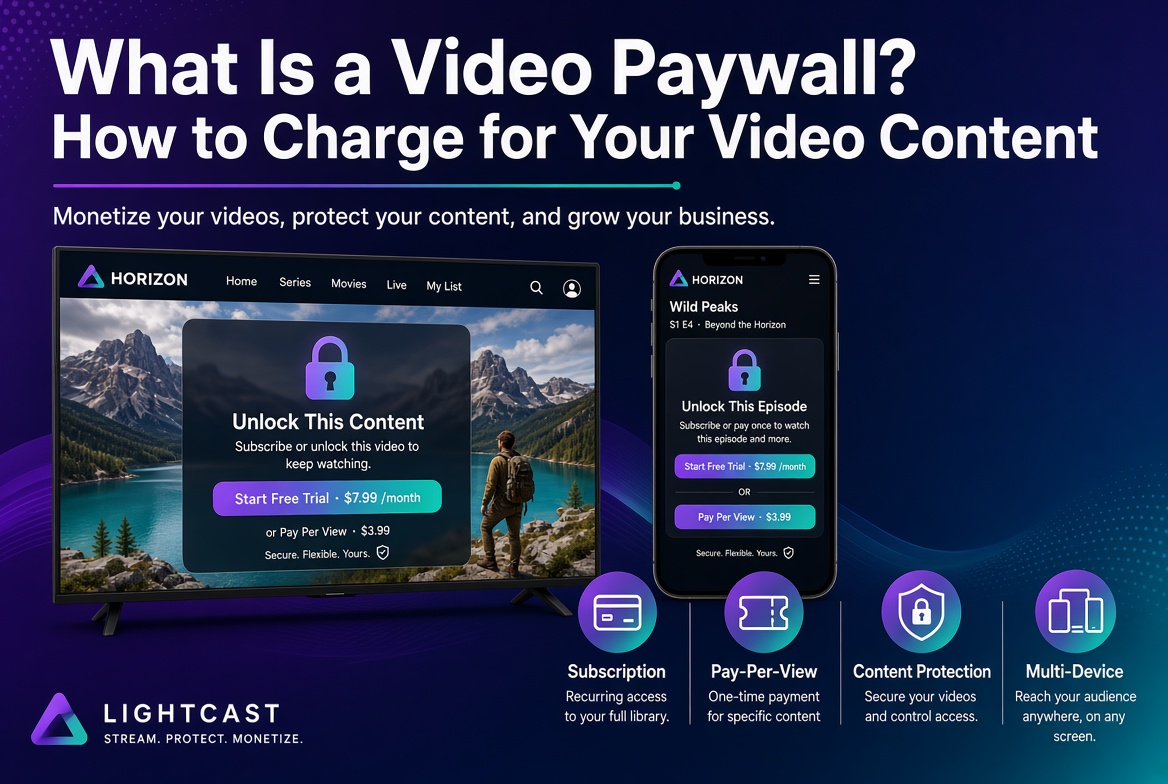
A video paywall is an access gate that requires a viewer to pay, subscribe, or sign in before they can watch your content. It is how an organization turns video into direct revenue, by deciding what is free, what is paid, and on what terms. A paywall combines three things: authentication to identify the viewer, payment to collect from them, and access control to show the content only to those who qualify. Lightcast builds this in natively, supporting subscriptions, pay-per-view, donor-supported access, and institutional licensing across branded apps on every major device, with the audience and the first-party data staying with you, as part of a platform serving 5,000+ organizations and 12,000+ branded apps.
At some point most organizations with video worth watching ask the same question: could we charge for this? A paywall is the mechanism that lets you answer yes, without handing your content or your audience to a public platform.
A video paywall is a barrier that sits between a viewer and your video, releasing the content only once the viewer meets a condition you set, usually payment or an active subscription. It is the digital equivalent of a ticket booth. You decide which content is open to everyone, which is reserved for paying viewers, and how people pay to get in. The paywall is not just a lock. It is the system that handles who gets access, how they pay, and how that access is enforced across every device they watch on. For the broader set of ways to earn from video, see our guide on streaming monetization models.
Three pieces work together behind the scenes. First, authentication identifies the viewer, through an account they create or log into, so the system knows who they are. Second, payment collects money from them, whether a recurring subscription charge or a one-time purchase, through an integrated billing system. Third, access control enforces the rule, releasing the specific content that viewer has paid for and withholding what they have not. Good paywalls also protect the content itself, so a single paid account cannot be freely copied or shared, which is where content protection comes in. For that side, see our guide on OTT DRM and content protection.
Paywalls are not one-size-fits-all. A few common models fit different content and audiences.
Subscription paywall. Viewers pay a recurring fee for ongoing access to a library or channel. Best when you publish regularly and want predictable, recurring revenue. This is the SVOD model, covered in our guide on what SVOD is.
Pay-per-view paywall. Viewers pay once for a single event or title. Ideal for live events, premieres, or marquee content people will pay for individually. See our guide on OTT pay-per-view.
Registration or soft wall. The content is free, but viewers must create an account to watch, which trades revenue for first-party data and a direct relationship you can build on later.
Hybrid. A mix, such as some free content to draw people in and paid content to convert them, or a subscription plus pay-per-view for special events. Most mature services end up here.
The obvious one is revenue, but it is not the only reason. A paywall gives you a direct commercial relationship with your audience rather than an anonymous view count. It generates first-party data, since paying viewers identify themselves, which tells you who your most engaged audience actually is. It signals value, because content people pay for is often content people take more seriously. And it keeps the relationship yours, on your branded platform, instead of routing your most valuable viewers through a third party. For where paid on-demand content lives, see our guide to the best on-demand video platforms.
A paywall is a tradeoff, and it is worth being clear-eyed about it.
Friction versus conversion. Every step between a viewer and your video loses some of them. The goal is to charge without making paying harder than it needs to be, with a smooth sign-up and checkout.
Security. A paywall is only as strong as its enforcement. Without content protection, paid content can be shared or pirated, which quietly undercuts the whole model.
Device reach. People pay on one device and watch on another. The paywall and the login have to work across connected TVs, phones, and the web, or you frustrate the customers you just won.
The right model. Charging per view for content people would rather subscribe to, or vice versa, leaves money on the table. Match the model to how your audience actually wants to pay.
The practical path is to use a platform that builds the paywall in, rather than stitching together separate tools for hosting, payment, login, and protection. A capable platform gives you the monetization models, the account and billing system, access control, and content protection as one connected system, published to every device under your own brand. That way the paywall is part of your streaming service, not a fragile add-on, and you can change pricing, models, and what is gated without rebuilding anything. The platform you choose is the decision that makes a paywall simple or painful, which we cover in our guide on how to choose an OTT platform.
Lightcast supports subscriptions, pay-per-view, donor-supported access, and institutional licensing directly, so you can gate content the way that fits your audience without bolting on a separate system. Explore the platform on our media cloud OVP and live streaming pages.
Your paid content and its login work across Roku, Fire TV, Apple TV, iOS, Android, and web, so viewers can buy on one screen and watch on another without friction.
Paid content is protected so access stays with the people who paid for it, which is what keeps a paywall from leaking the revenue it is meant to capture.
Lightcast does not retain, monetize, or share client data, so the paying audience and the first-party data behind your paywall belong to you.
A video paywall is the gate that lets you charge for your content, combining authentication, payment, and access control so only qualifying viewers can watch. It comes in several models, subscription, pay-per-view, registration, and hybrid, and the right one depends on how your audience wants to pay. The benefits go beyond revenue to include first-party data and a direct, owned relationship with your most valuable viewers, and the main things to get right are friction, security, device reach, and model fit. Lightcast builds paywalls in natively across branded apps on every major device, with content protection and full ownership of the audience and data staying with you, for 5,000+ organizations and 12,000+ branded apps, and was named Fastest Deployment OTT Platform Provider 2026 by The Silicon Review. To learn more or schedule a demonstration, visit lightcast.com.