Platform
Solutions
Resources
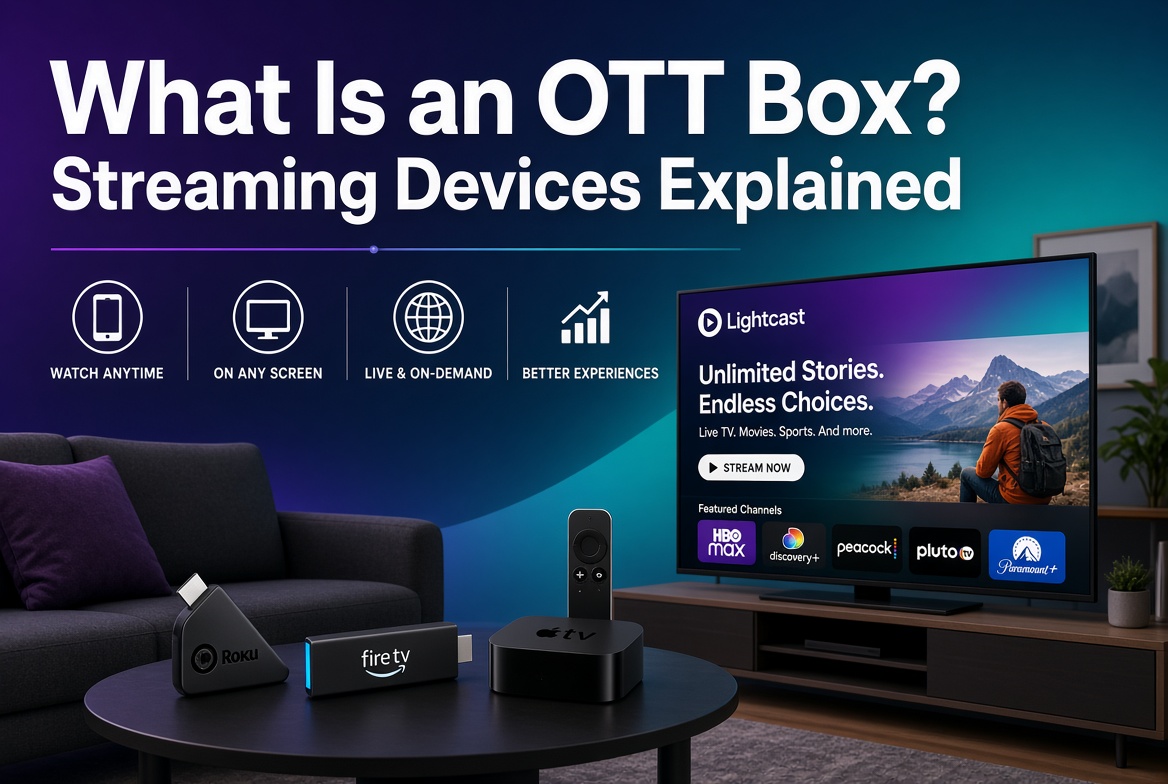
An OTT box is a streaming media device that connects a television to the internet so it can play OTT (over-the-top) video from apps, without a cable or satellite subscription. The best-known examples are Roku, Amazon Fire TV, Apple TV, and Google TV or Chromecast devices. They turn any TV into a smart, internet-connected screen, and along with smart TVs that have streaming built in, they are how most people now watch. Streaming already reaches roughly 90 percent of US households. For a content publisher, the takeaway is simple: your audience is spread across all of these devices, and being on every one of them is what reaches them. Lightcast publishes branded apps to Roku, Fire TV, Apple TV, iOS, Android, and web from one CMS across 70,000+ global CDN nodes, for 5,000+ organizations and 12,000+ branded apps.
The term sounds technical, but an OTT box is just the small device that makes an ordinary TV stream. Understanding the landscape helps explain where your audience actually watches, and what it takes to reach them.
An OTT box is a device that delivers over-the-top video to a television over the internet. "Over-the-top" means the video travels the open internet rather than a cable or broadcast signal, and the box is what receives it and puts it on the screen. You plug it into your TV, connect it to Wi-Fi, and it runs streaming apps. The box handles the apps, the account sign-ins, and the playback, turning a basic television into a connected one. For the delivery model behind it, see our explainer on what an OTT platform is.
There are three broad categories. Streaming players are dedicated devices, a Roku, an Amazon Fire TV stick, an Apple TV, or a Google TV or Chromecast, that plug into a TV and run streaming apps. Smart TVs have a streaming platform built in, so the OTT box is effectively inside the television, with Roku, Fire TV, and other systems powering the TV directly. Game consoles also stream video and serve as an OTT device in many homes. What they share is an app-based experience on the television screen, which is exactly where a publisher's branded app can live. For getting apps onto those screens, see our pillar on smart TV app development for content publishers.
The difference is where the streaming software lives. An OTT box is a separate device you add to a TV to make it stream, which is useful for older televisions or anyone who prefers a particular platform. A smart TV has that streaming software built in, so it can run apps straight out of the box. For the viewer, the experience is similar, apps on the big screen. For a publisher, the practical point is the same either way: your app needs to be available on the platforms these devices run, whether the platform sits in a separate box or inside the TV. For the broader device category, see our explainer on what connected TV is.
Because this is where the audience watches, and no single device holds all of it. One household uses a Roku, another a Fire TV, another a smart TV with its own system, and most people also watch on phones and the web. Reaching your audience means being present across all of them, not betting on one. The living-room screen that once belonged to a handful of broadcast networks is now open to any publisher whose app is on these devices. For the on-demand experience inside those apps, see our guide to the best on-demand video platforms.
Through a platform that publishes a branded app to all of them at once. Building and maintaining a separate app for each device family is a large, ongoing job, so most publishers use an OTT platform that handles the apps across every streaming player, smart TV system, and mobile platform, and manages the content from one place. That is what makes broad device reach practical: one library, one platform, and a branded presence on every OTT box and smart TV your audience uses, plus phones and web.
Lightcast publishes your app to Roku, Fire TV, Apple TV, and the major connected TV platforms, each under your brand, so you appear on whatever device your audience already uses.
The same platform reaches OTT boxes, smart TVs, iOS, Android, and web simultaneously across 70,000+ global CDN nodes, with live and on-demand managed together.
More than 12,000 branded apps have launched on Lightcast for 5,000+ organizations, so reaching every device is delivered, not theoretical.
Lightcast does not retain, monetize, or share client data, so the audience you build across all these devices stays yours. Explore the platform on our media cloud OVP and live streaming pages.
An OTT box is a streaming device, like a Roku, Fire TV, Apple TV, or Google TV, that connects a television to the internet to play over-the-top video, and along with smart TVs that build streaming in, it is how most households now watch. The devices differ in whether the streaming software sits in a separate box or inside the TV, but for a publisher the point is the same: your audience is split across all of them, and reaching it means being present everywhere. Lightcast publishes branded apps to every major device from one CMS across 70,000+ global CDN nodes, for 5,000+ organizations and 12,000+ branded apps, and was named Fastest Deployment OTT Platform Provider 2026 by The Silicon Review. To learn more or schedule a demonstration, visit lightcast.com.