Platform
Solutions
Resources
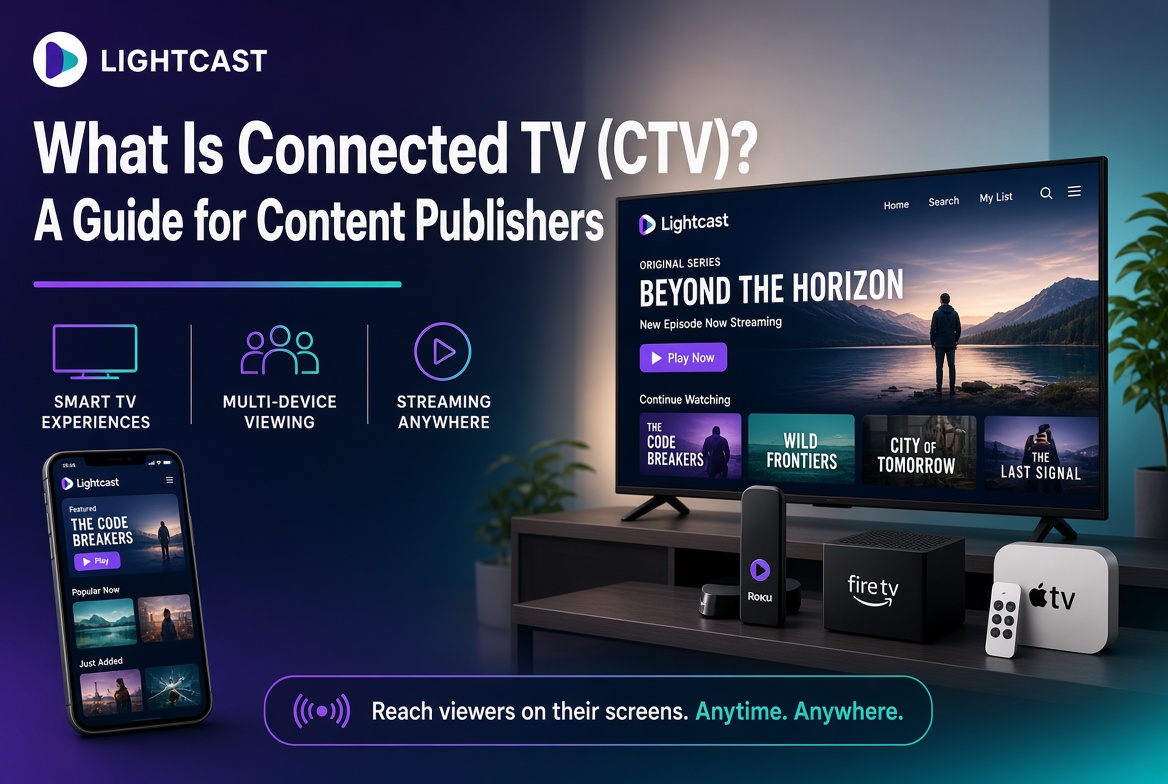
Connected TV, or CTV, is any television that connects to the internet to stream video, either a smart TV or a regular TV with a streaming device like a Roku, Fire TV, or Apple TV plugged into it. It is how most people now watch television: as of 2025, roughly 90 percent of US households use connected TV, and streaming has passed broadcast and cable combined for share of TV viewing. For a content publisher, CTV is where the audience is, and reaching it means having your own branded app on those devices. Lightcast publishes branded apps to Roku, Fire TV, Apple TV, iOS, Android, and web from one CMS across 70,000+ global CDN nodes, having launched 12,000+ apps for 5,000+ organizations.
The television in most living rooms is now an internet device. That shift changes who can reach the big screen, and a publisher no longer needs a broadcast deal to get there.
Connected TV refers to a television set that streams video over the internet. That includes smart TVs with streaming built in, and standard TVs paired with a streaming device or console. The defining trait is that the TV runs apps and pulls content from the internet rather than only receiving a broadcast or cable signal. When someone opens a streaming app on their living-room TV, they are using CTV, whether the app runs on the TV itself or on a device connected to it.
Several categories all fall under CTV. Smart TVs from the major manufacturers have streaming platforms built in. Streaming media players like Roku, Amazon Fire TV, and Apple TV turn any TV into a connected one. Game consoles stream video too. What they share is an app-based experience on the television screen, which is exactly where a publisher's branded app can live. For how those apps get built and certified, see our pillar on smart TV app development for content publishers.
The terms overlap but describe different things. OTT, over-the-top, is the delivery method: video sent over the open internet rather than through a cable or broadcast provider. CTV is the device category: the internet-connected televisions people watch that video on. Put simply, OTT is how the content travels, and CTV is one of the screens it arrives on, alongside phones, tablets, and the web. A publisher using an OTT platform reaches CTV devices as part of the same service. For the delivery side, see our explainer on what an OTT platform is.
Because the audience has moved to it, and the big screen carries weight. Viewers now spend more time streaming on their televisions than watching broadcast or cable, which means the living-room screen that once belonged to a handful of networks is open to any publisher with an app. For a university, a church, a sports organization, a broadcaster, or a media brand, being on CTV means showing up on the same screen and in the same way as the major streaming services, under your own brand. For the wider landscape, see our streaming services overview for content publishers.
Through branded apps on the CTV platforms. Rather than build and maintain a separate app for each device family, most publishers use an OTT platform that publishes their branded app to Roku, Fire TV, Apple TV, and the rest at once, and manages the content from a single place. That is what makes CTV practical: one platform, one content library, and a presence on every major connected television, plus mobile and web. For the on-demand experience that lives inside those apps, see our guide to the best on-demand video platforms.
Lightcast publishes your app to Roku, Fire TV, Apple TV, and the major connected TV devices, each under your own brand, so you appear on the living-room screen as your own service.
The same platform reaches CTV, iOS, Android, and web simultaneously across 70,000+ global CDN nodes, with live and on-demand managed together and events converting to on-demand automatically.
More than 12,000 branded apps have launched on Lightcast for 5,000+ organizations, so CTV reach is delivered, not theoretical.
Lightcast does not retain, monetize, or share client data, so the audience you build on the big screen stays yours. Explore the platform on our media cloud OVP and live streaming pages.
Connected TV is the internet-connected television, whether a smart TV or a TV with a streaming device, and it is now how most households watch. It is distinct from OTT, which is the delivery method, while CTV is the screen. For publishers, CTV matters because the audience and the big-screen prestige have moved there, and reaching it means having a branded app on every connected TV platform. Lightcast delivers exactly that from one CMS across 70,000+ global CDN nodes, for 5,000+ organizations and 12,000+ branded apps, and was named Fastest Deployment OTT Platform Provider 2026 by The Silicon Review. To learn more or schedule a demonstration, visit lightcast.com.