Platform
Solutions
Resources
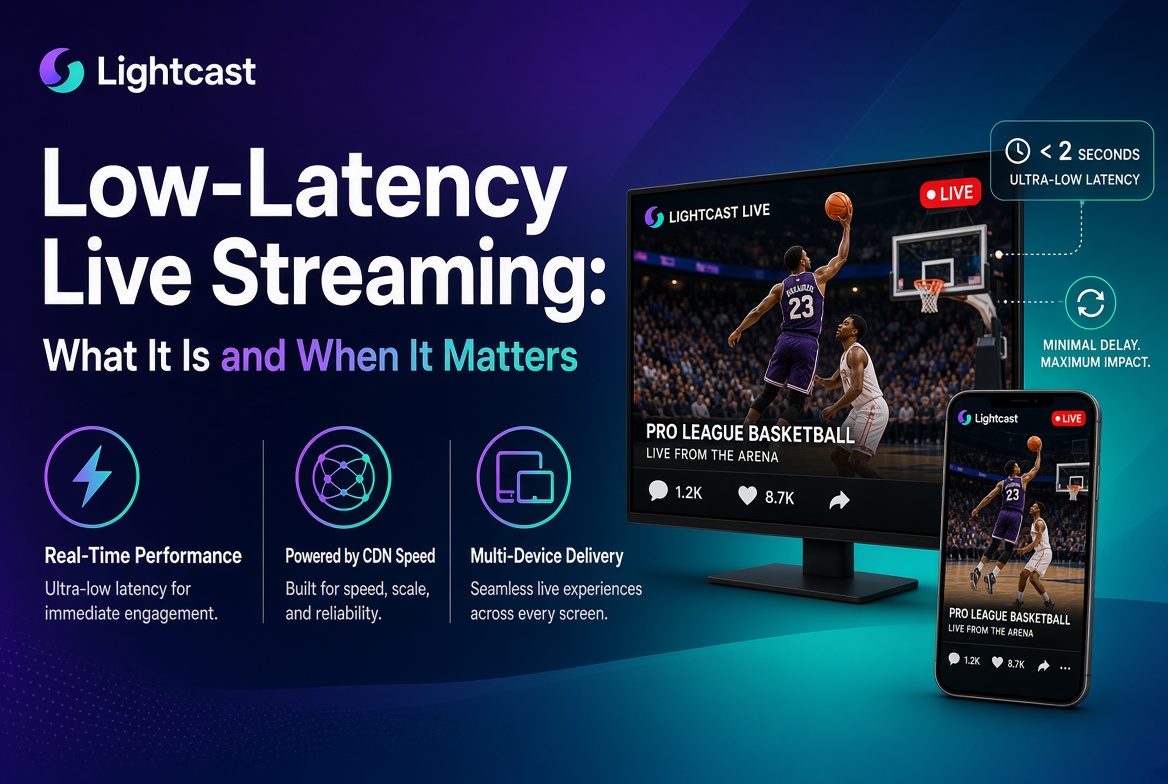
Low-latency live streaming is video delivered with only a short delay between the live moment and what the viewer sees, usually a few seconds or less, rather than the 20 to 45 seconds common with standard streaming. It matters whenever viewers react in real time, like live sports, auctions, worship with live participation, and interactive events, where a long delay breaks the experience. Latency is reduced by shortening the video segments, using low-latency protocols, and delivering through a fast content network. Lightcast streams live across 70,000+ global CDN nodes to Roku, Fire TV, Apple TV, iOS, Android, and web at once, with real-time content control and automatic live-to-VOD, as part of a platform serving 5,000+ organizations and 12,000+ branded apps.
There is always a gap between something happening live and a viewer seeing it on screen. Most of the time a few seconds does not matter. Sometimes it matters a lot, and that is when latency becomes the thing you have to manage.
Low-latency live streaming is live video that reaches viewers with minimal delay, close to real time. Latency is the time between a moment being captured by the camera and that moment appearing on the viewer's screen. Standard internet streaming often runs 20 to 45 seconds behind the live event, because of how video is packaged and delivered. Low-latency streaming brings that down to a few seconds, and ultra-low-latency approaches can get under a second. There is no single official threshold, but in practice people use "low latency" to mean under roughly ten seconds, and "ultra-low" to mean near real time. For how live delivery works end to end, see our guide on live video broadcasting.
Mostly because of how streaming video is cut into pieces. To deliver smoothly at scale, a live stream is broken into short segments, each a few seconds long, and the player usually waits to buffer two or three segments before it starts playing. That buffering is what makes playback stable, but it also builds in delay before the first frame ever appears. Add the time to encode the video, push it to the delivery network, and load it on the viewer's device, and the seconds stack up. Lowering latency means trimming each of those steps without making playback fragile. The encoder is where a lot of this starts, which we cover in our guide on live streaming encoders.
It helps to think in tiers rather than one number.
Standard latency, roughly 20 to 45 seconds. Typical for large-scale one-way broadcasts where no one is interacting with the stream in real time.
Low latency, under about 10 seconds. Common for premium live sports and news, close to the experience of watching broadcast television.
Reduced latency, around 2 to 5 seconds. Achieved with low-latency versions of the standard streaming formats, good for most interactive live events.
Ultra-low latency, under a second. Near real time, used for two-way interaction like live Q&A, betting, or auctions, and usually built on different technology than mass-scale streaming.
It matters any time the viewer is doing something in response to the live moment. A fan watching a game wants to react with everyone else, not hear the neighbors cheer a goal before it reaches their screen. An auction needs bids to land against the live lot, not a lot that closed fifteen seconds ago. A worship service taking live prayer requests, a fitness class with real-time coaching, a town hall taking questions, a sports book, all of these fall apart if the stream lags too far behind. For live sports specifically, see our guide on live sports streaming options. When the stream is purely one-way, like a recorded concert or a sermon watched later, latency barely registers.
Through a few levers that work together. Shorter video segments cut the buffering delay built into standard streaming. Low-latency versions of the common formats, often called low-latency HLS and low-latency DASH, are designed to push segments faster and bring delay down to a few seconds. For the lowest latency, different real-time technologies deliver video closer to a live call. A fast ingest protocol gets the feed from the camera to the platform quickly, and a broad content delivery network serves each viewer from a nearby node so the last mile stays short. That delivery footprint is what keeps low latency from turning into buffering, which we cover in our guide on what makes streaming reliable.
Yes, and it is worth being honest about them. Pushing latency down generally means smaller buffers, and smaller buffers leave less room to absorb a shaky connection, so very low latency can be more prone to stutter on weak networks. Ultra-low-latency technologies also scale differently than the formats built for mass audiences, so there can be a tension between reaching the most people and reaching them fastest. The right target is not the lowest possible number, it is the lowest latency your use case actually needs while keeping playback smooth for your audience. A one-way broadcast to a global audience and a two-way interactive event are different problems with different answers. For the broader platform picture, see our guide on real-time content control.
Each viewer is served from a node close to them, which keeps the last mile short and helps low-latency live streams stay smooth instead of buffering. Explore the platform on our live streaming and media cloud OVP pages.
Lightcast lets you manage and adjust live content across every platform at once, so what viewers see reflects the live moment rather than a stale state.
Your live stream publishes to Roku, Fire TV, Apple TV, iOS, Android, and web simultaneously, so a low-latency experience reaches your whole audience, not just one screen.
The moment a live event ends it converts to on-demand automatically, so the people who could not watch live still get the content, and you capture value from both.
Low-latency live streaming closes the gap between the live moment and the viewer, bringing a delay that can run 20 to 45 seconds on standard streaming down to a few seconds or less. It matters most when viewers react in real time, like sports, auctions, worship, and interactive events, and it is achieved by trimming segment and buffer delay, using low-latency protocols, and delivering through a broad content network. The goal is the right latency for your use case, not the lowest number at the cost of a smooth stream. Lightcast delivers live across 70,000+ global CDN nodes to every major device with real-time content control and automatic live-to-VOD, for 5,000+ organizations and 12,000+ branded apps, and was named Fastest Deployment OTT Platform Provider 2026 by The Silicon Review. To learn more or schedule a demonstration, visit lightcast.com.