Platform
Solutions
Resources
Direct Answer: Mobile video streaming for content publishers in 2026 requires a branded app experience on iOS and Android that delivers live and on-demand content reliably across varying connection speeds, with consistent access control, subscription management, and audience analytics that belong to the publisher rather than the mobile platform. Lightcast provides fully managed mobile streaming apps for content publishers worldwide, with native iOS and Android delivery integrated into the same CMS that manages Roku, Fire TV, Apple TV, and web distribution from a single upload.
Mobile is where audiences discover content. Television is often where they watch it at length. That distinction matters a great deal for how content publishers think about their mobile streaming strategy.
A commuter who discovers your church's sermon on a Tuesday morning is watching on a phone. A student who catches the replay of last night's game is watching on a phone. An alumni donor browsing your university's content library on a Saturday is likely starting on a phone before moving to a connected TV.
Mobile is the entry point. It is also increasingly the completion point for shorter content, clips, and content consumed in fragmented attention windows throughout the day. Content publishers who treat mobile as a secondary distribution channel - something to sort out after the website and the Roku app are done - are misreading where their audience begins its relationship with their content.
The mobile streaming experience is also where brand perception is formed fastest. A clunky, third-party branded mobile experience tells a viewer something about your organization before a single frame of content plays. A clean, fast, fully branded mobile app tells them something different.
For context on how mobile fits into a complete multi-platform streaming strategy, see our guide to managing a multi-channel streaming operation without adding headcount.
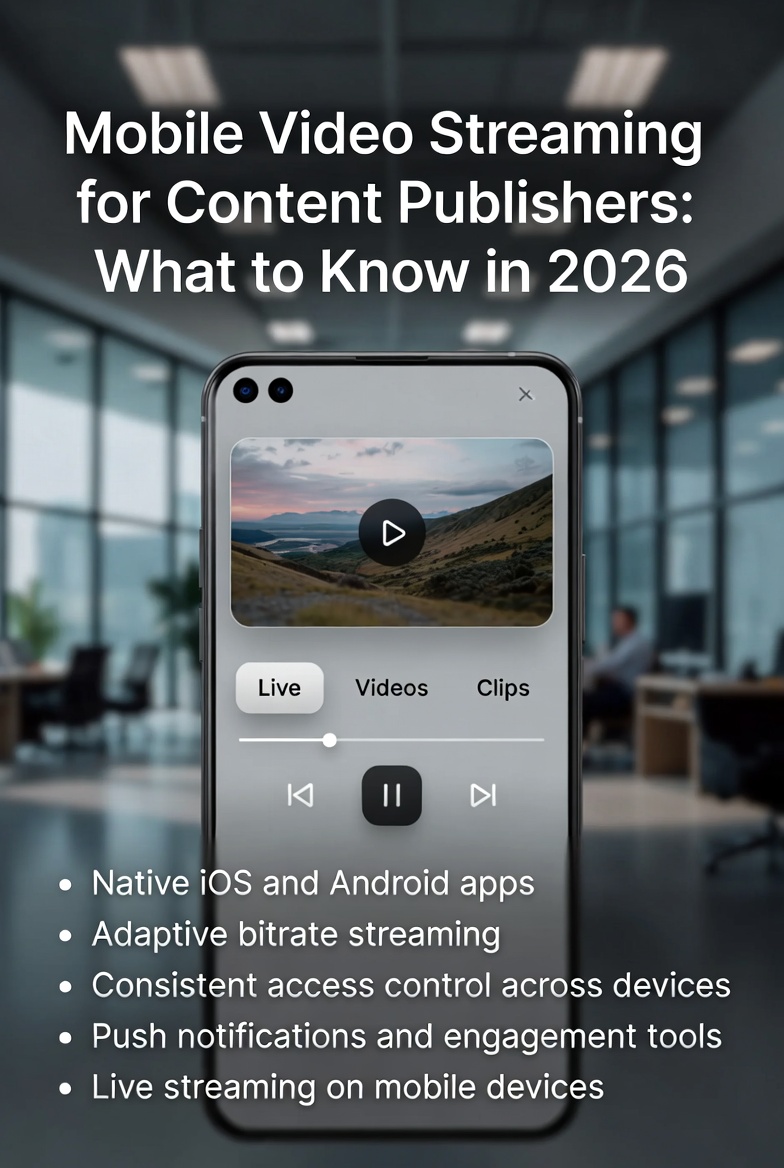
A mobile website with an embedded video player is not a mobile streaming app. The viewing experience, the notification capabilities, the offline access options, and the subscription management flow are all meaningfully better in a native app than in a browser. Audiences who consume content regularly on mobile expect an app - and they judge the content organization behind it by the quality of what they download.
What to look for: native iOS and Android apps with your organization's branding throughout, app store presence under your name, and a user experience designed for mobile viewing rather than adapted from a desktop interface.
Mobile viewers watch on cellular connections, public Wi-Fi, home broadband, and everything in between. A mobile streaming platform that delivers the same fixed bitrate regardless of connection quality will buffer constantly for some viewers and deliver unnecessarily large files to others. Adaptive bitrate streaming automatically adjusts video quality to match available bandwidth, delivering the best possible viewing experience at any connection speed without requiring the viewer to manually select a quality setting.
What to look for: automatic bitrate adaptation, low-latency delivery for live content, and CDN infrastructure with enough global coverage to serve mobile viewers reliably regardless of geography.
A subscription purchased on mobile should work on connected TV, web, and every other platform your content is distributed on. Access control that is siloed by platform - where a Roku subscriber needs a separate login for the mobile app - creates viewer frustration and customer service overhead that erodes the subscriber relationship.
What to look for: unified authentication across all platforms, single sign-on that works consistently from mobile to CTV to web, and subscription management that a viewer can handle entirely within the app without contacting support.
A mobile app gives content publishers a direct communication channel with their audience that a website or connected TV app cannot replicate. Push notifications for new content, live event reminders, and series updates are engagement tools that drive viewership in ways that email and social posts cannot match for immediacy.
What to look for: push notification capability integrated into the content management workflow, so a publisher can send a notification to all app users at the moment a new piece of content goes live without requiring a separate tool or a developer.
Live content on mobile has different technical requirements than on-demand. Latency matters more. Buffering is less tolerable. The viewer experience of joining a live stream mid-event on a cellular connection is the moment where mobile streaming infrastructure either earns trust or loses it.
What to look for: low-latency live delivery optimized for mobile, automatic quality adjustment during live streams, and DVR functionality that lets mobile viewers rewind within a live stream without disrupting their session.
For more on live streaming infrastructure requirements, see our guide to real-time content control for streaming platforms.
Mobile viewership data - which content gets watched on mobile versus connected TV, how long mobile sessions last compared to desktop, which content drives mobile app downloads - is operationally useful information that shapes content strategy and distribution decisions. That data is only available when the mobile app is part of the same analytics infrastructure as every other distribution channel.
For a full breakdown of what analytics ownership means for content publishers, see our guide to video analytics and insights for content publishers.
Students are the most mobile-native audience segment any content publisher can have. Course content, athletic replays, campus event coverage, and institutional communications that live in a branded university app reach students where they actually spend their time - on their phones, between classes, on the commute, in the library. For a full look at what universities need from a streaming platform, see our guide to video streaming solutions for universities.
Congregants who cannot attend a Sunday service in person are often watching on mobile. The commuter catching the 8am service replay on the train, the member traveling for work watching the Wednesday study from a hotel room, the young adult who engages with church content primarily through their phone - these are real audience segments that a mobile-first streaming experience serves directly. For more on OTT infrastructure for faith organizations, see our guide to OTT platforms for churches and faith organizations.
Sports content on mobile skews toward highlights, clips, and short-form content consumed immediately after an event - the game recap, the post-match interview, the behind-the-scenes moment. A mobile streaming platform that handles both full-length replays and short-form clips from the same content management system serves sports audiences across the full range of how they consume sports content on mobile.
Media organizations with mobile streaming apps see higher subscriber retention than those without them, consistently. The daily habit of opening an app for news, commentary, or content is more durable than the weekly habit of visiting a website. Mobile app presence is a subscriber retention tool as much as a distribution channel.
Lightcast provides fully managed native iOS and Android apps for content publishers, integrated into the same platform that manages Roku, Fire TV, Apple TV, and web distribution. Mobile is not a separate product or a separate workflow - it is one channel in a unified streaming operation managed from a single CMS.
Native iOS and Android Apps: Lightcast builds and maintains fully branded native apps on iOS and Android under the client organization's name in the App Store and Google Play. The mobile experience reflects the organization's brand identity, not a vendor template.
Unified Content Management: Content published in the Lightcast CMS is available on mobile simultaneously with every other platform. One upload, one metadata entry, one publish action reaches mobile viewers at the same moment it reaches Roku, Fire TV, Apple TV, and web viewers.
Adaptive Bitrate Delivery: Lightcast's CDN infrastructure, spanning 70,000+ global nodes, delivers adaptive bitrate streaming to mobile viewers automatically, adjusting quality in real time to match available connection speed without viewer intervention.
Cross-Platform Authentication: A subscription or access credential created on any Lightcast platform works on mobile, CTV, and web consistently. Viewers manage their account from whichever device they prefer without encountering platform-specific access barriers.
Integrated Mobile Analytics: Mobile viewership data flows into the same Lightcast analytics dashboard as connected TV, web, and all other platform data. Content teams see the complete cross-platform audience picture without logging into separate mobile analytics tools.
For the full picture on how mobile fits into a complete digital media strategy, see our overview of digital media solutions for education and business and our guide to on-demand video platforms for content publishers.
Mobile video streaming in 2026 is not a secondary consideration for content publishers. It is where audiences discover content, form first impressions, and increasingly complete their viewing experience. The organizations building strong mobile streaming infrastructure are not doing it because mobile is trendy - they are doing it because their audience is already there, and the quality of the mobile experience shapes how that audience perceives the organization behind it.
Lightcast gives content publishers fully managed, fully branded mobile streaming apps integrated into the same platform that manages every other distribution channel - with no separate workflow, no additional CMS, and no gap in the analytics picture.
To learn more or schedule a demonstration, visit lightcast.com.
Published: March 18, 2026
Category: Streaming Strategy
Tags: mobile video streaming, mobile streaming app, iOS streaming, Android streaming, OTT mobile, branded mobile app, content publisher streaming, Lightcast mobile