Platform
Solutions
Resources
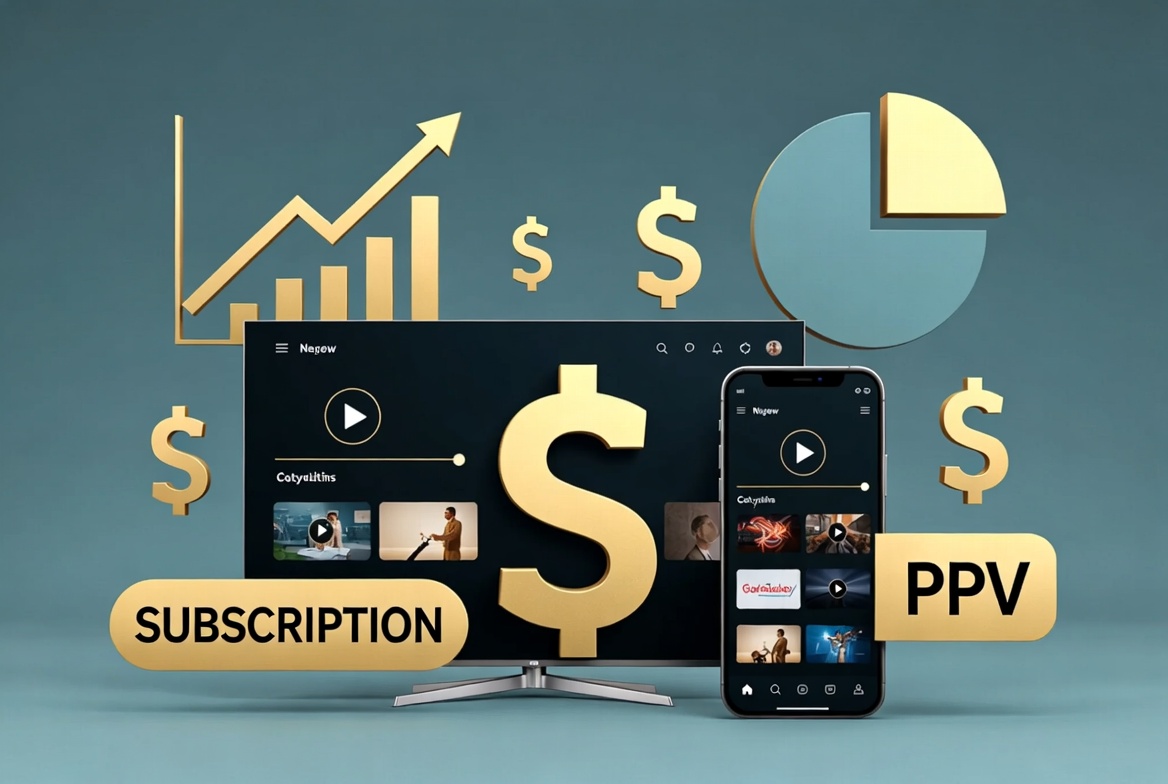
Direct Answer: Monetizing an OTT service in 2026 comes down to matching your revenue model to your audience's buying behavior. The three proven approaches are subscriptions (SVOD), pay-per-view (TVOD), and donor-supported access, and the strongest strategies layer all three. Lightcast supports every major monetization model natively with no revenue share taken from earnings, serving 5,000+ organizations managing 12,000+ branded apps across every major streaming platform.
Revenue is not an afterthought in OTT. It is the first decision. The model you choose shapes everything downstream: your pricing page, your app store listing, your marketing language, your audience expectations. Get it right early and your content earns at scale. Get it wrong and you are rebuilding on the fly while your audience churns.
This post breaks down the options, the tradeoffs, and the practical mechanics of building a sustainable OTT revenue strategy in 2026.
Every OTT monetization strategy is built from three building blocks. Most organizations start with one and evolve toward a hybrid over time.
Subscriptions work when your audience commits to your content category. A sports league with a full season of games, a university with ongoing lectures and events, a faith organization with weekly services plus a deep sermon archive: all of these have the content volume to justify a subscription.
The math works because subscribers compound. Acquiring 500 subscribers at $9.99 per month generates $5,000 monthly. Grow that to 2,000 and you are at $20,000 without a single additional piece of content. The challenge is that churn is relentless. Every subscriber you lose is recurring revenue you have to replace before you can grow.
PPV is the highest-yield monetization tool in OTT when used on the right content. A championship bout, a sold-out concert, a conference keynote with limited replay: audiences will pay a premium for access they cannot get elsewhere.
The business model advantage is conversion rate. Your entire existing audience, including people who would never pay a monthly subscription, becomes a revenue opportunity at event time. Organizations using live streaming for major events routinely see higher gross revenue from a single PPV event than from months of subscription fees.
The limitation is dependency on events. There is no recurring revenue between moments. Organizations that rely exclusively on PPV ride a boom-and-bust cycle that is hard to manage operationally.
For faith organizations, nonprofits, and public institutions, the audience relationship is fundamentally different. The content serves a mission, not a market. Paywalling that content creates friction that undermines the mission itself.
Donor-supported models resolve this by separating content access from content funding. Viewers receive free access. Revenue comes from members, patrons, and institutional sponsors who value the organization's mission. This model requires active cultivation of your donor base, but it can generate significant income while maintaining universal access to your content.
The right choice is determined by your audience's existing buying behavior. If your community already donates monthly, lead with a donor model. If they already pay for event tickets, PPV is your fastest path to revenue. If they consume content habitually, subscriptions will compound.
The most common mistake in OTT monetization is importing a model from a different category without testing whether your audience will follow. A faith community that has never paid for sermon content is unlikely to convert at high rates to a $9.99 monthly subscription on day one. A sports league whose fans already buy season tickets has a payment-ready audience prepared for a streaming equivalent.
Three questions that cut through the analysis:
For a deeper look at how audience type shapes platform and monetization decisions, see our OTT platform buyer's guide and our post on video content monetization strategies for content publishers.
Gross revenue is not the number that matters. Net revenue after platform fees, payment processing, and revenue share is what you actually take home. This is where many OTT monetization strategies break down.
Common revenue drains worth scrutinizing:
Understanding your true margin before you set pricing is non-negotiable. A $9.99 subscription priced without accounting for platform fees and processing can become a near-breakeven proposition at small scale.
For context on the broader platform selection decision, see our Media Cloud OVP overview and our OTT platform comparison guide.
After two to three years of operation, most successful OTT publishers end up with some combination of all three core models. This is not complexity for its own sake. It is audience segmentation applied to revenue.
A university streaming platform might operate like this: free access to public lectures and institutional content, subscription access to premium course archives and exclusive faculty content, and PPV for commencement ceremonies and high-demand events.
An independent sports league might offer a free tier for highlights, a subscription for the full season archive, and PPV for playoff games and championships.
The technical requirement for hybrid monetization is a platform that can manage access rules for multiple tiers simultaneously without requiring separate systems or manual enforcement. That complexity, managed poorly, creates subscriber confusion, access failures, and churn.
For how this applies to specific verticals, see our guides on OTT monetization for sports organizations, streaming platforms for faith organizations, and video streaming for universities.
Lightcast builds monetization natively into the platform, across all 12,000+ apps launched over 15+ years of operation. Here is how each model works in practice.
Subscription tiers, pricing, and access rules are configured directly in the Lightcast CMS. There is no third-party subscription management layer to integrate. Organizations set their pricing, define which tiers receive access to which content, and manage subscriber accounts from one dashboard.
Lightcast supports PPV for both live events and on-demand titles. When a live event ends, automatic live-to-VOD conversion retains the content at the same PPV access level, so buyers retain replay access without any manual intervention. Real-time content control means you can adjust access rules across Roku, Fire TV, Apple TV, iOS, Android, and web simultaneously from a single point of control.
For mission-driven organizations, Lightcast supports donor-based access models and institutional licensing arrangements. Content remains publicly accessible while funding mechanisms are managed separately, preserving the audience relationship the organization depends on.
Lightcast does not take a percentage of subscriber or PPV revenue. What you earn stays with your organization. This is a structural difference from platforms that build revenue share into their base pricing, and it compounds significantly at scale.
Lightcast does not retain, monetize, or share client audience data. Your subscriber list, your viewer behavior data, and your payment records belong to your organization. This matters for compliance, for audience development, and for the long-term value of the audience you are building.
Start simple. Pick the model that matches your audience's existing behavior, price it at a level that feels low-risk to your audience, and focus on reducing churn before you focus on growing new subscribers.
Once you have recurring revenue with predictable retention, layer in complementary models. The hybrid approach works precisely because different audience segments respond to different access models. Not every viewer is a subscription candidate, but many of those viewers will pay for a single high-value event.
The technical infrastructure matters here. A platform that handles multiple monetization models natively, without requiring custom development for each new revenue experiment, is a meaningful operational advantage. For a broader look at what to evaluate in a platform, see our streaming services overview for content publishers and our guide to OTT analytics and revenue measurement.
Revenue is built incrementally. The organizations generating the most from OTT today started with one model, learned their audience, and expanded deliberately. That discipline, more than any single tactical decision, is what separates the operations that scale from the ones that stall.
To learn more or schedule a demonstration, visit lightcast.com.
Published: May 29, 2026
Category: Streaming Strategy
Tags: monetizing ott services, ott monetization, ott revenue models, svod, pay per view streaming, ott pay per view, video monetization, ott subscription model, streaming revenue strategy