Platform
Solutions
Resources
Direct Answer: OTT analytics is the measurement of how audiences interact with streaming content, including what they watch, how long they stay, where they drop off, and what keeps them coming back. It turns raw viewing activity into decisions about content, monetization, and retention. Lightcast gives publishers full ownership of this data across Roku, Fire TV, Apple TV, iOS, Android, and web in one place, serving 5,000+ organizations, and unlike many platforms it does not retain, monetize, or share that audience data.
Most streaming platforms drown you in numbers and starve you of answers. A dashboard full of charts is not analytics. Analytics is knowing which number to act on.
This guide cuts to the metrics that actually change decisions, and explains why owning the underlying data matters more than the dashboard it sits in.
OTT analytics is the collection and interpretation of data about how viewers engage with over-the-top streaming content. OTT means content delivered directly over the internet to any device, bypassing traditional cable and broadcast.
Where traditional TV ratings estimate audiences from a sample, OTT analytics measures actual behavior from every viewer. You see precisely what each person watched, on which device, for how long, and what they did next. That precision is the entire advantage of running your own platform, and it is wasted if you cannot access or own the data behind it.
Plenty of metrics look impressive and tell you nothing. A handful genuinely drive decisions.
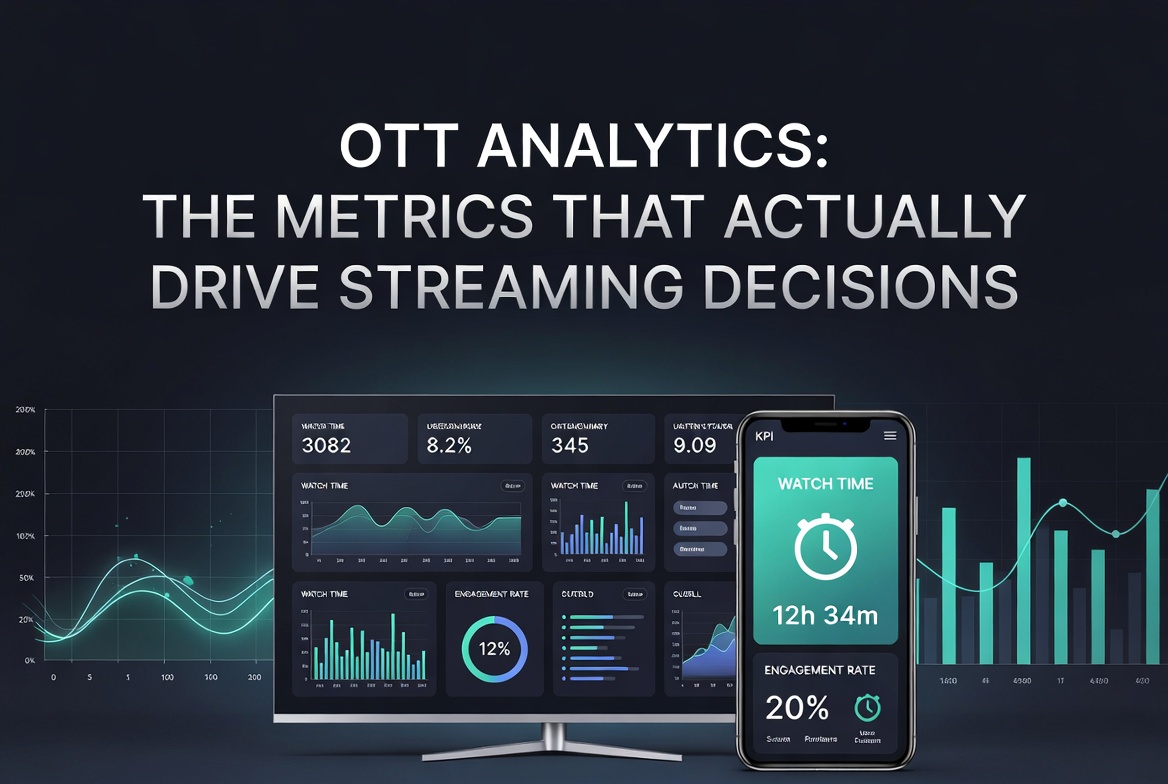
Watch time and completion rate tell you whether content holds attention. A video with high views but low completion is a title people click and abandon, which is a content problem disguised as a success. Engagement and return frequency reveal whether you are building a habit or just collecting one-time visits. Churn rate is the single most important number for any subscription business, because retaining an existing viewer costs a fraction of acquiring a new one. Device and platform breakdown shows where your audience actually watches, which should shape where you invest. Drop-off points within individual videos show the exact moment you lose people, which is often the most actionable insight of all.
The goal is not more metrics. It is the few that connect directly to a decision you can make this week.
The metrics to be skeptical of are the ones that only ever go up. Total views, total accounts created, hours streamed across all time. They feel like progress and rarely inform a decision, because they never tell you what to change. A useful metric has a clear action attached to a clear threshold. If completion rate on a series drops below a number you care about, you change the format. If churn climbs in a specific viewer segment, you look at what that segment stopped watching. Tie every metric you track to the decision it would trigger, and drop the ones that trigger nothing.
Analytics earns its keep when it changes what you do, not when it fills a report.
Content decisions improve when you can see which topics, formats, and lengths actually get finished, so you produce more of what works. Monetization decisions sharpen when you can connect viewing behavior to who subscribes, renews, or pays for an event, which is the foundation of choosing the right model. Retention improves when churn signals show up in viewing data weeks before a cancellation, giving you time to act. The publishers who win are not the ones with the most data. They are the ones who built a habit of checking a small set of numbers and changing something in response. For more on turning these signals into a monetization strategy, see our guide to video content monetization, and for the deeper analytics playbook, our guide to video analytics and audience insights.
Live and on-demand content produce very different data, and reading them the same way is a mistake.
Live streaming analytics center on concurrency, peak audience, and stream health in the moment, because a buffering problem during a live event cannot be fixed after the fact. On-demand analytics center on long-tail consumption: how a title performs over weeks and months as it keeps earning inside your library. The most useful platforms let you see both in one view, because a single live event that converts to on-demand content has a full lifecycle worth measuring end to end.
Reading them together also protects you from false conclusions. A live event with a huge concurrent peak can look like a runaway success, but if the on-demand replay gets almost no completion afterward, the real story is a one-time spike, not durable demand. Only the combined view tells you which it is.
Lightcast has spent more than 15 years building analytics that publishers can actually own and act on. Here is what that looks like in practice.
Your audience watches on Roku, Fire TV, Apple TV, iOS, Android, and web. Lightcast brings the data from all of them into one place through the Media Cloud OVP, so you are not stitching together six separate reports.
This is the part that sets Lightcast apart. Lightcast does not retain, monetize, or share your viewer data. On many platforms, the analytics you see are a window into data the platform actually owns. With Lightcast, the relationship and the data behind it are yours.
Because Lightcast manages live and on-demand from one CMS, you see a piece of content across its full lifecycle, from a live broadcast to its long tail as a library asset, without switching tools.
Analytics are only useful if you can act on them. Lightcast pairs real-time data with real-time content control across every platform simultaneously, so an insight can become a change in minutes rather than days.
OTT analytics is the measurement of how audiences actually engage with your streaming content, and its value lies in the handful of metrics that change decisions: completion rate, return frequency, churn, device mix, and in-video drop-off. The platforms worth choosing do two things well. They surface the metrics that matter instead of burying them, and they give you genuine ownership of the underlying data rather than a window into data they keep for themselves.
If you are evaluating platforms on more than analytics, our buyer's guide to choosing an OTT platform covers the full picture.
To learn more or schedule a demonstration, visit lightcast.com.
Published: June 5, 2026
Category: Streaming Analytics
Tags: ott analytics, streaming analytics, video analytics, ott metrics, viewer engagement, churn rate, watch time, audience data, ott kpis, streaming data