Platform
Solutions
Resources
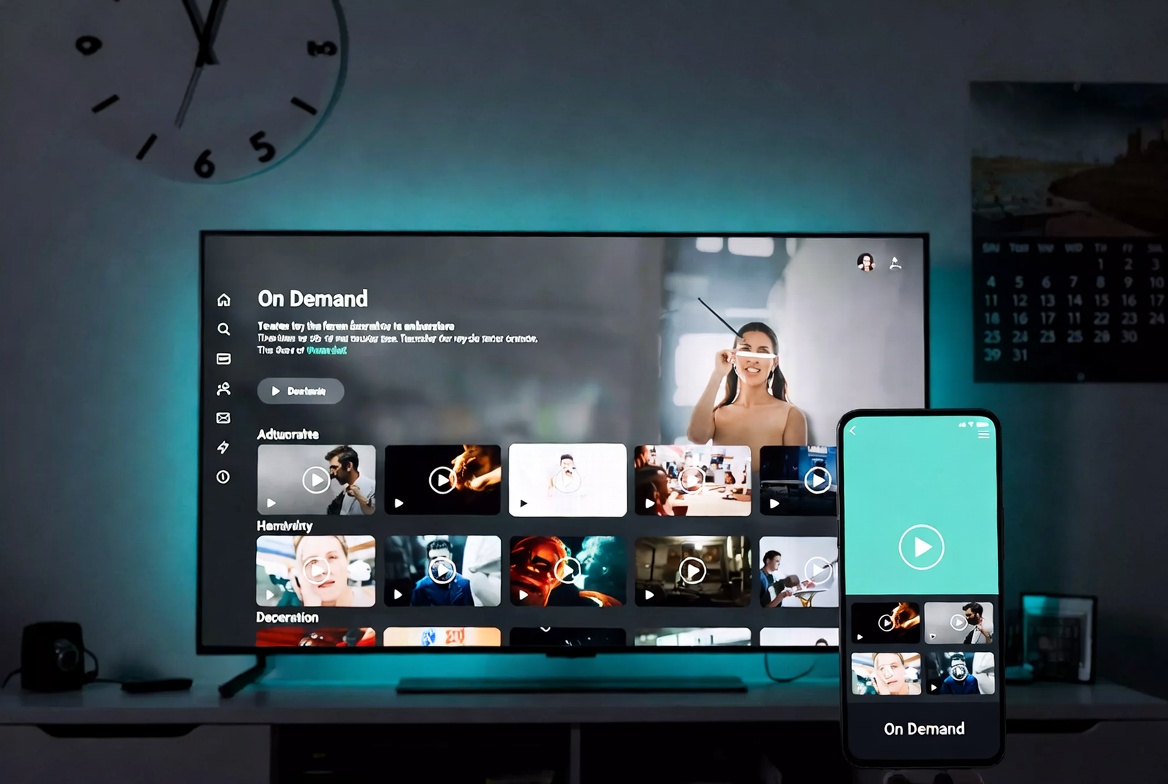
Direct Answer: VOD stands for video on demand, which means content viewers can watch whenever they choose rather than at a fixed broadcast time. A VOD library streams stored video to any connected device on the viewer's schedule, with full control to start, pause, rewind, and resume. Lightcast delivers VOD across Roku, Fire TV, Apple TV, iOS, Android, and web simultaneously, serving 5,000+ organizations and 12,000+ branded apps worldwide, with automatic live-to-VOD conversion built in.
The acronym shows up everywhere in streaming, and it is often used without explanation. If you have seen SVOD, TVOD, and AVOD thrown around and wondered what separates them, this post answers that clearly.
Understanding what VOD means is the first step toward deciding how to build and monetize a content library that your audience can actually use on their own terms.
VOD means video on demand. It describes any system where viewers select and watch video content at a time of their choosing, rather than tuning in to a scheduled broadcast.
The defining characteristic is viewer control. With traditional television, the broadcaster decides what airs and when. With video on demand, the viewer decides. They press play when they want, pause when life interrupts, and pick up exactly where they left off, often across different devices.
Every major streaming experience you already know is built on VOD. The same underlying model powers the content libraries that universities, faith organizations, sports leagues, broadcasters, and media brands run on their own branded platforms.
Video on demand works by storing encoded video files on servers and delivering them to a viewer's device the moment they request it. The process happens in a few clear steps.
First, source video is uploaded and encoded into multiple resolutions so it can play smoothly on a phone, a tablet, a laptop, or a connected TV. Next, those files are distributed across a content delivery network, which places copies of the video closer to viewers so playback starts quickly and holds up under load. Lightcast operates more than 70,000 global CDN nodes for exactly this reason: proximity to the viewer is what keeps buffering down.
When a viewer taps play, the platform serves the file from the nearest node and adapts the quality in real time to match their connection. The viewer gets instant, on-demand access, and the publisher gets a library that scales to a global audience without breaking.
For a deeper look at how publishers evaluate the platforms that run all of this, see our guide to the best on-demand video platforms.
VOD is not a single business model. The acronym describes the delivery method, and the prefix tells you how the content is paid for. There are four common types.
Viewers pay a recurring fee, monthly or annual, for unlimited access to a content library. This is the model most associated with mainstream streaming services, and it is the strongest choice when you have enough depth of content to justify an ongoing subscription.
Viewers pay per item, either renting or buying a single title or event. Pay-per-view falls under TVOD, which makes it the natural fit for high-value one-time content like a championship game, a concert, or a special broadcast.
Content is free to the viewer and funded by advertising. AVOD removes the price barrier entirely, which maximizes reach, and it works best when audience volume is large enough to generate meaningful ad revenue.
Many organizations do not fit a pure commercial model. Faith organizations, nonprofits, and educational institutions often fund access through donations or institutional licensing rather than consumer payments. The technology is identical. Only the funding mechanism changes.
The strongest strategies rarely rely on one model alone. For a full breakdown of how to combine these, read our guide to video content monetization for publishers.
VOD and live streaming are often discussed together, but they solve different problems.
Live streaming delivers content in real time as an event happens, which creates urgency and shared experience. Video on demand delivers stored content on the viewer's schedule, which maximizes convenience and long-term value from each piece of content.
The two are most powerful when connected. A live event captures the moment, and once it ends, that recording becomes a permanent library asset that keeps earning. Lightcast handles this with automatic live-to-VOD conversion, so a broadcast becomes on-demand content without manual reprocessing. For more on the live side, see our overview of live video broadcasting for content publishers and the Lightcast live streaming capabilities.
For any organization that owns content, video on demand is what turns a one-time production into a durable asset. A sermon, a lecture, a match, or a performance is watched live by a limited audience. As VOD, it reaches everyone who missed it, indefinitely.
It also shifts the economics. On-demand libraries compound. Every title you add increases the total value of your platform and the reasons for a viewer to subscribe, rent, or return. That is why platform selection matters so much, and why measuring what viewers actually watch is essential. Our guide to OTT analytics and audience insights covers how to read that data.
Lightcast has spent more than 15 years building the infrastructure that content publishers use to run video on demand at scale. Here is what that looks like in practice.
Lightcast delivers your VOD content to Roku, Fire TV, Apple TV, iOS, Android, and web simultaneously from a single content management system. You manage one library through the Media Cloud OVP, and your audience reaches it on whatever device they own.
Subscriptions, pay-per-view, donor-supported access, and institutional licensing are all supported natively. You choose the model, and Lightcast does not take a cut of your earnings.
Lightcast does not retain, monetize, or share your viewer data. The relationship with your audience stays yours, which matters more every year as data ownership becomes a competitive issue.
Live broadcasts become on-demand content automatically, so every event you stream adds to your permanent library without extra production work.
Lightcast was named Fastest Deployment OTT Platform Provider 2026 by The Silicon Review. For publishers who need a working VOD platform in weeks rather than quarters, that speed is the difference between launching this season and missing it.
VOD means video on demand: content viewers watch whenever they choose, on any device, with full playback control. It comes in four common types, SVOD, TVOD, AVOD, and donor or license-supported access, and it works by storing encoded video and delivering it through a content delivery network the instant a viewer presses play. For content publishers, VOD is what converts a single production into a lasting, monetizable asset.
If you are evaluating how to build or grow a video on demand library, our streaming services overview for content publishers is the best place to start.
To learn more or schedule a demonstration, visit lightcast.com.
Published: June 1, 2026
Category: Streaming Basics
Tags: vod meaning, what is vod, video on demand meaning, vod definition, what is video on demand, video on demand, svod, tvod, avod, on demand video platform