Platform
Solutions
Resources
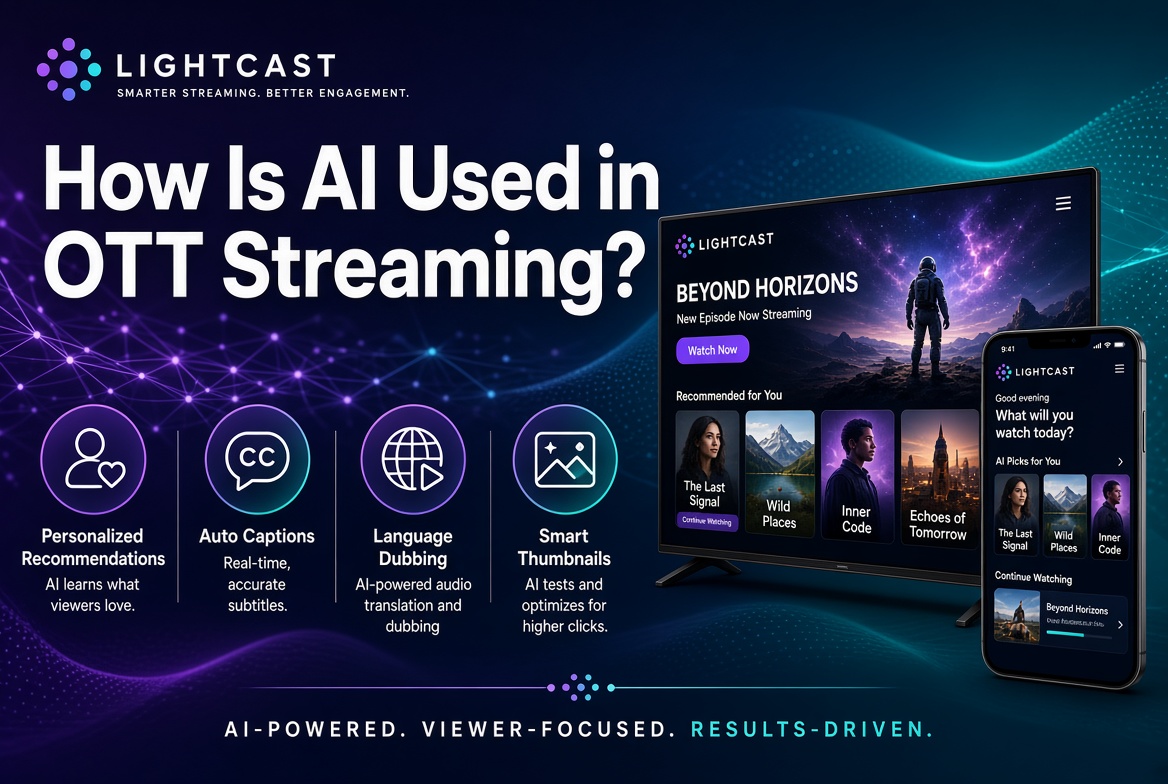
AI is used in OTT streaming to help viewers find content, to automate the work of preparing and managing video, and to make advertising and analytics smarter. The most visible use is content discovery: AI recommendation systems decide much of what viewers watch, with Netflix reporting that about 80 percent of what its members watch comes from its recommendations. Behind the scenes, AI also generates captions and subtitles, dubs content into other languages, creates thumbnails, and tags metadata, turning hours of manual work into minutes. The catch is that AI is only as good as the data behind it, which is why owning your first-party viewer data matters. Lightcast applies AI across the content workflow and gives publishers full ownership of that data, as part of a platform serving 5,000+ organizations and 12,000+ branded apps across 70,000+ global CDN nodes.
AI in streaming is not one feature. It is a layer running through discovery, operations, advertising, and analytics. The services that use it well make the experience feel effortless, and the work behind it disappear.
In four main places. It powers content discovery, deciding what to surface to each viewer. It automates content operations, from captioning to metadata. It sharpens advertising, matching ads to audiences. And it strengthens analytics, turning raw viewing data into predictions about churn and engagement. Each one removes friction or adds precision, and together they explain why AI has moved from a nice-to-have to a core part of how modern streaming runs. For the analytics side, see our guide to OTT analytics.
By learning what each viewer wants and putting it in front of them. Recommendation systems analyze viewing behavior to predict what someone will watch next, then personalize the home screen around it. This matters more than it sounds: when Netflix reports that roughly 80 percent of its viewing comes from recommendations, it means discovery, not the catalog itself, is doing most of the work of keeping people engaged. For a publisher, good discovery turns a library into something viewers actually explore, rather than a list they scroll past. For how that library is built, see our guide to the best on-demand video platforms.
By automating the slow, manual parts of publishing video. AI now generates captions and subtitles automatically, which also supports accessibility and reaches viewers who watch with sound off. It dubs or subtitles content into other languages, opening an audience a single-language library could never reach. It creates thumbnails and tags metadata so content is searchable and presentable without a person doing it by hand. Work that used to take hours per video now happens in minutes, which is the difference between a library that stays current and one that falls behind. For how this fits a broader plan, see our pillar on digital media strategy for content publishers.
By making ads more relevant and monetization more precise. AI matches ads to the right audience and moment, which tends to lift engagement over untargeted placements, and it helps decide when and how often to show ads without wearing viewers out. On the subscription side, the same intelligence that predicts what someone will watch also predicts who is likely to cancel, so retention efforts can focus where they count. For the revenue picture, see our pillar on video content monetization for content publishers.
Because AI runs on data, and the quality of the data sets the ceiling on the results. Recommendations, churn prediction, and personalization all depend on a complete picture of how your audience behaves. When that data sits inside a third party's platform, your AI is working with a partial view, and the insights, like the audience, are not fully yours. Full first-party data ownership means the intelligence is built on the whole picture and stays with your organization. It is the quiet foundation under every other use of AI in streaming.
Lightcast applies AI to the slow parts of publishing, auto-generated captions and subtitles, AI dubbing for localization, AI thumbnail generation, and automated metadata, so content gets to viewers faster and more accessibly.
Lightcast does not retain, monetize, or share client data, so the first-party viewer data that AI depends on stays with your organization and works for you, not a third party.
AI-prepared content publishes to Roku, Fire TV, Apple TV, iOS, Android, and web simultaneously across 70,000+ global CDN nodes, with live and on-demand managed together. Explore the platform on our media cloud OVP and live streaming pages.
AI runs through OTT streaming in four places: content discovery and personalization, which drives most of what viewers actually watch; content operations like captioning, dubbing, thumbnails, and metadata; advertising and monetization; and analytics. The through line is data, since AI is only as good as the first-party data behind it, which is why ownership matters. Lightcast applies AI across the content workflow and keeps that data with the publisher, for 5,000+ organizations and 12,000+ branded apps, and was named Fastest Deployment OTT Platform Provider 2026 by The Silicon Review. To learn more or schedule a demonstration, visit lightcast.com.