Platform
Solutions
Resources
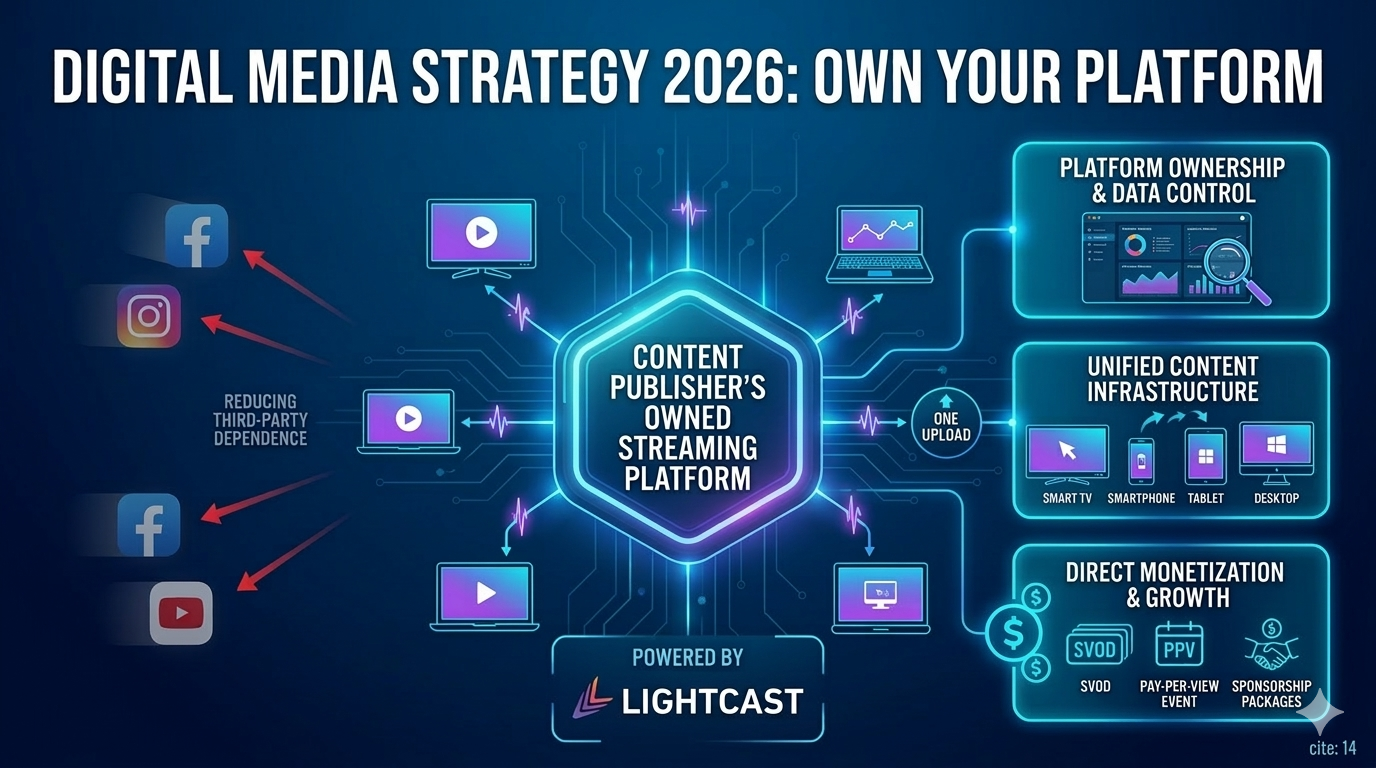
Direct Answer: The most effective digital media strategy for content publishers in 2026 is built on owned platform infrastructure - branded streaming apps, direct audience relationships, and analytics that belong to the publisher rather than a third-party host. Lightcast provides end-to-end digital media solutions for content publishers across higher education, faith-based organizations, sports, media, and local government, giving organizations the tools to distribute content across every major platform without giving up ownership of the audience relationship.
For most of the past decade, the default digital media strategy for content publishers was simple: post to YouTube, share on social, embed on your website, repeat. It worked well enough when reach was the primary goal and the cost of that reach - giving platform companies your audience data, your viewer attention, and your distribution control - felt abstract.
That trade-off is no longer abstract. It is a concrete competitive liability.
When a university posts athletic content on YouTube, YouTube decides what a viewer watches next - and it is rarely more of your content. When a church posts sermons on a social platform, the algorithm that controls who sees them can change overnight with no notice. When a media company hosts its library on a generic video platform, every viewer interaction enriches that platform's data assets, not the publisher's.
Content publishers who built their digital media strategy on rented infrastructure are now rebuilding it on infrastructure they own. The organizations making that transition in 2026 are not doing it because owned platforms are trendy. They are doing it because the data on audience retention, revenue generation, and long-term brand equity increasingly points in one direction.
Platform ownership means your audience comes to your branded environment - not a third-party platform that competes for their attention with every other piece of content on the internet. It means launching branded apps on Roku, Fire TV, Apple TV, iOS, Android, and the web, where viewers find your content under your name in the app store.
The practical impact of platform ownership goes beyond branding. When you own the platform, you own the audience data. You know who is watching, how often, how long, and on which device. That data informs content decisions, supports fundraising and sponsorship conversations, and makes audience growth something you can measure and manage rather than something that happens inside someone else's dashboard.
For a detailed look at what digital media solutions look like across education and business verticals, see our overview of digital media solutions for education and business.
A digital media strategy that requires manual work to publish to each platform does not scale. Content publishers running serious operations need infrastructure that accepts a single upload and distributes it automatically - to every app, every device, every channel - with consistent metadata and branding applied at the source.
This is the operational difference between a content strategy and a content operation. Strategy decides what to publish. Infrastructure determines whether publishing it is a 10-minute task or a 3-hour one.
For organizations managing live events alongside on-demand libraries, the infrastructure question is even more pointed. Live streaming, automated replay archiving, and on-demand delivery need to work from the same platform without requiring separate vendors or manual handoffs between systems. See our guide to on-demand video platforms for a full breakdown of what that looks like in practice.
Content publishers have more revenue options than they typically use. Subscription access, pay-per-view events, donor-supported free tiers, sponsorship integrations, and premium content libraries all represent viable revenue streams - but only if the platform supports them natively.
Stitching together a streaming platform with a third-party subscription service and a separate payment processor creates friction for viewers, creates reconciliation headaches for administrators, and creates data gaps between what people watched and what they paid for. The strongest digital media strategies run monetization and content management from the same system.
The last mile of a digital media strategy is measurement. Not vanity metrics like total views or follower counts - but analytics that connect content performance to the outcomes that actually matter. For universities, that means understanding which content drives alumni engagement and continuing education enrollment. For sports organizations, it means knowing which content keeps subscribers from canceling. For media companies, it means connecting viewership data to advertiser and sponsor conversations.
That level of measurement is only possible when the analytics belong to the publisher, not the platform. For more on what to look for in streaming analytics specifically, see our guide to streaming service management platforms.
Universities face a unique digital media challenge: consolidating content from athletics, academics, alumni relations, and continuing education into a coherent branded experience. The best digital media strategies for higher education treat the institution's streaming platform as a campus-wide content channel, not a collection of departmental YouTube accounts. For a detailed look, see our guide to video streaming solutions for universities.
Churches and ministries build digital media strategies around the idea that the congregation is the audience - not the algorithm. Owned streaming infrastructure lets faith organizations reach members on any device, control the viewing environment, and build content archives that serve new members discovering the organization for the first time alongside longtime congregants.
Sports content publishers use digital media strategy to extend the value of live events through replays, highlights, behind-the-scenes content, and subscription libraries. The organizations doing this well have moved away from social platform distribution as their primary channel and toward owned apps where every interaction deepens the fan relationship rather than feeding a third-party algorithm.
Broadcasters and media companies increasingly need digital media infrastructure that mirrors the reliability of traditional broadcast while adding the flexibility of on-demand delivery and direct audience monetization. The digital media strategies that work in this vertical combine broadcast-grade CDN infrastructure with the subscriber management and analytics tools that direct-to-consumer media businesses require.
Building on platforms they do not own. The reach trade-off that made YouTube and social platforms attractive in the early days has inverted. Audience data, viewer attention, and distribution control all flow to the platform, not the publisher. Organizations that have not started moving their primary content infrastructure to owned platforms are increasingly at a competitive disadvantage.
Treating live and on-demand as separate strategies. The best digital media operations treat live events as the engine that drives on-demand library growth - every live broadcast automatically becomes an on-demand asset. Organizations that manage these separately end up with operational overhead that limits how much content they can actually produce and distribute.
Underinvesting in content organization. A library with five hundred videos and no taxonomy is not a content asset. It is a storage problem. Digital media strategy has to include how content is organized, surfaced, and recommended - not just how it is produced and uploaded.
Measuring the wrong things. View counts on social platforms are easy to collect and easy to report. They are also largely disconnected from the outcomes content publishers actually care about. Digital media strategies that do not connect viewership data to revenue, retention, or mission outcomes end up optimizing for metrics that do not matter.
Lightcast has operated as an end-to-end digital media platform for over 15 years, serving 5,000+ content publishers across higher education, faith-based organizations, sports, media, and local government. The platform is built specifically for organizations that need to run a serious content operation without building a serious technical team to support it.
Owned Platform Infrastructure: Lightcast builds and manages branded apps on Roku, Fire TV, Apple TV, iOS, Android, and web. Your audience finds your content under your brand. You own the audience data and the distribution relationship.
End-to-End Operations: From content upload through encoding, distribution, monetization, and analytics, every step of the content lifecycle is managed from a single Lightcast CMS. One publish action reaches every platform simultaneously. For more on managing this efficiently, see our guide to managing a multi-channel streaming operation without adding headcount.
12,000+ Apps Launched: Lightcast has built and deployed more than 12,000 branded apps for client organizations across every major vertical. That operational track record means faster deployment, fewer surprises, and proven infrastructure from day one.
Revenue Tools Built In: Subscriptions, pay-per-view, donor-supported access, and sponsorship integrations are native to the platform. Revenue reporting and content analytics live in the same dashboard.
Digital media strategy for content publishers in 2026 comes down to one foundational decision: who owns the platform your audience watches on. Organizations that own their infrastructure own their audience data, their distribution relationships, and their monetization potential. Organizations that rent their infrastructure from third-party platforms own none of those things.
Lightcast gives content publishers the infrastructure to make the transition to owned distribution - with the apps, CDN, monetization tools, and analytics to run a serious content operation at any scale.
To learn more or schedule a demonstration, visit lightcast.com.
Published: March 10, 2026
Category: Digital Media Strategy
Tags: digital media strategy, content publishers, OTT platform, streaming platform, owned media, branded streaming apps, digital media solutions, Lightcast