Platform
Solutions
Resources
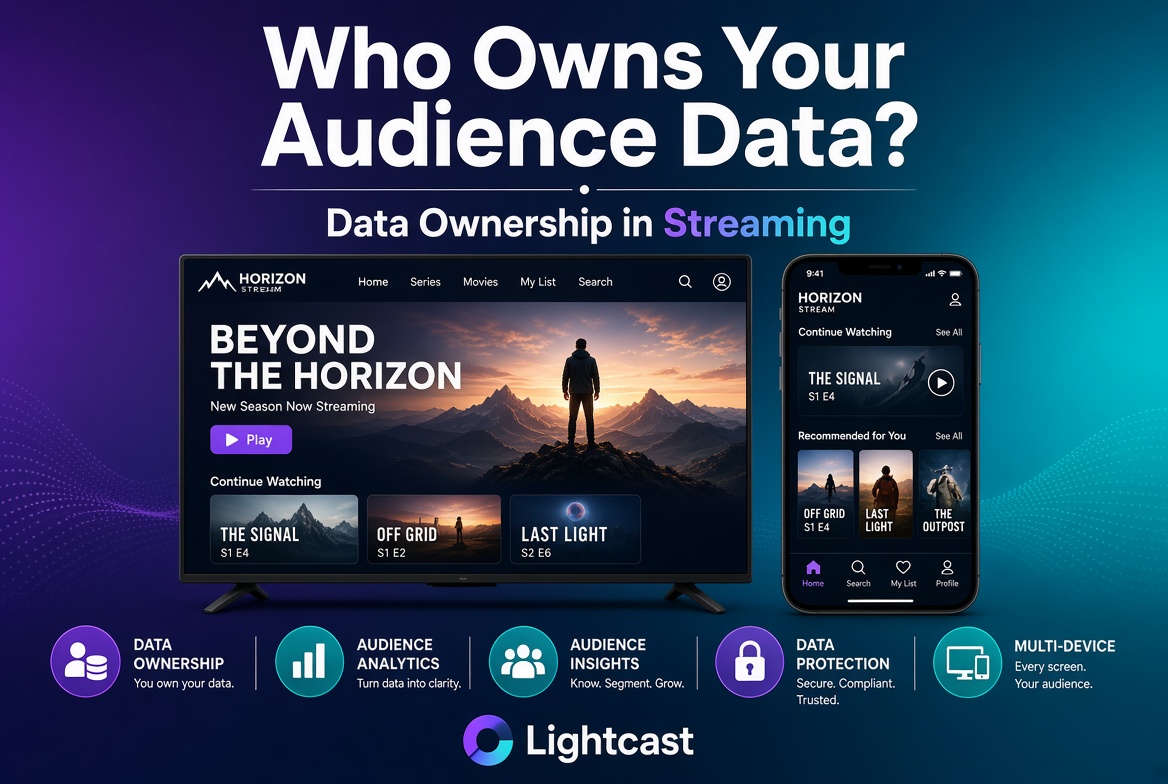
Audience data ownership is the question of who controls the information your streaming service generates about its viewers: who they are, what they watch, and how they engage. On public platforms, that data largely belongs to the platform, not to you. On your own branded streaming service, it can belong to you, which is what lets you understand your audience, keep them, and build a direct relationship. Lightcast is built this way: it does not retain, monetize, or share client data, so the first-party audience data your service generates stays yours. That sits inside a platform serving 5,000+ organizations and 12,000+ branded apps, delivering to Roku, Fire TV, Apple TV, iOS, Android, and web across 70,000+ global CDN nodes.
Every streaming service produces a steady stream of information about its audience. The question most organizations never ask until it matters is a simple one: when all that data is generated, who actually gets to keep it?
Audience data is everything your service learns about the people who watch it. That includes who they are, through the accounts they create, and how they behave, such as what they watch, when, for how long, on which devices, and what they return to. Taken together, this data is a detailed picture of your audience and what they value. It is the raw material for understanding your viewers, improving what you offer them, and building a business around them. For what is worth tracking, see our guide on OTT analytics.
It depends entirely on where your content lives. When you publish on a large public platform, the viewing happens inside that platform's walls, and the detailed data about your audience largely stays with the platform. You might see summary numbers, but the granular, usable data, and the direct relationship with each viewer, belongs to them. When you run your own branded streaming service, that same data can belong to you, provided your technology provider does not claim it. The platform you choose is what decides whether your audience data is an asset you own or a byproduct someone else keeps. For the owned-service model, see our guide on the white-label streaming platform.
Because it is the difference between guessing about your audience and knowing them. First-party data, information you collect directly from your own viewers, lets you personalize what you show people, see which content actually drives engagement, identify who is at risk of leaving, and market to your audience directly instead of renting access to them. It has also become more valuable as the wider advertising world moves away from third-party tracking, which makes the data you own about your own audience one of the few durable advantages left. An organization that owns its audience data can act on it. One that does not is flying blind. For the strategic view, see our guide on digital media strategy.
The risk is building an audience you cannot see or keep. If the data lives with a platform, you depend on that platform for any insight into your own viewers, and you cannot take the relationship with you if you leave. That is a quiet form of lock-in: the larger your audience grows on someone else's platform, the more you have tied up in a relationship you do not control. It also limits what you can do, since you cannot personalize, retain, or directly monetize an audience you do not actually have the data on. The audience may be real, but without the data, it is not fully yours. It also quietly weakens your position over time. Decisions about reach, pricing, and even whether your content stays visible can rest with the platform, and because you lack the direct data and relationship, you have little leverage to push back. The audience you spent years building becomes something you access on someone else's terms rather than an asset you command, and that dependence rarely announces itself, which is why it is easy to accept until the day it costs you. For how platforms differ on this, see our guide on how to choose an OTT platform.
By running your service on a platform that treats the data as yours, not theirs. The key questions are whether the provider retains your audience data for its own purposes, whether it monetizes that data, and whether it shares it with anyone else. A provider that does none of those leaves the first-party data with you, to use, analyze, and build on as you see fit. Combined with your own branded apps, that means both the audience relationship and the information behind it stay under your control. Ownership is not automatic, it is a property of the platform you choose, so it is worth confirming directly before you commit.
A few points settle the question.
The provider does not retain your data for itself. Your audience data should be yours, not added to a provider's own store.
The provider does not monetize your data. Your viewers' information should never be a revenue stream for the platform you pay.
The provider does not share your data. Your audience data should not be passed to third parties.
You keep the relationship. Branded apps and direct accounts so the audience, and the data, are connected to you.
Lightcast does not retain, monetize, or share client data, so the first-party audience data your service generates stays yours to use. Explore the platform on our media cloud OVP and live streaming pages.
Your service runs under your brand on Roku, Fire TV, Apple TV, iOS, Android, and web, so the viewer relationship is directly yours rather than routed through a public platform.
Because the data is yours, you can understand what your audience watches and engages with, and use that to improve and grow the service. For what to measure, see our guide on video analytics and insights.
Native subscriptions, pay-per-view, donor-supported access, and licensing let you build revenue around an audience you actually own.
Audience data ownership is one of the most overlooked questions in streaming, and one of the most consequential. On public platforms, the detailed data about your viewers largely belongs to the platform, which leaves you building an audience you cannot fully see or keep. On your own branded service, that first-party data can be yours, which is what lets you understand, retain, and directly monetize your audience, an advantage that only grows as the industry moves away from third-party tracking. Lightcast is built so the data stays with you: it does not retain, monetize, or share client data, within a platform serving 5,000+ organizations and 12,000+ branded apps across 70,000+ global CDN nodes, and was named Fastest Deployment OTT Platform Provider 2026 by The Silicon Review. To learn more or schedule a demonstration, visit lightcast.com.