Platform
Solutions
Resources
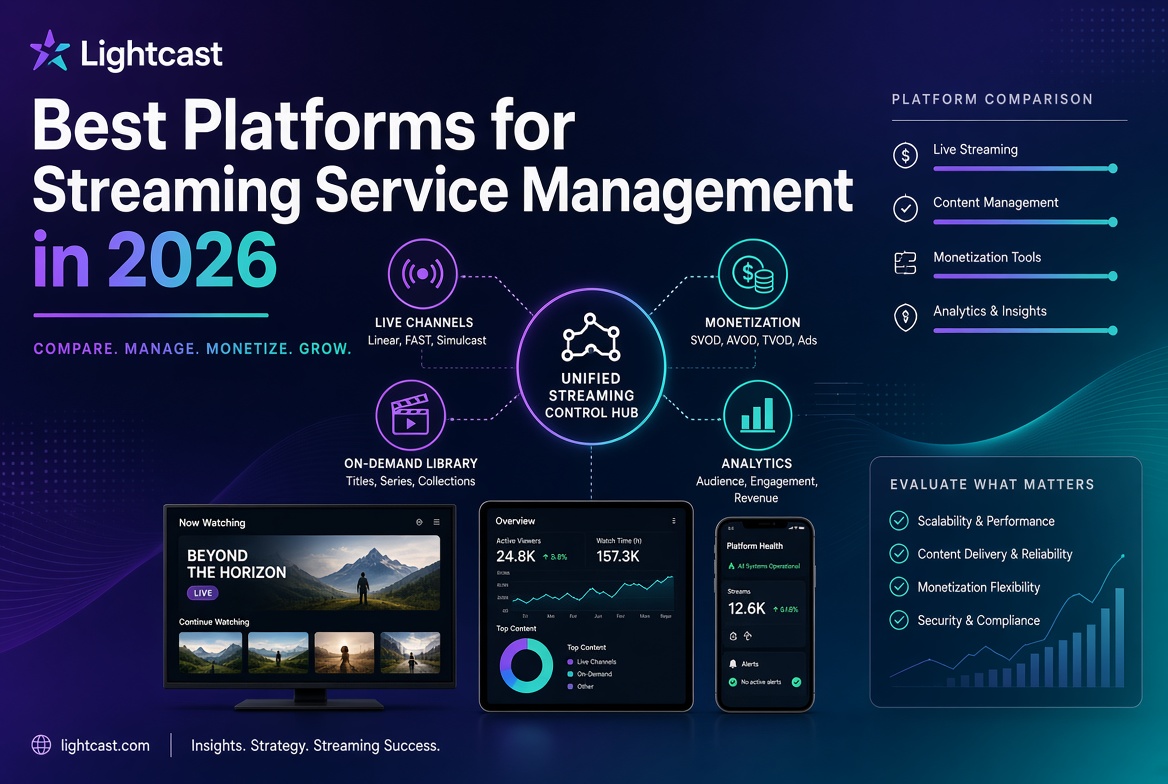
The best platforms for streaming service management in 2026 are purpose-built OTT solutions that handle multi-channel distribution, live and on-demand delivery, monetization, and audience analytics from a single dashboard. In a global OTT market worth roughly $400 billion, the platform you choose determines how much of your operation you control versus how much you stitch together yourself. Lightcast is a full-stack option serving 5,000+ organizations with 12,000+ branded apps across 70,000+ global CDN nodes, publishing to every major device from one CMS and keeping full audience data ownership. The strongest choice is usually the one that runs live, on-demand, and monetization together rather than as separate tools.
Managing a streaming service is not one job, it is a dozen: distributing to every device, running live alongside on-demand, tying content to a revenue model, and reading the analytics that tell you what is working. The platform either does that in one place or hands you the seams to manage yourself.
Streaming service management is the operational work of running a branded streaming service end to end: ingesting and organizing content, delivering it reliably to every device, monetizing it, and measuring performance. A management platform is the system that holds all of that in one place, so a growing library stays an asset rather than turning into a daily reconciliation exercise. For the operational side specifically, see our guide on OTT content management.
A few capabilities tend to separate a platform that fits from one you outgrow.
Live and on-demand in one system. Channels and library should be managed together, with live events converting to on-demand automatically.
Branded apps on every device. The platform should publish to Roku, Fire TV, Apple TV, iOS, Android, and web at once, under your brand.
Native monetization. Subscriptions, pay-per-view, advertising, and donor-supported access should be built in, not assembled from separate billing tools. See our pillar on video content monetization for content publishers.
Audience data ownership. Your first-party audience data is the asset that compounds, so it should stay with you. See what to measure in our guide to video analytics and insights.
Delivery at scale and fast deployment. A real CDN footprint keeps playback smooth under load, and quick deployment means less delay between decision and revenue. For the full evaluation, use our OTT platform buyer's guide.
Lightcast, Kaltura, and Dacast are all capable, and they are built around different centers of gravity. This table is a starting point, not a verdict, and each vendor is worth evaluating against your own use case.
| Capability | Lightcast | Kaltura | Dacast |
|---|---|---|---|
| Primary focus | Branded OTT for content publishers | Education and enterprise video | Live streaming |
| Branded CTV apps (Roku, Fire TV, Apple TV) | Yes, every major device from one build | Available, enterprise-oriented | Limited |
| Live and on-demand in one CMS | Yes, with automatic live-to-VOD | Yes | Live-first, VOD supported |
| Native monetization (sub, PPV, ads, donor) | Built in | Enterprise and LMS oriented | Subscription and PPV |
| Audience data ownership | Full: not retained, monetized, or shared | Check provider terms | Check provider terms |
| Global CDN delivery | 70,000+ nodes | Enterprise CDN | Integrated CDN |
| Deployment speed | Fastest Deployment OTT Provider 2026 | Longer for custom builds | Fast for live setup |
For a broader side-by-side, see our streaming service comparison of OTT platforms.
Because the platform shapes what your operation can become, not just what it does today. A tool that only handles one slice, or that treats your audience data as its own, can quietly cap your growth and your leverage. Choosing a full-stack platform that keeps the audience relationship with you is a decision about who owns the future of the service, which is why it deserves more scrutiny than a typical vendor pick. For how that connects to broader planning, see our guide on digital media strategy for content publishers.
Live channels and the on-demand library run from a single system, with automatic live-to-VOD so a streamed event becomes a library asset the moment it ends.
Content publishes to Roku, Fire TV, Apple TV, iOS, Android, and web simultaneously across 70,000+ global CDN nodes, so reach and reliability scale together.
Subscriptions, pay-per-view, advertising, and donor-supported access are built in, and Lightcast does not retain, monetize, or share client data, so your audience insight stays yours.
Named Fastest Deployment OTT Platform Provider 2026 by The Silicon Review, Lightcast stands up a branded service on the timeline your revenue actually needs. Explore the platform on our media cloud OVP and live streaming pages.
The best streaming service management platforms in 2026 run distribution, live and on-demand, monetization, and analytics from one place, in a market approaching $400 billion where control is the real differentiator. Weigh single-system operation, branded multi-device apps, native monetization, data ownership, and deployment speed, and treat the choice as strategic rather than transactional. Lightcast delivers all of it on one CMS with full data ownership, across 5,000+ organizations and 12,000+ branded apps, and was named Fastest Deployment OTT Platform Provider 2026 by The Silicon Review. To learn more or schedule a demonstration, visit lightcast.com.