Platform
Solutions
Resources
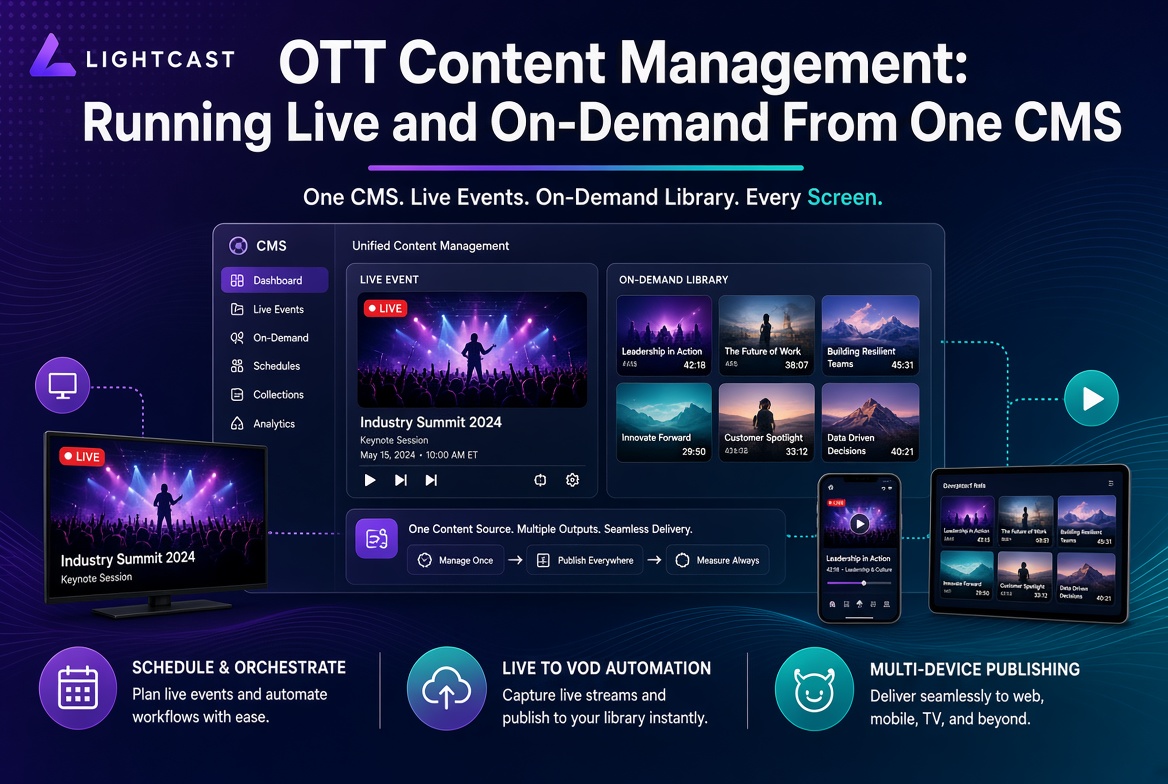
OTT content management is how a publisher organizes, schedules, and controls all of its streaming video, live and on-demand, across every device it publishes to. Done well, it runs from a single content management system rather than a patchwork of tools. That matters because a streaming operation is not one feed, it is live channels, an on-demand library, and multiple monetization models, all of which have to stay consistent across Roku, Fire TV, Apple TV, iOS, Android, and web at the same time. Lightcast manages live and on-demand from one CMS, converts live events to on-demand automatically, and lets you control content in real time across all platforms simultaneously, having launched 12,000+ branded apps for 5,000+ organizations.
The hard part of running an OTT service is rarely making the content. It is managing it once there is a lot of it, spread across live and on-demand, several revenue models, and half a dozen devices that all need to agree with each other.
OTT content management is the operational layer of a streaming service. It covers ingesting and organizing your video library, scheduling live channels and programming, publishing to every device, tying content to the right monetization model, and updating all of it as things change. It is the difference between a growing catalog being an asset and being a daily chore.
The core idea is a single source of truth. One system holds your content, its metadata, its scheduling, and its access rules, and pushes a consistent version to every platform. For how control works across those platforms, see our pillar on real-time content control for streaming platforms.
Because complexity multiplies quietly. A handful of videos on one device is simple. But add a live channel, an on-demand archive, a subscription tier, an ad-supported tier, a few pay-per-view events, and six device platforms, and every change now has to propagate correctly across all of them. Miss one, and a viewer on Fire TV sees something different from a viewer on Roku, or a pulled video is still live somewhere.
When content lives in separate tools, that reconciliation becomes manual work that grows with your catalog. Scheduling in one place, hosting in another, and monetization in a third means three systems that can disagree. For how scheduling fits in, see our guide on television streaming scheduling for content publishers.
Four capabilities separate a real system from a collection of tools.
Live and on-demand in one place. Channels and library should be managed together, not in separate products.
Automatic live-to-VOD. A live event should become an on-demand asset the moment it ends, with no re-uploading or manual handoff.
Real-time control across every platform. A change you make should reach Roku, Fire TV, Apple TV, and mobile at once, so nothing is out of sync.
Monetization tied to content. Access rules and revenue models should live with the content, not in a bolted-on billing layer. For the strategy behind it, see our post on digital media strategy for content publishers.
Because every seam between tools is a place work accumulates and errors hide. Two systems that each do one job well still have to be kept in agreement by someone, and that someone is your team, forever. A single CMS removes the reconciliation entirely: the content, its schedule, its access rules, and its delivery are the same object, so there is nothing to sync. The payoff is not just fewer mistakes, it is that a growing library stays manageable instead of becoming a second full-time job. See the platform view on our best on-demand video platforms guide.
Live channels and the on-demand library are managed from a single system, so there is one source of truth rather than several to reconcile.
Every live event becomes an on-demand asset the moment it ends, with no re-uploading, so your archive builds itself.
Changes reach Roku, Fire TV, Apple TV, iOS, Android, and web simultaneously across 70,000+ global CDN nodes, so every device stays in sync in the moment.
Access rules and revenue models live with each asset, and Lightcast does not retain, monetize, or share client data, so your audience insight stays yours. Explore the platform on our media cloud OVP and live streaming pages.
OTT content management is the operational backbone of a streaming service, keeping live channels, an on-demand library, and multiple monetization models consistent across every device. The complexity multiplies with scale, which is why one CMS beats stitched-together tools: there are no seams to reconcile. Lightcast manages live and on-demand from a single system with automatic live-to-VOD and real-time control across all platforms, having launched 12,000+ branded apps for 5,000+ organizations, and was named Fastest Deployment OTT Platform Provider 2026 by The Silicon Review. To learn more or schedule a demonstration, visit lightcast.com.