Platform
Solutions
Resources
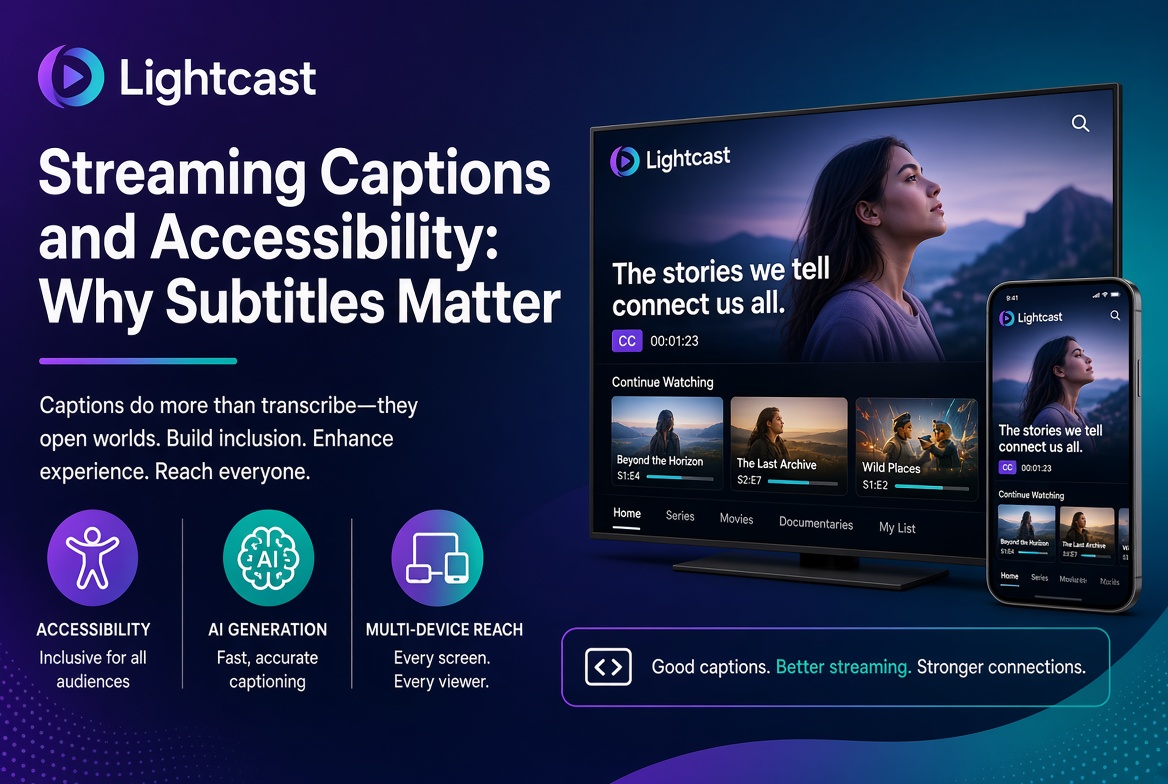
Captions matter in streaming because they expand your audience and your engagement, not just your accessibility. Half of Americans watch content with subtitles on most of the time, and among Gen Z it is 70 percent, so captions are now a mainstream viewing preference as much as an accessibility feature. They also help you reach deaf and hard-of-hearing viewers, people watching with the sound off, and non-native speakers, and they support the accessibility expectations many organizations face. The good news is that adding them no longer takes hours of manual work. Lightcast generates captions and subtitles with AI, as part of a platform that delivers branded streaming to Roku, Fire TV, Apple TV, iOS, Android, and web from one CMS across 70,000+ global CDN nodes, serving 5,000+ organizations and 12,000+ branded apps.
Captions used to be an afterthought for a small slice of viewers. Now a large majority of people have them on at least some of the time, which makes them one of the easiest ways to reach more of your audience.
Because most viewers now use them, and they measurably help people keep watching. In a Preply survey, 50 percent of Americans said they watch content with subtitles most of the time, and 89 percent have used them at some point. Captions keep viewers engaged when the audio is muddled, the accent is unfamiliar, or they are watching somewhere they cannot turn the sound up. For a publisher, that means captions are not a niche accommodation, they are a broad engagement tool that helps more of your audience stay with your content. For how this fits your approach, see our pillar on digital media strategy for content publishers.
A wider group than most people assume. Deaf and hard-of-hearing viewers depend on them, and serving that audience is both right and expected. But the majority of caption users are not hard of hearing at all. They are people watching on a muted phone in public, parents keeping the volume down, viewers following a strong accent or technical content, and non-native speakers who find it easier to follow along in text. Among Gen Z, 70 percent are frequent subtitle users. Captions quietly serve all of them at once. For the on-demand library they apply to, see our guide to the best on-demand video platforms.
They overlap, but the distinction is useful. Captions are a text version of the audio intended for viewers who may not hear it, so they include speech and often relevant sounds, and closed captions can be turned on or off. Subtitles are typically a text translation of dialogue for viewers who can hear but need the words in another language. In everyday use the terms blur together, and a good platform handles both, timed text that appears with the video whether it is for accessibility or translation.
For many organizations, yes, and for all of them they are increasingly expected. Accessibility rules like the Americans with Disabilities Act set expectations for public-facing content, government bodies have obligations under Section 508, and various rules cover captioning for certain broadcast and online video. Beyond the specifics, audiences simply expect captions now. Rather than treat this as a hurdle, the practical move is to use a platform that produces captions as part of publishing, so meeting the expectation is routine. For a vertical where this is front and center, see our guide on streaming platforms for local government.
You have two paths, and they are no longer close in effort. The manual route means transcribing and timing text by hand, or paying a service to, which is accurate but slow and expensive at scale. The modern route is AI-generated captions, where the platform transcribes the audio automatically and produces timed captions in minutes, which you can review and adjust. For a growing library, automated captioning is the difference between captioning everything and captioning almost nothing. For more on where AI fits across streaming, see our guide on how AI is used in OTT.
Lightcast produces captions and subtitles with AI, so you can caption your content quickly instead of transcribing by hand, and keep a growing library accessible without falling behind.
Your captioned content publishes to Roku, Fire TV, Apple TV, iOS, Android, and web at once, so the accessibility you add reaches viewers wherever they watch.
Caption your on-demand library and your events from one platform, with live converting to on-demand automatically, so accessibility is part of how you publish rather than a separate project.
Lightcast does not retain, monetize, or share client data, so the audience your accessible content reaches stays yours. Explore the platform on our media cloud OVP and live streaming pages.
Captions matter in streaming because most viewers now use them, half of Americans most of the time and 70 percent of Gen Z, which makes them a broad engagement tool as well as an accessibility one. They serve deaf and hard-of-hearing viewers, muted and public watching, non-native speakers, and the many people who simply prefer them, and they help organizations meet the accessibility expectations their audiences and rules set. With AI-generated captions, adding them is fast rather than a manual slog. Lightcast produces captions and subtitles with AI and delivers them across every device from one CMS, for 5,000+ organizations and 12,000+ branded apps, and was named Fastest Deployment OTT Platform Provider 2026 by The Silicon Review. To learn more or schedule a demonstration, visit lightcast.com.