Platform
Solutions
Resources
Direct Answer: Live camera feeds for content publishers in 2026 require streaming infrastructure that ingests live video from one or multiple camera sources, encodes and delivers it reliably to audiences on Roku, Fire TV, Apple TV, iOS, Android, and web simultaneously, and automatically converts every live feed into an on-demand archive the moment it ends. Lightcast supports live camera feed streaming for 5,000+ content publishers worldwide, with 70,000+ CDN nodes delivering broadcast-grade live video globally and automatic live-to-VOD conversion that makes every feed immediately available as on-demand content.
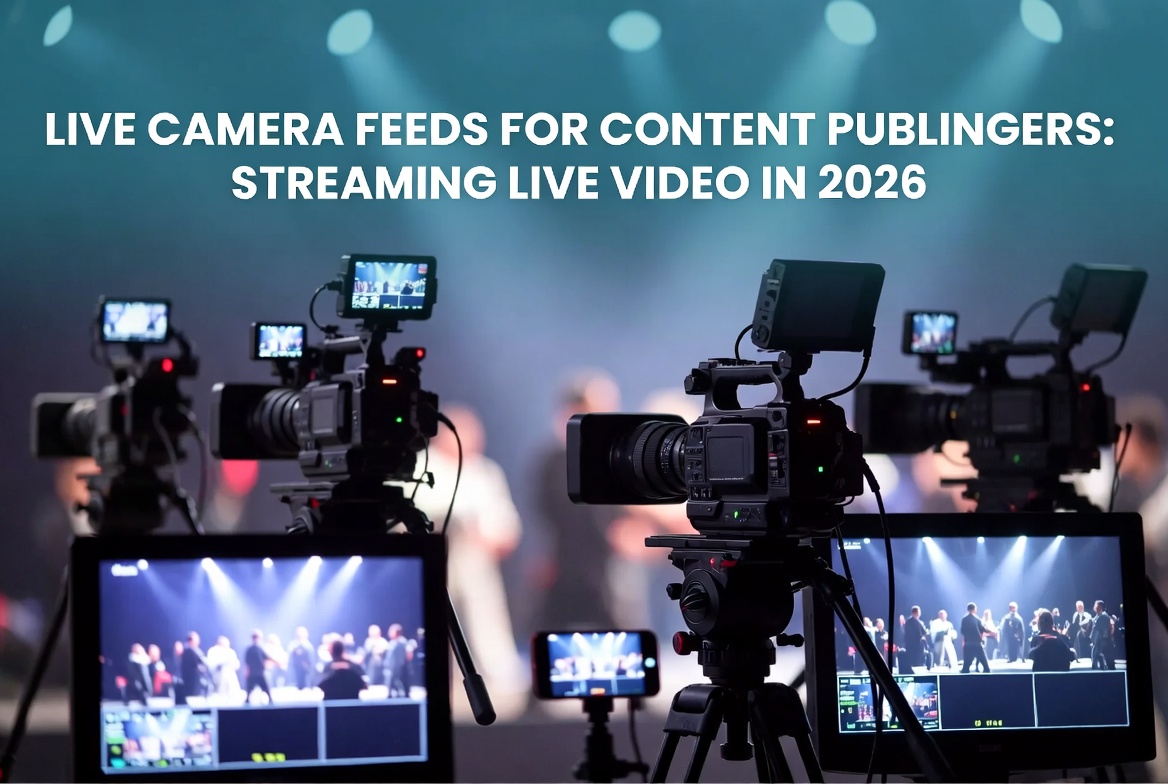
Live camera feeds are the raw material of live streaming. The camera pointed at the game. The camera covering the Sunday service. The camera broadcasting a commencement ceremony, a public meeting, a concert, a campus event, or a breaking news development. Every live streaming operation starts with a camera feed and the infrastructure that takes that feed from the source to the audience.
For content publishers evaluating live streaming options, the camera feed question has two parts. The first is the production side - what cameras, encoders, and production equipment are needed to generate a quality live feed. The second is the distribution side - what streaming infrastructure takes that feed and delivers it reliably to every device the audience is watching on.
This guide focuses on the distribution side, which is where most content publishers encounter the most significant infrastructure decisions and the most consequential differences between platforms.
For a broader look at live streaming infrastructure requirements, see our guide to live video broadcasting for content publishers.
The live camera feed enters the streaming infrastructure through an ingest point - typically an RTMP or SRT stream from a hardware encoder or software encoder like OBS. The quality and reliability of this ingest connection directly affects the quality of what the audience sees. Redundant ingest paths that provide a failover if the primary connection drops are the baseline for any live camera feed operation where reliability matters.
The raw camera feed needs to be encoded into the multiple bitrate versions that adaptive streaming requires. A viewer on a 4K television with fast home broadband gets a different quality stream than a viewer on a phone with a slow cellular connection. Encoding infrastructure that generates those multiple versions automatically, at broadcast quality, is what makes adaptive bitrate delivery possible across the full range of devices and connections in a live audience.
The encoded stream travels from the ingest point through a content delivery network to viewers wherever they are watching. CDN coverage and redundancy determine whether a live camera feed reaches a viewer in a remote area as reliably as it reaches one in a major metropolitan market. For content publishers with geographically distributed audiences, global CDN coverage is not a premium feature - it is the baseline that determines whether the live feed actually works for the full audience.
A live camera feed in 2026 needs to reach viewers on every screen simultaneously. Roku in the living room. iPhone on the commute. Fire TV in the bedroom. Apple TV in the home office. Web browser at work. A streaming infrastructure that delivers to some of these platforms natively and requires separate workflows for others is not a complete live camera feed solution for a content publisher serving a distributed audience.
Every live camera feed is also an archive asset the moment it ends. The replay of last night's game. The recording of this morning's service. The archive of yesterday's public meeting. Streaming infrastructure that automatically converts every live feed to on-demand content the moment the broadcast ends eliminates the manual archiving step that consumes operations team time and delays replay availability for the audience.
Sports is the highest-stakes live camera feed use case for most content publishers. Game cameras, sideline cameras, replay feeds, and multi-angle production setups all feed into a streaming infrastructure that needs to deliver reliably to the largest concurrent audience of the season - which is often a championship game or playoff event that arrives without warning about its viewership scale. For more on sports live streaming, see our guide to live sports streaming options and our overview of OTT platforms for sports organizations.
The weekly service camera feed is the most consistent live streaming operation in the faith organization space. A single primary camera feed delivering a Sunday service to a distributed congregation, week after week, with the reliability that congregants have come to depend on. Missed streams are not acceptable in this context because the service is not a convenience - it is the primary point of connection for remote members. For more on faith organization streaming, see our guide to OTT platforms for churches and faith organizations.
University camera feeds cover a wide range of live events - commencement ceremonies, athletic events, public lectures, campus town halls, and institutional announcements. The commencement camera feed in particular is one of the highest-stakes academic live streams an institution produces, reaching alumni, parents, and family members across every geography simultaneously. For more on university streaming infrastructure, see our guide to video streaming solutions for universities.
Government camera feeds for public meetings, council sessions, and civic events serve a transparency function that makes reliability a civic obligation rather than a preference. A camera feed that drops during a public comment period or buffers through a council vote is not a technical inconvenience - it is a transparency failure. For more on government streaming, see our guide to streaming platforms for local government.
Performing arts camera feeds capture productions where the visual quality of the live feed reflects directly on the organization's creative reputation. A ballet or theater production streamed with broadcast-grade quality builds the organization's streaming audience. One delivered with visible quality degradation or reliability problems does the opposite. For more on performing arts streaming, see our guide to OTT platforms for performing arts organizations.
Broadcasters managing live camera feeds across news, sports, and programming need the real-time content control infrastructure to respond to live developments without disrupting the viewing experience. A breaking news camera feed that needs to interrupt scheduled programming. A live sports feed that runs beyond its scheduled window. A studio camera feed that needs to transition to a remote location feed mid-broadcast. For more on broadcaster streaming infrastructure, see our guide to OTT platforms for broadcasters.
Confirm that the streaming platform supports the ingest protocol your production setup uses. RTMP remains the most common ingest protocol for hardware and software encoders. SRT is increasingly used for lower-latency applications and remote production scenarios. A platform that requires a specific encoder or ingest configuration that conflicts with existing production equipment creates unnecessary complexity and cost.
A single ingest path is a single point of failure. For live camera feeds where a dropped stream during a key moment is unacceptable, redundant ingest paths that automatically switch if the primary connection fails are a baseline requirement. Ask specifically how failover works and how long the transition takes - a 30-second gap in a live feed during a championship game is a meaningful failure even if the stream recovers.
A live camera feed that works at 500 concurrent viewers needs to work at 50,000. Ask every platform you evaluate for specific examples of high-concurrent-viewership live events they have supported - with actual numbers. CDN infrastructure that has not been tested at the scale your highest-stakes events might reach is a liability.
Latency requirements vary by use case. A pre-produced event streamed to a passive audience can absorb 30-second latency with no meaningful impact. A live camera feed where viewers are discussing the action in real time on social media alongside the stream needs latency measured in seconds rather than minutes. Confirm that the platform can deliver the latency profile your specific use case requires.
Ask directly: when the live camera feed ends, how long before the replay is available in the on-demand library, and what steps does the operations team need to take to make that happen? The answer reveals whether live-to-VOD conversion is genuinely automatic or a manual process described as automatic. For more on on-demand library management, see our guide to on-demand video platforms for content publishers.
Lightcast has supported live camera feed streaming for content publishers across sports, faith, education, government, performing arts, and broadcast for over 15 years. Live feed delivery is a core operational function of the platform built for the reliability requirements of organizations that broadcast regularly and cannot afford infrastructure failures during live events.
Redundant Ingest and Automatic Failover: Lightcast accepts live camera feeds through redundant ingest paths with automatic failover, keeping broadcasts running when individual connection points fail.
Simultaneous Multi-Platform Delivery: A single live camera feed ingested into Lightcast delivers simultaneously to Roku, Fire TV, Apple TV, iOS, Android, and web. One feed. Every platform. No per-platform manual configuration at broadcast time.
70,000+ CDN Nodes: Global CDN infrastructure delivers live camera feeds reliably to audiences regardless of geography or concurrent viewer volume, with adaptive bitrate delivery that matches video quality to available bandwidth for every viewer.
Automatic Live-to-VOD: Every live camera feed broadcast on Lightcast is automatically captured and available as on-demand content the moment the broadcast ends. No manual archiving. No delay. The replay is there when the audience goes looking for it.
Real-Time Monitoring: During live camera feed broadcasts, Lightcast provides a monitoring dashboard with concurrent viewer counts, stream health indicators, platform performance, and geographic distribution, all in real time with immediate controls available throughout the broadcast. For more on real-time content control, see our guide to real-time content control for streaming platforms.
Branded Distribution: Live camera feeds deliver through branded apps on every major platform under the publisher's name. The audience experiences the live feed in the publisher's branded environment, not a generic streaming interface. For more on branded app distribution, see our guide to television streaming and scheduling for content publishers.
Full Audience Data Ownership: Every viewer interaction with every live camera feed belongs to the publisher. Lightcast does not retain, monetize, or share audience data from client live streams.
For the complete picture on how live camera feed streaming fits into a broader streaming strategy, see our overview of streaming services for content publishers and our guide to managing a multi-channel streaming operation without adding headcount.
Live camera feeds are where content publisher credibility is built or lost in real time. The infrastructure that takes a camera feed from the source to the audience - reliably, at broadcast quality, on every device the audience is using, with automatic replay archiving the moment the feed ends - is what separates a live streaming operation that earns audience trust from one that manages it.
Lightcast provides that infrastructure for content publishers across every vertical, with 15 years of live camera feed streaming experience and the fastest deployment in the industry.
To learn more or schedule a demonstration, visit lightcast.com.
Published: May 26, 2026
Category: Streaming Strategy
Tags: live camera feeds, live camera streaming, live video feed, live feed platform, OTT live streaming, broadcast live camera, Lightcast live streaming