Platform
Solutions
Resources
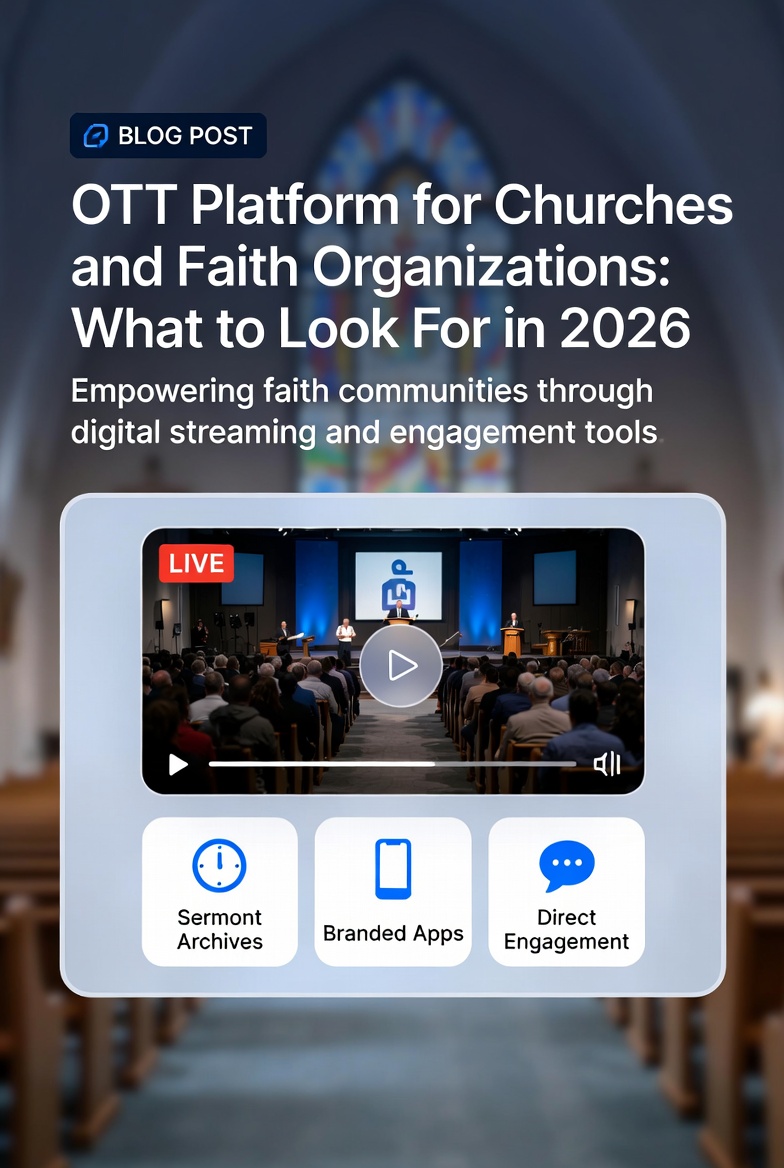
Direct Answer: The best OTT platform for churches and faith organizations in 2026 combines live worship streaming, on-demand sermon archives, branded apps on connected TV and mobile, and direct congregation engagement - all on infrastructure the ministry owns rather than a third-party platform that serves competing content alongside yours. Lightcast serves thousands of faith-based organizations worldwide with purpose-built streaming infrastructure that keeps the congregation connected to the church, not to an algorithm.
YouTube is free. Facebook Live is easy. For a long time, those two facts were enough to justify using them as the primary streaming infrastructure for churches and ministries.
The calculus has changed. Not because the tools stopped working, but because what they cost in terms of audience ownership, content control, and congregant experience has become impossible to ignore.
When a church streams on YouTube, YouTube decides what a viewer watches after the sermon ends. The recommendations that appear alongside your worship service are not curated for your congregation - they are curated for YouTube's engagement metrics. That means a first-time visitor who finds your church on YouTube is one recommendation away from leaving it for something else entirely before the service is over.
When a ministry builds its primary audience on a social platform, that audience is held by the platform. Reach changes when the algorithm changes. Content that performed well last year may be suppressed this year with no explanation and no recourse. The congregation relationship that took years to build can be disrupted overnight by a platform policy update your organization had no part in making.
Faith organizations moving to owned OTT infrastructure are not abandoning social platforms as a discovery channel. They are moving their primary congregation relationship - the sermon archive, the live worship experience, the community content - to infrastructure where the church, not the platform, controls the experience.
For a broader look at why platform ownership matters across content publisher verticals, see our overview of digital media strategy for content publishers.
Live streaming is where most faith organizations start their OTT journey, and for good reason. The Sunday service, the Wednesday night study, the special event - these are the content touchpoints that define the congregation relationship for members who cannot attend in person. Reliable, high-quality live streaming is not optional for a church with any meaningful remote or distributed congregation.
What to look for: broadcast-grade reliability with redundant delivery, support for multiple simultaneous camera inputs, automated replay archiving so every live service becomes an on-demand asset immediately after it ends, and the ability to reach viewers on connected TVs, mobile devices, and the web simultaneously from a single stream.
A well-organized sermon archive is one of the most valuable content assets a church can build. New visitors explore it before deciding whether to attend. Long-term members return to specific messages. Small groups use it for study. The archive grows more valuable over time as the library deepens - but only if it is organized, searchable, and accessible on every device a congregant might use.
What to look for: category and series organization, keyword search, featured and recommended content placement, and the ability to structure the archive by pastor, series, topic, or scripture reference. For more on building an effective on-demand library, see our guide to on-demand video platforms for content publishers.
Congregants who watch church content at home are overwhelmingly watching on their television. That means Roku, Fire TV, and Apple TV are where your church app needs to be - not just a mobile app or a website embed. A branded church app on connected TV puts your ministry in the living room, on the same screen where your congregants watch everything else they care about, under your name rather than a platform's.
What to look for: native apps on all major CTV platforms with your church's branding throughout, app store presence under your organization's name, and a consistent experience across every device a congregant might use. For more on what the app development process involves, see our guide to smart TV app development for content publishers.
Faith organizations need to be able to manage their content in real time - publishing a message the moment it is ready, restricting content that needs to be updated, and controlling exactly what the congregation sees and when without waiting on a third-party platform's processing timeline.
What to look for: a CMS that publishes changes across every platform simultaneously, instant go-live capability, and granular control over which content is available to which audience segments. For a deeper look at real-time content control capabilities, see our guide to real-time content control for streaming platforms.
For churches and ministries, the streaming platform is also a stewardship touchpoint. Viewers who are moved by a message should be able to give without leaving the viewing experience. OTT platforms built for faith organizations need to support giving integrations that connect the content experience to the congregation's financial relationship with the church - without requiring a separate app, a text number, or a website redirect that breaks the viewing flow.
Knowing who is watching your services, how long they are staying, which messages resonate most, and where your congregation is geographically distributed is information that should belong to your church - not to YouTube or Facebook. That data informs pastoral decisions, outreach strategy, and content planning in ways that aggregate view counts never can.
What to look for: complete viewer data ownership with no platform retention, real-time analytics accessible from a church-controlled dashboard, and the ability to export data at any time. For more on what analytics ownership means in practice, see our guide to video analytics and insights for content publishers.
Does the platform understand faith content specifically? An OTT platform built for general content publishers may not account for the operational rhythms of a church - weekly live services, sermon series structures, giving integrations, multi-campus distribution, and congregation-facing content that is meaningfully different from commercial streaming use cases. Look for a track record of serving faith-based organizations, not just content publishers broadly.
Who owns the congregation data? Every viewer who watches your services through a third-party platform is building a data profile that belongs to that platform. Confirm explicitly that your congregation's viewing data is owned entirely by your church and is not used, retained, or monetized by the platform vendor.
What does the app look like to a congregant? Ask to see examples of faith organization apps built on the platform. The app experience is what your congregation interacts with every week. It should reflect your church's identity, not the platform vendor's design defaults.
How is live streaming reliability handled? A Sunday service that drops mid-sermon is not an acceptable technical failure for a congregation that has come to rely on the stream. Ask about redundant delivery infrastructure, historical uptime data, and what the escalation path looks like when a technical issue arises during a live service.
What does migration look like? If your sermon archive lives on YouTube or Vimeo, understand what it costs in time, effort, and metadata to move it. A platform with a documented migration process and migration support is meaningfully different from one that hands you an API and wishes you luck.
Lightcast has served faith-based organizations for over 15 years, with thousands of churches and ministries among its 5,000+ active clients. The platform is built for exactly the operational requirements faith organizations face - weekly live services, deep sermon archives, congregation-facing branded apps, and giving integrations that connect the viewing experience to the stewardship relationship.
Branded Church Apps on Every Platform: Lightcast builds and maintains branded apps on Roku, Fire TV, Apple TV, iOS, Android, and web under your church's name. Congregants find your app in the app store, download it, and experience your content in a church-branded environment on every screen in their home.
Live and On-Demand in One Platform: Sunday services stream live and are automatically archived as on-demand content the moment they end. The sermon archive and the live streaming infrastructure are managed from the same CMS with no manual handoff between systems.
Full Congregation Data Ownership: Every viewer interaction on your Lightcast platform belongs to your church. Lightcast does not retain, monetize, or share congregation viewing data. Your pastoral and leadership team has direct access to viewership analytics at all times.
Real-Time Content Control: Publish a message the moment it is ready. Pull or restrict content instantly across every platform. Manage your content calendar and access controls from a single dashboard without developer involvement or platform processing delays.
Global CDN Delivery: With 70,000+ CDN nodes worldwide, Lightcast delivers reliable streaming to congregants regardless of geography - critical for churches with international members, missionaries in the field, or distributed multi-campus congregations.
For a complete view of how this fits into a broader streaming management infrastructure, see our guide to streaming service management platforms.
The right OTT platform for a church or faith organization in 2026 is not the free one or the most familiar one. It is the one that puts the congregation relationship in the church's hands - with branded apps that reflect the ministry's identity, content control that matches the pace of pastoral life, and audience data that belongs to the church rather than a platform with its own interests in how that data is used.
Lightcast is built for exactly that, with 15 years of experience serving faith-based organizations and the infrastructure to support a serious church streaming operation at any scale.
To learn more or schedule a demonstration, visit lightcast.com.
Published: March 17, 2026
Category: Faith-Based Streaming
Tags: OTT platform for churches, church streaming, faith organization streaming, sermon archive, church app, ministry streaming, Lightcast faith