Platform
Solutions
Resources
Direct Answer: Real-time content control for streaming platforms means the ability to publish, update, schedule, restrict, and manage content across every distribution channel simultaneously - without delays, without developer involvement, and without waiting for a third-party platform to process changes. Lightcast provides real-time content control for 5,000+ content publishers across Roku, Fire TV, Apple TV, iOS, Android, and web from a single CMS dashboard, giving organizations the operational agility to manage live and on-demand content at the speed their audiences expect.
Real-time content control is one of those capabilities that content publishers do not fully appreciate until they do not have it.
It is the ability to take a video live across every platform the moment it is ready - not after a 24-hour processing queue. It is the ability to pull a piece of content from your entire distribution network instantly when something changes - not submit a removal request and wait. It is the ability to update a thumbnail, correct a title, change an access tier, or redirect viewers to a different piece of content while a situation is actively unfolding - not after the fact.
For content publishers managing live events, breaking news, time-sensitive programming, or large content libraries with frequent updates, real-time control is not a nice-to-have feature. It is a core operational requirement.
For context on how real-time content control fits into a broader streaming management infrastructure, see our guide to streaming service management platforms.
The fundamental limitation of third-party video platforms is that content control flows through their infrastructure on their timeline. When you upload to YouTube, YouTube processes, indexes, and distributes your content according to its own system priorities. When you need to make a change, you make a request to their platform and wait for it to propagate.
For most casual publishing that timeline is acceptable. For organizations running time-sensitive operations it is not.
Consider what real-time content control failure looks like in practice. A university athletic department streams a game that ends early due to a weather cancellation. The scheduled replay content needs to be replaced immediately with a statement from the athletic director. On a third-party platform, that change propagates on the platform's schedule. On owned infrastructure with real-time control, it happens in seconds.
Or a faith organization publishes a sermon that contains a factual error the pastor wants corrected before Sunday evening. On YouTube, the video is already indexed, shared, and potentially cached across viewer devices. On owned infrastructure with real-time control, the video can be swapped, restricted, or taken down across every distribution channel simultaneously.
The examples are different across verticals but the underlying need is the same: content publishers need to be able to act on their content at the speed of the situation, not at the speed of a third-party platform's processing queue.
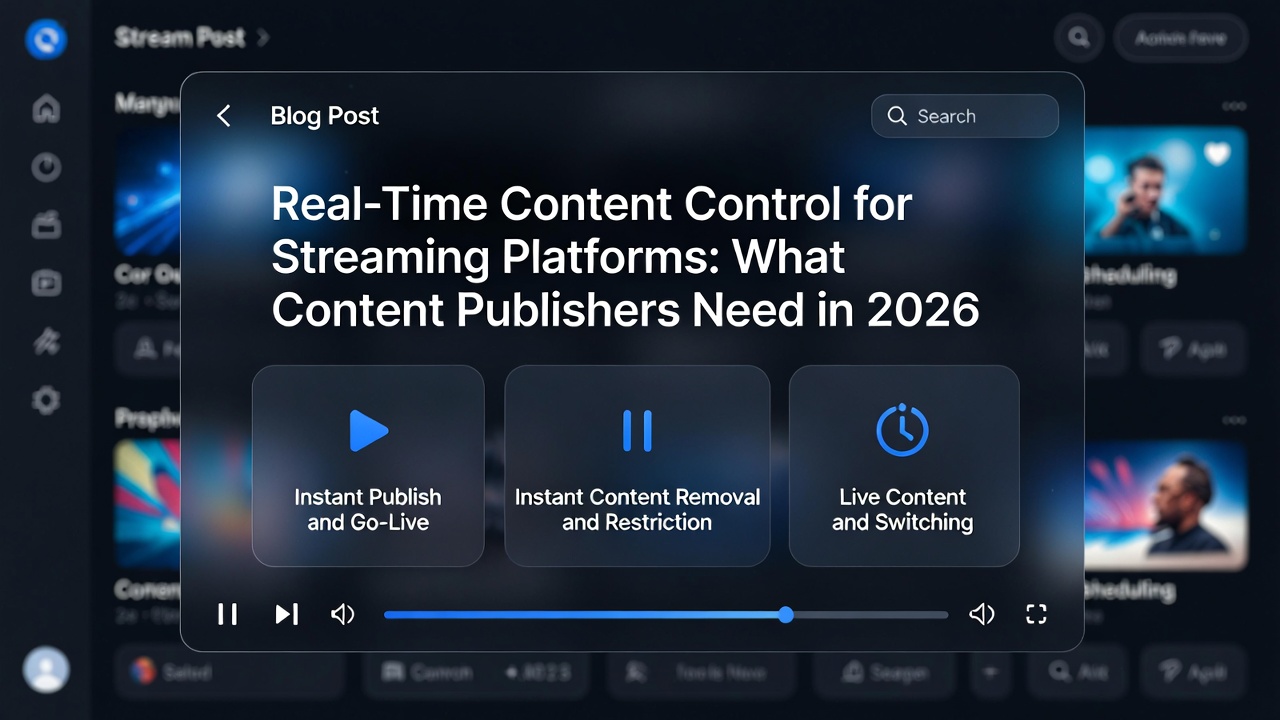
Content should be available to viewers within seconds of a publisher initiating distribution - not after a processing window that can stretch to hours on high-traffic platforms. For live event replays, breaking institutional communications, and time-sensitive programming, the gap between upload and availability directly affects viewer experience and organizational credibility.
What to look for: confirmed go-live times with no processing delays, real-time status visibility across every distribution channel, and the ability to schedule content to go live at a precise future time without manual intervention at the moment of publication.
The ability to remove or restrict content in real time is as important as the ability to publish it. Errors happen. Situations change. Rights windows expire. Content that was appropriate yesterday may need to be restricted today for legal, editorial, or operational reasons.
On owned streaming infrastructure, a removal or restriction propagates to every platform simultaneously the moment it is initiated. On third-party platforms, content that has been shared, cached, or indexed may remain accessible to viewers long after a removal request has been submitted.
For content publishers running scheduled programming or linear channels, real-time scheduling control means the ability to adjust the content lineup while distribution is already underway. A pre-scheduled program that needs to be replaced, a live event that runs long, or an unplanned piece of content that needs to be inserted into the schedule - all of these require scheduling systems that respond in real time, not on a batch processing cycle.
For more on managing live streaming operations efficiently, see our guide to managing a multi-channel streaming operation without adding headcount.
Content publishers with subscription or pay-per-view monetization need the ability to change access controls without content downtime or viewer-facing disruption. Moving a piece of content from pay-per-view to subscription access, opening a previously gated piece of content for free viewing during a promotional window, or restricting previously open content to paid subscribers only - all of these need to take effect across every platform the moment the change is made.
For a full look at how access control connects to monetization strategy, see our guide to how to monetize your on-demand video library.
Real-time content control extends beyond the video file itself to every element of how content is presented to viewers. Titles, descriptions, thumbnails, categories, featured placements, and recommended content all shape how viewers discover and engage with your library. The ability to update any of these elements across every distribution channel simultaneously - without a delay, without a developer, and without a support ticket - is the difference between a content operation and a content management problem.
Real-time control is only meaningful if it applies equally across every platform your content is distributed on. A change that takes effect immediately on your website but takes 48 hours to propagate to your Roku channel is not real-time control - it is selective control with significant gaps. Owned streaming infrastructure built for multi-platform distribution ensures that every content action, from publication to removal to access tier change, takes effect simultaneously across Roku, Fire TV, Apple TV, iOS, Android, and web.
For more on branded app distribution across all major platforms, see our guide to smart TV app development for content publishers.
Universities need real-time content control for athletic event management, campus emergency communications, course content updates, and the frequent scheduling changes that come with academic calendars. A department that cannot update its streaming content without submitting a request to an IT team or waiting for a third-party platform to process a change is not running an agile content operation. For more on university streaming needs specifically, see our guide to video streaming solutions for universities.
Churches and ministries publish content on tight weekly cycles and frequently need to update, correct, or supplement content that has already been distributed. Real-time control means the ability to respond to congregation needs and pastoral direction without the friction of platform processing delays or developer involvement.
Sports content publishing is inherently time-sensitive. Game outcomes, injury updates, schedule changes, and broadcast rights windows all create situations where content needs to be published, pulled, or modified immediately. Organizations without real-time control over their streaming infrastructure manage these situations reactively - after the fact, with limited tools.
Broadcasters and media companies operate content operations where real-time control is a baseline expectation, not a premium feature. The ability to break into scheduled programming, update content metadata at scale, and manage distribution rights in real time is fundamental to broadcast-grade operations - and it requires infrastructure designed for that level of operational responsiveness.
Lightcast is built on the premise that content publishers need to be in complete control of their content at all times - not waiting on a platform, not submitting requests through a support system, and not discovering that a change they made three hours ago still has not propagated to their Roku channel.
Single CMS, Every Platform: Every content action taken in the Lightcast CMS - publish, remove, restrict, reschedule, update - takes effect simultaneously across every distribution platform. Roku, Fire TV, Apple TV, iOS, Android, and web all reflect the change in real time from a single administrative action.
Instant Go-Live: Content published in the Lightcast CMS is available to viewers within seconds. No processing queues. No platform delays. No gap between the moment a publisher initiates distribution and the moment a viewer can access the content.
Real-Time Live Event Management: During live events, Lightcast provides a live monitoring dashboard with concurrent viewer data, platform performance, and immediate controls for stream management. If something needs to change during a live broadcast, it changes immediately - not after a delay that a live audience will notice.
Granular Access Control: Access tier changes, subscription restrictions, and pay-per-view windows are configurable in real time from the Lightcast CMS and take effect immediately across every platform. A promotional free-access window that opens at noon on Saturday is open at noon on Saturday - on every device, for every viewer, simultaneously.
15 Years of Operational Infrastructure: Real-time content control at scale requires infrastructure that has been built, tested, and refined across thousands of live deployments. Lightcast has been managing streaming content operations for 5,000+ organizations for over 15 years, with the operational depth that newer platforms have not yet developed.
For a complete view of how real-time content control connects to the broader digital media strategy picture, see our overview of digital media solutions for education and business and our guide to on-demand video platforms for content publishers.
Real-time content control is what separates content publishers who manage their streaming operation from those who react to it. When content changes propagate instantly across every platform, organizations can respond to live situations, correct errors before they compound, and manage complex content operations with a level of precision that third-party platform publishing simply does not allow.
Lightcast gives content publishers that control - across every major streaming platform, from a single dashboard, in real time.
To learn more or schedule a demonstration, visit lightcast.com.
Published: March 16, 2026
Category: Streaming Operations
Tags: real-time content control, streaming platform management, content operations, OTT platform, live content management, streaming CMS, Lightcast