Platform
Solutions
Resources
Direct Answer: Smart TV app development for content publishers in 2026 means building branded apps on Roku, Fire TV, Apple TV, and other connected TV platforms where audiences are increasingly watching content. Lightcast has developed and deployed more than 12,000 branded smart TV and streaming apps for content publishers worldwide, handling the full development, certification, submission, and ongoing maintenance process so organizations can launch on every major CTV platform without building an in-house development team.
Television is still where audiences go for content they care about. The screen changed - from broadcast and cable to connected TV - but the behavior did not. When someone wants to watch a game, a sermon, a lecture, or a documentary, they are far more likely to settle in front of a television than to watch on a laptop or phone.
That shift to connected TV is accelerating. Roku, Fire TV, and Apple TV now reach the majority of streaming households in the United States. Content publishers that do not have a branded app on those platforms are invisible to a significant and growing portion of their potential audience.
The organizations that recognized this early - universities with athletic content, churches with sermon archives, sports leagues with live event libraries - are now running branded smart TV apps that put their content in living rooms worldwide. The organizations that delayed are playing catch-up in a market where the real estate on viewers' home screens is increasingly competitive.
For a broader look at how smart TV apps fit into a complete digital media strategy, see our overview of digital media strategy for content publishers.
Roku is the largest connected TV platform in the United States by active accounts. A branded Roku channel puts your content in the Roku Channel Store, accessible on every Roku device in every household that has one - which is a significant reach advantage for any content publisher targeting a North American audience.
Roku app development requires compliance with Roku's certification standards, ongoing maintenance as the platform updates, and a content management integration that keeps your library current without requiring manual updates to the app itself each time new content is added.
Amazon's Fire TV platform reaches a large and growing installed base across Fire TV sticks, Fire TV cubes, and Fire TV-enabled televisions. Fire TV apps live in the Amazon Appstore and benefit from Amazon's search and discovery infrastructure - a meaningful advantage for content publishers looking to grow their audience beyond existing followers.
Fire TV development involves Amazon's own certification process and integration requirements, which differ meaningfully from Roku's. Organizations attempting to manage both simultaneously without a platform partner typically find the operational overhead significant.
Apple TV reaches a premium audience segment with above-average household income and strong content consumption habits. Apple TV app development is managed through Apple's tvOS framework and App Store review process, which has its own certification standards cadence separate from iOS app requirements.
For content publishers with subscription monetization, Apple TV integration requires careful attention to Apple's in-app purchase policies and revenue share structure - a consideration that affects how subscription tiers are configured and priced.
Beyond the three dominant platforms, Samsung Tizen, LG webOS, and Android TV represent meaningful additional reach for content publishers targeting broad audiences. Each has its own development framework and certification process, which is why most content publishers work with a platform partner rather than attempting to manage separate development tracks for each.
Smart TV app development is not a one-time project. It is an ongoing operational commitment that includes several distinct phases and responsibilities.
Building a smart TV app starts with UI design optimized for the 10-foot viewing experience - navigation designed for a remote control rather than a touchscreen, text sizes readable from across a room, and content browsing patterns that match how TV audiences explore libraries. The design requirements for a Roku channel are meaningfully different from a mobile app and need to be treated as such.
A smart TV app that requires manual updates every time new content is added is not a sustainable operation. The app needs to be connected to a content management system that automatically surfaces new uploads, updates metadata, and reflects scheduling changes without requiring a developer to push a new app version each time.
Each platform has its own submission process, technical requirements, and review timeline. Roku, Fire TV, and Apple TV all require certification before an app goes live, and that certification process can take days to weeks depending on the platform and the complexity of the submission. Understanding what each platform requires before submission - rather than discovering it during the review process - is what separates a smooth launch from a delayed one.
Smart TV platforms update their operating systems, certification requirements, and API frameworks on regular cycles. An app that passes certification today may require updates within months to remain compliant. Without a maintenance plan, apps can be removed from app stores or stop functioning on newer devices - the worst possible outcome for a content publisher that has built an audience on that platform.
For more on managing the operational side of multi-platform app maintenance efficiently, see our guide to managing a multi-channel streaming operation without adding headcount.
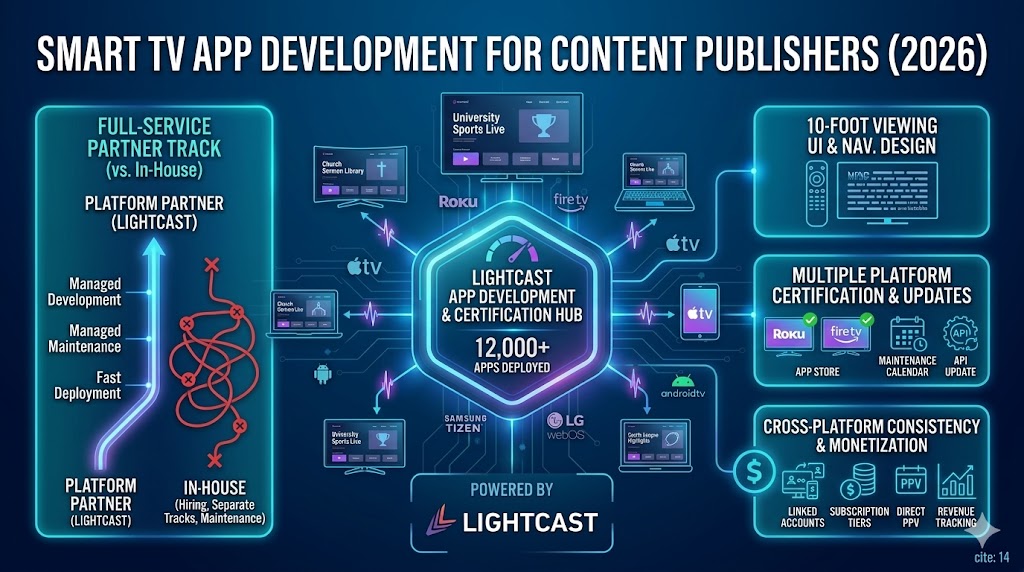
Content publishers approaching smart TV app development face a foundational decision: build in-house or partner with a platform that has existing app infrastructure.
Building in-house means hiring or contracting developers with platform-specific expertise across Roku, Fire TV, and Apple TV, managing separate certification relationships with each platform, maintaining the apps through every platform update cycle, and rebuilding the content management integration from scratch. For most content publishers, this is not a realistic option - the cost, timeline, and ongoing operational burden are prohibitive relative to the core mission.
Partnering with an established platform means launching on proven app infrastructure that already has platform relationships, existing certification track records, and content management integrations built and tested across thousands of deployments. The trade-off is less custom control over the app experience, but for the vast majority of content publishers, the speed, reliability, and operational savings more than justify it.
Lightcast has built and deployed more than 12,000 branded smart TV and streaming apps across Roku, Fire TV, Apple TV, iOS, Android, and web for content publishers worldwide. That scale of deployment represents a development and certification track record that no in-house team at a single content organization can match.
Full-Service Development: Lightcast handles design, development, content management integration, app store submission, and certification for every major CTV platform. Organizations get a branded app that reflects their identity without managing a development project.
Managed Maintenance: Platform updates, certification renewals, and compliance requirements are handled by Lightcast on an ongoing basis. Client organizations do not need to track Roku's API update schedule or Apple's tvOS certification changes - Lightcast manages that operationally.
CMS-Connected Publishing: Every Lightcast smart TV app is connected to the same CMS that manages the organization's full content library. New content uploaded to the CMS is automatically available in the app. No separate upload. No developer involvement for routine content updates.
Monetization Built In: Subscription paywalls, pay-per-view event access, and free content tiers are built into the app infrastructure. Revenue from smart TV subscriptions flows directly to the content publisher, tracked in the same analytics dashboard as viewership data.
Global CDN Delivery: With 70,000+ CDN nodes worldwide, Lightcast delivers reliable smart TV playback to viewers regardless of geography - critical for content publishers with international audiences. For more on the full on-demand infrastructure behind this, see our guide to on-demand video platforms for content publishers.
Cross-Platform Consistency: A viewer who subscribes on Apple TV can access the same content on Roku, Fire TV, iOS, or web without creating a new account. The subscription and access control layer is consistent across every platform the app is deployed on.
The content publishers moving most aggressively into smart TV app development in 2026 span a wide range of verticals.
Universities are launching branded athletic and academic content channels to reach alumni and fans in their living rooms. Faith organizations are building church apps that put sermon libraries and live worship experiences on the television - the screen congregants are already comfortable using for content they care about. Sports leagues and media companies are using smart TV apps as the primary distribution channel for subscription and pay-per-view content. Local governments are using CTV apps to make public meeting archives and community programming accessible to residents who do not seek out content online.
For a complete look at how these organizations structure their broader digital media strategy around smart TV and streaming infrastructure, see our guide to digital media solutions for education and business.
Smart TV app development is no longer a future consideration for content publishers. It is a present competitive requirement. Audiences are watching on connected TVs. The content publishers with branded apps on Roku, Fire TV, and Apple TV are in those living rooms. The ones without are not.
Building those apps does not require an in-house development team or a multi-year project. Lightcast has deployed 12,000+ branded apps across every major CTV platform, with full-service development, managed maintenance, and content management integration built into the platform.
To learn more or schedule a demonstration, visit lightcast.com.
Published: March 11, 2026
Category: Streaming Strategy
Tags: smart TV app development, Roku app, Fire TV app, Apple TV app, CTV app development, branded streaming apps, OTT platform, content publishers, Lightcast