Platform
Solutions
Resources
Direct Answer: Television streaming and scheduling for content publishers in 2026 means delivering a true channel experience on connected TV - branded apps on Roku, Fire TV, and Apple TV with scheduled linear programming, live event windows, and on-demand libraries all managed from a single CMS the publisher controls. Lightcast provides end-to-end television streaming and scheduling infrastructure for 5,000+ content publishers worldwide, giving organizations the tools to run a professional streaming channel on every major television platform without a broadcast network or cable distribution deal.
When most people think about television streaming, they think about on-demand. A library of content available whenever the viewer wants it. That is one part of the picture.
The other part - and the one that most content publishers have not fully addressed - is scheduling. The ability to run a continuous, structured channel experience on connected TV where content plays in a programmed sequence, live events interrupt scheduled programming at defined windows, and viewers can tune in the way they tuned into cable television for decades.
That linear channel experience is what separates a content library from a channel. And in 2026, the distinction matters more than it ever has because connected TV audiences are increasingly expecting both - the flexibility of on-demand alongside the familiar rhythm of scheduled programming that tells them something is always on.
For content publishers that have spent years building audiences on social platforms and web video, the shift to television streaming and scheduling represents the next infrastructure layer. It is where the audience relationship matures from transactional to habitual.
A television streaming operation that exists only on the web is not a television streaming operation. The audience for premium content in 2026 is watching on Roku, Fire TV, and Apple TV. These are the platforms where viewers settle in for long-form content, where the viewing session averages significantly longer than mobile or desktop, and where the experience most closely mirrors traditional television consumption behavior.
A branded app on connected TV under the publisher's name in the app store is the foundation. It is the address where the audience finds the channel. Everything else - the scheduling, the live programming, the on-demand library - delivers through that branded presence in the living room.
What this requires: fully managed app development and maintenance on every major CTV platform, with the publisher's brand throughout the experience. For more on what that process involves, see our guide to smart TV app development for content publishers.
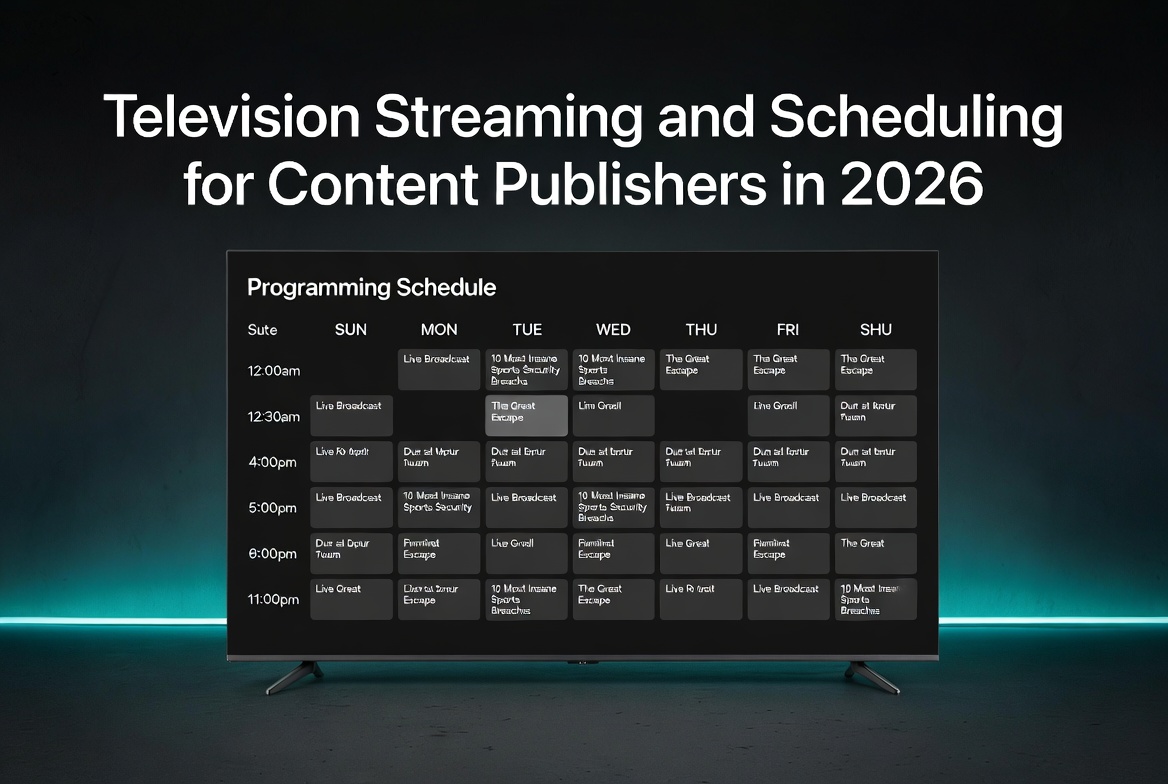
Linear scheduling is what makes a streaming platform feel like a channel rather than a library. Content plays in a programmed sequence on a defined schedule. Viewers who open the app find something already playing. They can join mid-program the way they would tune into cable, or they can browse the schedule to see what is coming next.
For content publishers with large archives - broadcasters, faith organizations with years of sermon recordings, sports organizations with seasons of game footage, educational institutions with extensive lecture libraries - linear scheduling is what transforms that archive from a storage problem into a programming asset. Content that might never be discovered by a viewer browsing an on-demand library becomes part of a channel that surfaces it in context.
What this requires: a playout system integrated with the content management workflow, schedule management tools that allow programming changes without developer involvement, and the ability to insert live event windows into the scheduled lineup at defined times.
The most valuable moments in any content publisher's calendar are live. Games, services, conferences, premieres, breaking news - these are the events that drive tune-in behavior and subscription conversion at rates that pre-produced content cannot match.
In a complete television streaming operation, live events do not exist separately from the scheduled channel. They are windows in the programming schedule - the channel goes live at a defined time, the live event plays, and the scheduled programming resumes when it ends. The replay automatically enters the on-demand library and can be scheduled back into the linear feed for later broadcast.
What this requires: live streaming infrastructure integrated with the same platform managing scheduled content, automatic live-to-VOD conversion, and scheduling tools that handle the transition between live and pre-produced content without manual intervention at broadcast time. For more on live streaming infrastructure, see our guide to live video broadcasting for content publishers.
The strongest television streaming operations in 2026 give viewers both experiences simultaneously. The linear channel for viewers who want to tune in and watch whatever is on. The on-demand library for viewers who want a specific piece of content on their schedule.
Both experiences need to live in the same branded app, managed from the same CMS, with analytics that show how viewership divides between linear and on-demand across different content types and audience segments. For more on building an effective on-demand library, see our guide to on-demand video platforms for content publishers.
Television scheduling requires the ability to make programming changes in real time - a live event that runs long, a content swap driven by breaking developments, a schedule adjustment that needs to take effect immediately across every platform the channel is distributed on. That real-time control needs to execute simultaneously on Roku, Fire TV, Apple TV, and every other distribution surface without requiring separate actions on each platform. For more on real-time content control, see our guide to real-time content control for streaming platforms and our comparison of real-time control vs. scheduled publishing.
Television streaming analytics for content publishers need to answer questions that traditional broadcast ratings never could. Which scheduled programs drive the longest viewing sessions. Which live events generate the highest tune-in rates. How linear viewing behavior differs from on-demand viewing behavior for the same content. Which connected TV platforms deliver the most engaged audiences. All of that data needs to live in one dashboard that belongs to the publisher, not to the distribution platform. For more on streaming analytics, see our guide to video analytics and insights for content publishers.
For broadcasters, television streaming is the direct-to-consumer extension of their existing broadcast operation. The linear channel experience is familiar territory - the challenge is replicating it on connected TV with full audience data ownership and direct monetization that does not exist in the traditional broadcast relationship. A streaming channel that mirrors the broadcast schedule while adding on-demand access and direct subscriber billing represents a new revenue stream from an existing content operation. For more on broadcaster OTT infrastructure, see our guide to OTT platforms for broadcasters.
Churches and ministries with years of sermon archives have the raw material for a genuine linear channel - topical series, seasonal programming, special event replays, and weekly service recordings that can be organized into a continuous programming schedule that gives congregants something to tune into any time they open the app. A faith channel that feels like a television experience rather than a video library builds a different and deeper habit of engagement with the community. For more on faith organization streaming, see our guide to OTT platforms for churches and faith organizations.
Sports channels on connected TV are where the fan relationship is most durably built. Game day programming windows, pre-game and post-game shows, archive game replays scheduled throughout the week, and documentary content that fills the schedule between live events - a sports channel that programs its content intentionally gives fans a reason to open the app every day rather than just on game days. For more on sports streaming infrastructure, see our guide to OTT platforms for sports organizations and our overview of live sports streaming options.
Universities and continuing education programs that program their content as a channel - lecture series, documentary programming around academic topics, athletic content, and campus life coverage organized into a genuine schedule - build alumni and community engagement that a static content library never achieves. A university channel on Roku that alumni can tune into from anywhere in the world is a fundamentally different kind of institutional connection than a website with video embeds. For more on university streaming, see our guide to video streaming solutions for universities.
Television streaming opens monetization options that web video and social platforms cannot support at the same level.
Subscription access to the channel - monthly and annual tiers, student and senior pricing, institutional licensing for organizations that want to offer channel access as a benefit - represents the most predictable revenue model for content publishers with consistent programming schedules.
Sponsorship on a branded connected TV channel is categorically different from advertising on a third-party platform. The publisher controls placement, pricing, and the sponsor relationship entirely. Pre-roll and mid-roll sponsorship spots on live events and popular scheduled programming, branded content series, and sponsor acknowledgments during linear programming are all available on owned infrastructure in ways that YouTube ad revenue share cannot approach.
For a complete breakdown of streaming monetization options, see our guide to video content monetization for content publishers.
Lightcast is built as an end-to-end television streaming platform - not a video host with scheduling features added on top. Live programming, linear channel management, on-demand library organization, and branded connected TV app distribution all operate from a single Lightcast CMS that the publisher owns and controls.
Branded CTV Apps on Every Platform: Lightcast builds and maintains branded apps on Roku, Fire TV, Apple TV, iOS, Android, and web under the publisher's name. Viewers find the channel in the app store. The experience reflects the publisher's brand throughout.
Linear Channel Scheduling: Content can be programmed into a continuous channel schedule with pre-produced content, live event windows, and automatic transitions managed from the Lightcast CMS without developer involvement for routine scheduling updates.
Live and On-Demand in One Platform: Live events and on-demand libraries are managed from the same CMS. Every live broadcast is automatically captured and available as on-demand content the moment it ends. The on-demand library and the linear schedule feed from the same content source.
Real-Time Schedule Management: Programming changes take effect immediately across every platform simultaneously. A schedule adjustment made in the Lightcast CMS is live on Roku, Fire TV, Apple TV, and web within seconds.
Global CDN Delivery: 70,000+ CDN nodes deliver reliable television streaming to viewers regardless of geography, with adaptive bitrate delivery that maintains quality across varying connection speeds.
Full Audience Data Ownership: Every viewer interaction with the channel - linear and on-demand - belongs to the publisher. Lightcast does not retain, monetize, or share audience data from client platforms.
Fastest Deployment in the Industry: Lightcast was named the Fastest Deployment OTT Platform Provider 2026 by The Silicon Review. For publishers who want a channel live before a specific season or launch date, deployment speed is a real operational factor. For more on that recognition, see our post on the Silicon Review award.
For the complete picture on how television streaming fits into a broader content strategy, see our overview of digital media strategy for content publishers and our guide to video content distribution platforms.
Television streaming and scheduling in 2026 is how content publishers build the kind of habitual, daily audience relationship that transforms a content library into a channel. Branded apps on connected TV, linear programming schedules, live event windows, on-demand access, and real-time content control - all from a single platform the publisher owns - is what separates organizations building a television presence from those hosting videos online.
Lightcast gives content publishers the complete infrastructure to build and operate that television presence, with 15 years of operational experience and the fastest deployment in the industry.
To learn more or schedule a demonstration, visit lightcast.com.
Published: May 19, 2026
Category: Streaming Strategy
Tags: television streaming, linear streaming, channel scheduling, connected TV, OTT television, branded TV channel, streaming scheduling, Lightcast television streaming