Platform
Solutions
Resources
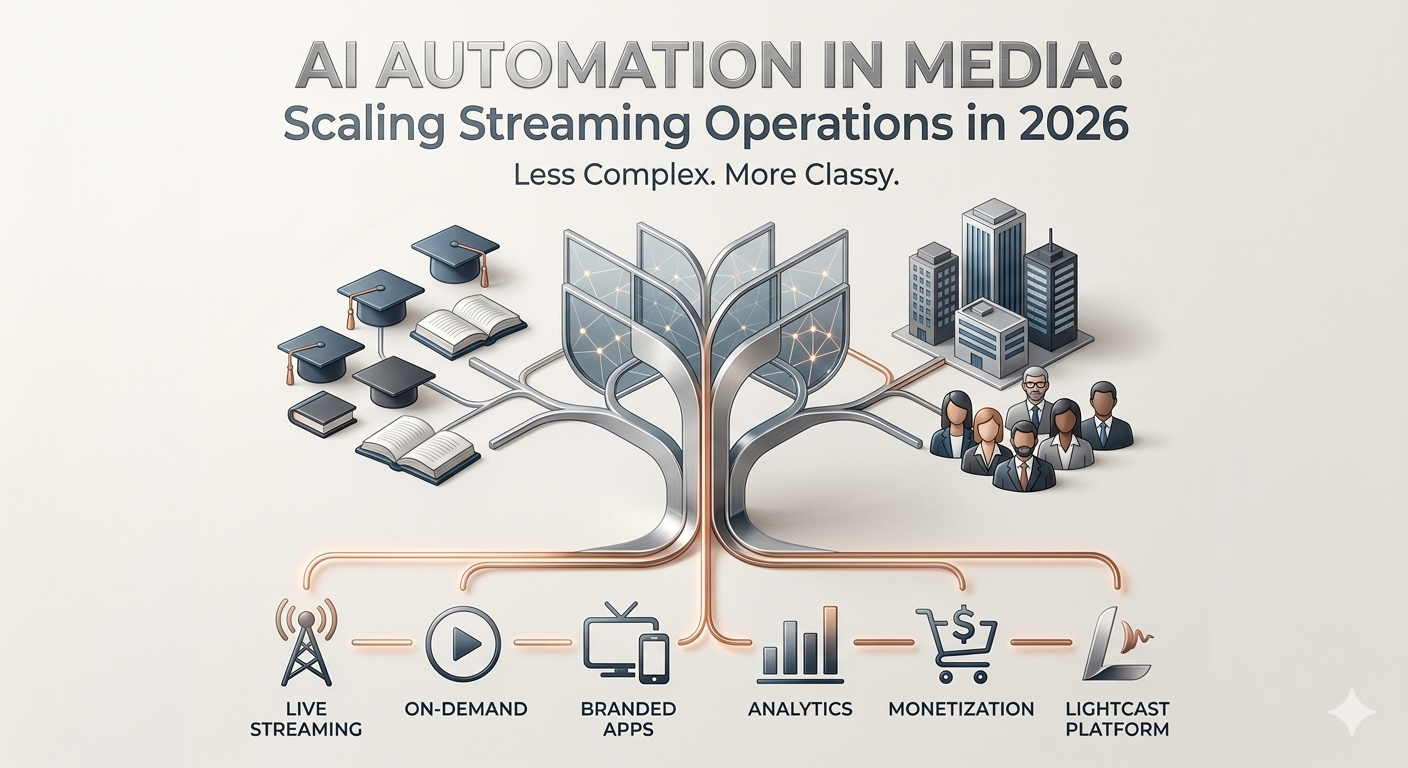
Direct Answer: AI automation in media is helping content publishers scale streaming operations by automating repetitive workflow tasks - encoding, metadata tagging, content scheduling, thumbnail generation, and audience analytics - so that editorial and operational teams spend time on strategy rather than logistics. Lightcast integrates AI-powered workflow automation into its end-to-end streaming platform, giving 5,000+ content publishers the operational leverage to manage large content libraries and complex distribution across Roku, Fire TV, Apple TV, iOS, Android, and web without proportionally growing headcount.
AI automation in media gets discussed at two levels that rarely match. At the headline level, it is about generative AI producing content - scripts, thumbnails, voiceovers, synthetic presenters. At the operational level, which is where most content publishers actually encounter it, it is about automating the repetitive workflow steps that consume disproportionate team time without adding proportionate audience value.
The second version is where the near-term leverage is. Content publishers are not primarily constrained by their ability to generate content. They are constrained by their ability to publish, distribute, tag, schedule, monitor, and analyze content efficiently enough to keep pace with audience expectations across every platform where viewers expect to find them.
AI automation addresses those constraints by handling the steps that do not require human judgment - and flagging the ones that do.
For context on how automation fits into a complete streaming management operation, see our guide to streaming service management platforms.
Metadata is the infrastructure of a content library. Titles, descriptions, category tags, keywords, and search terms determine whether a viewer can find a specific piece of content in a library with hundreds or thousands of items. Done manually, metadata entry is time-consuming, inconsistent, and frequently incomplete - which is why most large content libraries have search and discovery problems that trace directly back to metadata quality.
AI-powered metadata automation analyzes content at upload and generates title suggestions, description drafts, keyword tags, and category assignments based on what is actually in the video. The editorial team reviews and approves rather than creating from scratch. The result is faster publishing, more consistent metadata quality, and content libraries that actually surface the right content for the right viewer at the right moment.
Video content published across Roku, Fire TV, Apple TV, iOS, Android, and web requires different encoding specifications for each platform and adaptive bitrate ladders that match the range of connection speeds viewers bring to each device. Configuring encoding manually for every piece of content across every platform is a technical burden that consumes time and introduces error.
AI-driven encoding automation handles format optimization dynamically - analyzing the source content, generating the appropriate encoding ladder for each distribution platform, and delivering the right quality level to each viewer automatically based on available bandwidth. The publisher sets the parameters once. The automation executes them across every piece of content at every distribution point.
Content scheduling across multiple platforms, time zones, and audience segments involves more variables than manual scheduling handles well at scale. When to publish a replay for maximum viewership. How to sequence on-demand content for a viewer who just finished a series. When to surface archived content that is relevant to a current event or season.
AI-assisted scheduling analyzes historical viewership data to recommend optimal publishing windows, sequences content in ways that improve session depth, and automates the distribution timeline across every platform so that content goes live at the right moment without requiring a team member to manually initiate each publish action.
For more on managing complex multi-platform publishing efficiently, see our guide to managing a multi-channel streaming operation without adding headcount.
Every live broadcast is also a content production event. The replay, the highlight clips, the condensed game, the best-of compilation - all of these are on-demand assets that live events generate automatically when the right infrastructure is in place. Without automation, converting a live broadcast into organized on-demand content requires manual video editing, re-encoding, metadata entry, and publishing across every platform. That process can take hours and frequently gets skipped entirely when teams are stretched.
Automated live-to-VOD conversion handles the foundational steps immediately. The replay is available the moment the live event ends. Automated chapter markers and timestamps help viewers navigate long-form content. AI-generated highlight reels surface the key moments without manual editing. For more on live broadcasting infrastructure, see our guide to live video broadcasting for content publishers.
Audience analytics generate more data than most content teams can manually process into useful insights. Viewership patterns across thousands of content items, audience retention curves for every video in the library, subscriber behavior trends across multiple platforms and device types - the raw data is valuable. Making it actionable requires pattern recognition at a scale that manual analysis cannot match.
AI-powered analytics surfaces the signals that matter - which content formats are driving the strongest retention, which audience segments are at risk of churning, which live events generated viewership spikes that suggest underserved demand - and presents them as actionable recommendations rather than raw data tables. For more on video analytics for content publishers, see our guide to video analytics and insights for content publishers.
Thumbnails drive click-through rates on content libraries more than almost any other single variable. A compelling thumbnail for a sermon replay, a sports highlight, or a university lecture meaningfully affects whether a viewer starts watching. Creating optimized thumbnails manually for every piece of content in a large library is a design resource commitment that most content teams cannot sustain.
AI thumbnail generation analyzes video content, identifies visually compelling frames, applies brand-consistent styling, and generates multiple thumbnail options for editorial review. The team selects and publishes. The automation handles the production work that would otherwise require a designer for every content item.
The operational leverage of AI automation in media is real, but it has clear boundaries that content publishers should understand before building workflows around it.
Editorial judgment. AI can generate metadata, suggest thumbnails, and recommend publishing windows. It cannot decide what content is worth producing, which stories matter to a specific community, or how to respond to a live event with the sensitivity the moment requires. The editorial function remains human.
Audience relationship. Automation can surface content to the right viewer at the right time. It cannot build the trust that makes a viewer choose your platform over a third-party alternative. That trust is built through the content itself and the consistency of the experience - both of which require human intention behind them.
Platform strategy. AI can optimize distribution timing and format. It cannot make the foundational decision about whether your content should live on owned infrastructure or third-party platforms - or what the long-term implications of that choice are for audience ownership and revenue potential. For more on that foundational question, see our overview of digital media strategy for content publishers.
Sports content operations produce high volumes of live event content on tight timelines. Automated live-to-VOD conversion, AI-generated highlight reels, and automated metadata for game replays - organized by team, sport, season, and event - make the difference between a sports content library that functions as a fan engagement tool and one that functions as a disorganized archive. For more on sports streaming infrastructure, see our guide to OTT platforms for sports organizations.
Universities manage content across athletics, academics, alumni relations, and continuing education - often with small teams and limited production resources. AI-powered metadata and automated publishing workflows reduce the operational overhead of managing large, multi-department content libraries, making it practical for institutions to maintain a well-organized, searchable archive without dedicated staff for each department's content. For more on university streaming, see our guide to video streaming solutions for universities.
Churches and ministries publish on weekly cycles with small communications teams. Automated metadata tagging for sermon series, AI-assisted thumbnail generation for consistency across a growing archive, and scheduled publishing that ensures content goes live at the right time without manual intervention - these are the workflow automations that most directly reduce friction for faith content operations. For more on faith organization streaming, see our guide to OTT platforms for churches and faith organizations.
Broadcasters and media companies operate at the highest volume and complexity level of any content publisher segment. AI automation in encoding, metadata, scheduling, and analytics is not optional at broadcast scale - it is the infrastructure that makes broadcast-volume publishing operationally manageable with teams sized for editorial work rather than logistics management.
Lightcast is built as an end-to-end streaming platform with automation integrated throughout the content lifecycle - not as a hosting service with AI features added on top. The automation capabilities are designed for the operational reality of content publishers who need to manage large libraries and complex distribution without building large operations teams.
Automated Encoding and Distribution: Content uploaded to the Lightcast CMS is automatically encoded for every distribution platform and delivered to Roku, Fire TV, Apple TV, iOS, Android, and web simultaneously - with adaptive bitrate optimization applied per viewer based on available bandwidth.
Live-to-VOD Automation: Every live broadcast on Lightcast is automatically captured, processed, and added to the on-demand library the moment it ends. No manual archiving step. No re-upload. The replay is available immediately.
Unified Analytics with AI-Surfaced Insights: Lightcast's analytics dashboard aggregates viewership data across every platform and surfaces the performance patterns that inform content decisions - without requiring a data analyst to manually process raw viewership tables.
Scheduled Publishing Automation: Content can be queued for future publication with precise go-live timing across every platform simultaneously. A piece of content configured to publish at a specific time does so exactly at that time - on every device, for every viewer, without manual initiation at go-live.
Real-Time Content Control: Automated workflows operate within a framework of real-time human control. Every automated action can be overridden, modified, or stopped immediately from the Lightcast CMS. Automation handles the execution. Editorial teams retain full control over the decisions. For more on real-time content control, see our guide to real-time content control for streaming platforms.
AI automation in media is most valuable when it handles the operational steps that consume team time without requiring editorial judgment - encoding, metadata, scheduling, live-to-VOD conversion, and analytics processing. That operational leverage frees content teams to focus on the decisions that actually require human judgment: what to produce, how to build audience trust, and what the long-term content strategy should be.
Lightcast integrates AI-powered automation throughout the streaming content lifecycle, giving content publishers the tools to scale their operations without scaling their operational overhead proportionally.
To learn more or schedule a demonstration, visit lightcast.com.
Published: April 6, 2026
Category: Streaming Strategy
Tags: AI automation media, streaming automation, content publisher AI, OTT automation, media workflow automation, AI video management, Lightcast AI