Platform
Solutions
Resources
Direct Answer: Education institutions are replacing legacy video infrastructure in 2026 because scattered tools - a learning management system for course recordings, YouTube for athletics, a separate platform for live events, and a website embed for everything else - cannot deliver the unified audience experience, real-time content control, or owned data that modern digital media strategy requires. Lightcast provides end-to-end digital media solutions for education, giving universities, colleges, and institutions a single platform for live streaming, on-demand library management, branded app distribution, and audience analytics across every device their students, faculty, and alumni use.
Most education institutions did not build their current video infrastructure intentionally. They assembled it over a decade of individual decisions that each made sense in isolation. The LMS vendor offered a video hosting add-on, so course recordings went there. YouTube was free and familiar, so athletics went there. A live streaming vendor handled commencement because the LMS could not handle the load. The website got an embedded player from whichever tool the web team knew how to use.
The result is a video infrastructure that looks like an archaeological dig - layers of decisions made by different departments in different budget cycles with no unified strategy behind any of them. It works, technically, in the sense that video can be uploaded and viewed. It fails operationally in every way that matters at scale.
Content is impossible to find across platforms. Analytics live in four different dashboards with four different methodologies that produce four different sets of numbers. The audience relationship is fragmented - a student who watches athletics on YouTube is a YouTube user, not a university audience member. And when one platform changes its terms, pricing, or algorithm, a department that built its content strategy on that platform has no leverage and limited options.
For a broader look at what modern digital media solutions for education and business look like, see our overview of digital media solutions for education and business.
Students, faculty, and alumni in 2026 interact with best-in-class streaming platforms every day. They know what a well-organized content library feels like. They know what a reliable live stream feels like. They know what a native app experience feels like versus a browser workaround with a login wall.
When an institution's digital media infrastructure does not meet that standard - when the athletics replay takes two days to appear, when the course recording library has no search function, when the commencement stream requires a desktop browser and a specific plugin - it communicates something about the institution's operational priorities. That communication is not favorable.
Every student who watches a lecture on the LMS, every alum who streams an athletics event on YouTube, and every prospective student who views campus life content on social media is generating viewership data. None of that data belongs to the institution. It belongs to the platforms.
The practical consequence is that education institutions are making content strategy decisions - what to produce, how to distribute it, which departments get video resources - without the viewership data that would make those decisions evidence-based. Which content drives alumni engagement? Which athletic events convert casual viewers into season ticket buyers? Which course video formats produce the strongest completion rates? These questions have answers. Legacy infrastructure keeps those answers hidden inside third-party platforms.
For more on what audience data ownership means in practice, see our guide to video analytics and insights for content publishers.
Managing video content across multiple platforms is not just an inconvenience. It is a measurable operational cost that compounds with every piece of content published. A communications team that has to upload the same video to three different platforms, enter metadata three times, and check playback on three different interfaces for every piece of content is spending time on logistics that should be spent on strategy.
Multiply that overhead across an athletics department, an academic affairs team, an alumni relations office, and a continuing education program - all running separate video workflows on separate platforms - and the operational cost of legacy infrastructure becomes significant even before accounting for the licensing fees for multiple vendor relationships.
For more on running a streaming operation efficiently, see our guide to managing a multi-channel streaming operation without adding headcount.
Every education institution that has built a meaningful athletic content presence on YouTube has experienced at least one moment of platform-induced anxiety - a policy change, a monetization rule update, a reach algorithm shift - that reminded them the platform they depend on has interests that do not align with theirs. The audience an institution spent years building on a third-party platform is not the institution's audience. It is the platform's audience that happens to watch the institution's content.
That dependency is a strategic vulnerability that legacy infrastructure cannot solve because the dependency is the infrastructure.
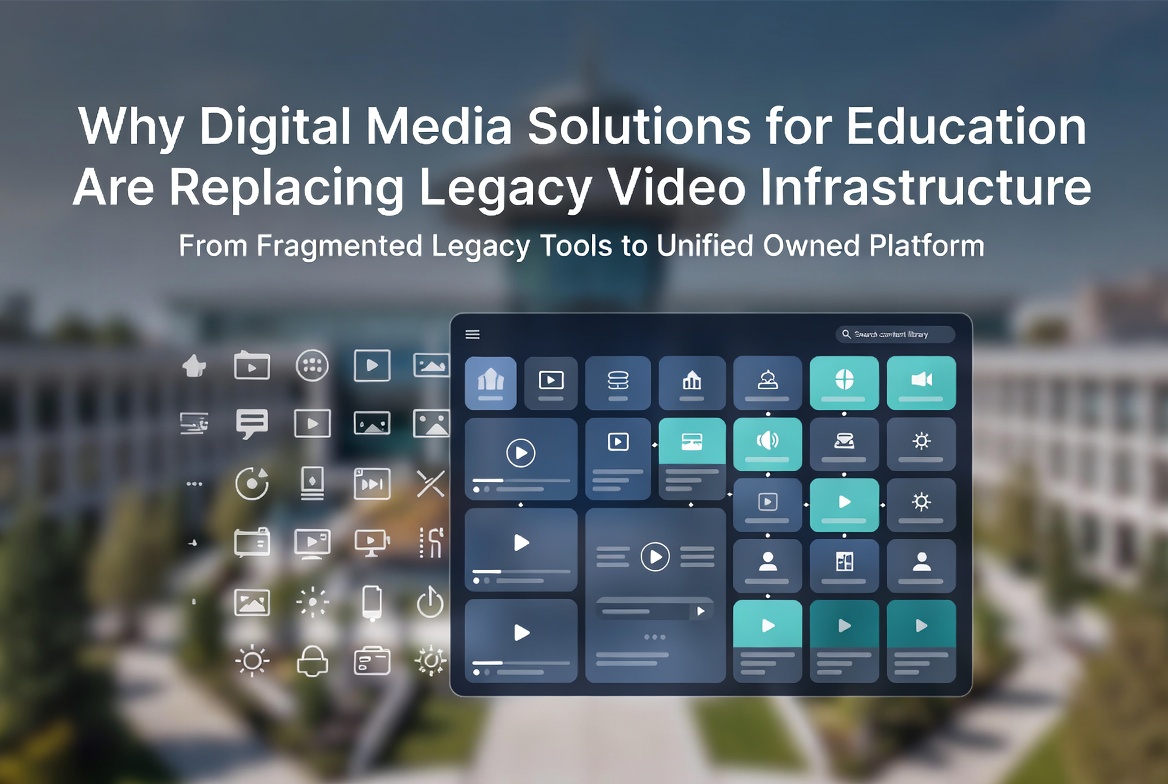
Modern digital media solutions for education consolidate live streaming, on-demand library management, course recording distribution, athletics content, alumni programming, and institutional communications into a single platform with a single CMS. Content produced by any department goes through one workflow, publishes to every distribution channel simultaneously, and appears in a single analytics dashboard that gives institutional leadership a complete view of how video content is performing across the entire organization.
That consolidation eliminates the per-platform overhead that fragments content teams, produces inconsistent metadata, and generates four different sets of analytics numbers that never reconcile into a single institutional picture.
Students, alumni, and fans watch content on their televisions. A Roku channel, a Fire TV app, and an Apple TV presence that surface under the institution's name in the app store are not optional distribution channels for education institutions serious about audience engagement. They are the primary surfaces where the most engaged audience segments consume long-form content.
A university athletics app on Roku that alumni download and watch from across the country builds a deeper ongoing relationship with that alumni segment than any email newsletter or social media presence can approach. For more on what building that CTV presence involves, see our guide to smart TV app development for content publishers.
Education institutions publish content on complex, time-sensitive schedules. A course recording that needs to be available to students at a specific time. A commencement stream that goes live at a precise moment. An athletics replay that should be available immediately after the final whistle. A message from the president's office that needs to reach the entire institution simultaneously.
Modern digital media solutions give institutions real-time control over all of that - from a single CMS, across every distribution platform, without waiting on a third-party platform's processing queue. For more on real-time content control, see our guide to real-time content control for streaming platforms.
When an institution's digital media infrastructure is owned rather than rented, every viewer interaction becomes institutional data. Which content drives alumni giving conversations. Which athletic events build the strongest fan base in specific geographic markets. Which course video formats produce the highest completion rates. Which content converts prospective students who visit the platform into applicants.
That data is only available when the streaming platform belongs to the institution - not when it lives inside a third-party platform's analytics dashboard that the institution accesses by permission.
The most common concern education institutions raise about replacing legacy video infrastructure is the content that already exists on third-party platforms. Years of athletics content on YouTube. Course recordings in the LMS. Alumni programming scattered across multiple tools.
The migration concern is legitimate but frequently overstated. The practical approach most institutions take is not a simultaneous cutover from every legacy platform. It is a consolidation strategy that moves new content to owned infrastructure immediately while migrating legacy content in priority order - starting with the highest-value archives and working backward.
YouTube does not have to disappear on day one. It can be repositioned as a discovery and top-of-funnel channel - surfacing clips and highlights that drive viewers to the institution's owned platform - while the owned platform becomes the primary destination for full-length content, live events, and the audience relationship the institution actually wants to build.
For more on building a complete digital media strategy around that transition, see our guide to digital media strategy for content publishers.
Lightcast has served higher education institutions for over 15 years, with universities, colleges, and athletic programs among its 5,000+ active clients. The platform is built for the operational complexity of education - multiple departments, multiple content types, multiple audience segments, and the institutional credibility requirements that come with representing an academic organization.
End-to-End Platform: Live streaming for athletics and campus events, on-demand library management for course recordings and alumni content, branded CTV and mobile apps, monetization for continuing education and premium athletics access, and real-time analytics - all from a single Lightcast CMS.
Branded Apps on Every Platform: Lightcast builds and maintains branded apps on Roku, Fire TV, Apple TV, iOS, Android, and web under the institution's name. Students, alumni, and fans find the university's content in the app store, not a vendor's platform. For more on university streaming specifically, see our guide to video streaming solutions for universities.
Automatic Live-to-VOD: Every live event - athletics, commencement, public lectures - is automatically captured and available as on-demand content the moment it ends. No manual archiving. No delay between the live audience and the replay audience. For more on live broadcasting infrastructure, see our guide to live video broadcasting for content publishers.
Full Data Ownership: Every viewer interaction on a Lightcast-powered education platform belongs to the institution. Lightcast does not retain, monetize, or share audience data from client platforms.
Fastest Deployment in the Industry: Lightcast was named the Fastest Deployment OTT Platform Provider 2026 by The Silicon Review - which means the transition from legacy infrastructure to owned platform happens faster than with any other provider in the market. For more on that recognition, see our post on the Silicon Review award.
Legacy video infrastructure is not failing education institutions because the tools stopped working. It is failing them because the operational model those tools represent - fragmented, platform-dependent, data-poor, and owned by vendors rather than institutions - cannot support the audience strategy that modern education institutions need to execute.
Modern digital media solutions for education replace that fragmentation with a single owned platform that gives institutions control of their content, their audience data, and the viewing experience they deliver to students, alumni, faculty, and fans.
Lightcast gives education institutions the infrastructure to make that transition - with the deployment speed, operational depth, and platform capabilities that 15 years of serving higher education has built.
To learn more or schedule a demonstration, visit lightcast.com.
Published: April 13, 2026
Category: Digital Media Strategy
Tags: digital media solutions education, university streaming, education video infrastructure, OTT platform education, higher education digital media, Lightcast education