Platform
Solutions
Resources
Direct Answer: The most popular OTT streaming platforms fall into two very different groups. Consumer services like Netflix, Disney+, Hulu, and Amazon Prime Video are the ones people watch. B2B platforms are the technology organizations use to build and run their own branded streaming services. If you own content and want to reach an audience directly, the second group is what matters. Lightcast is one of those platforms, with 12,000+ branded apps launched for 5,000+ organizations, delivering across Roku, Fire TV, Apple TV, iOS, Android, and web with no revenue share.
When people search for popular OTT platforms, they are often asking two different questions without realizing it. One group wants to know what to watch. The other wants to know how to build. Mixing them up leads to a lot of confusion, so this guide separates them clearly.
Streaming now accounts for nearly half of all television viewing in the United States, which is exactly why this question matters more every year.
There are two distinct meanings behind the phrase, and knowing which one you mean changes the entire answer.
The first meaning is consumer streaming services: the apps people subscribe to and watch. The second is OTT platform providers: the behind-the-scenes technology that organizations use to launch their own streaming services. A church, a university, or a sports league does not compete with Netflix for the same audience. It uses a platform to build its own service for its own audience. Both are called OTT platforms, which is where the confusion starts.
These are the household names, the services most people picture when they hear streaming.
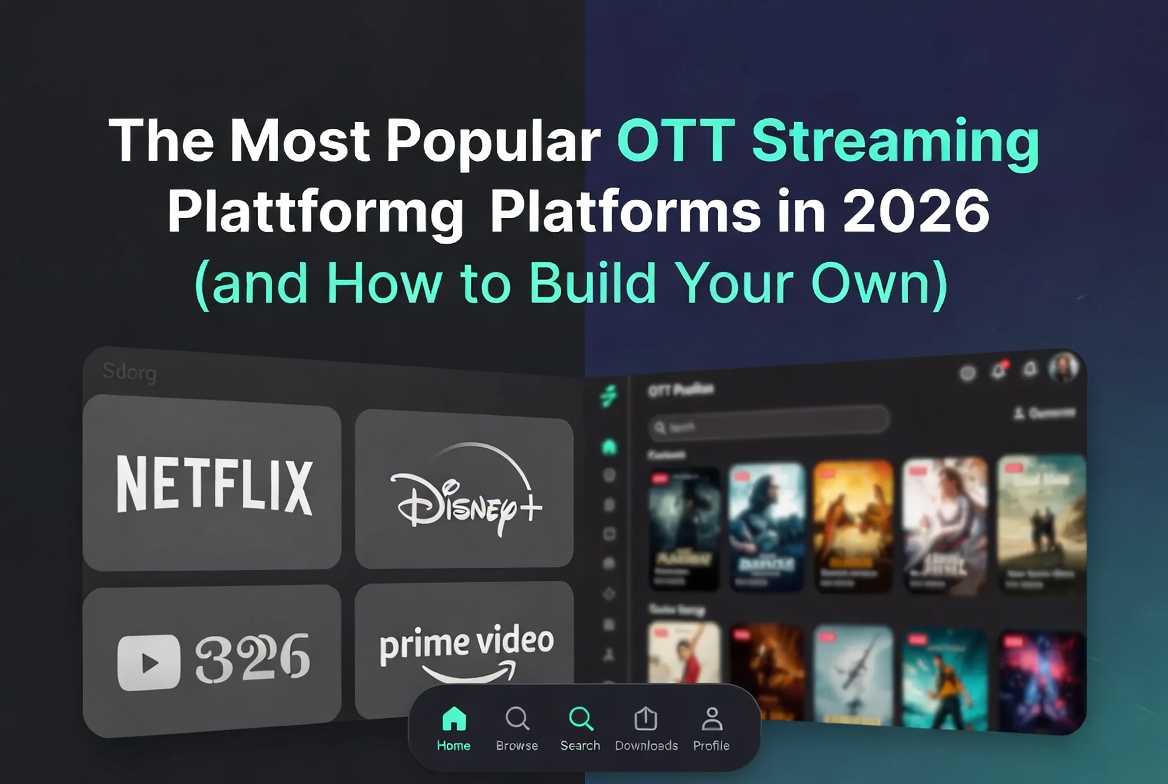
Netflix remains the largest by scale. Disney+, Hulu, and Amazon Prime Video are among the other dominant subscription services, alongside Max, Peacock, Paramount+, and Apple TV+. YouTube belongs here too, since it delivers video over the internet directly to viewers. What these have in common is enormous content libraries, massive marketing budgets, and audiences measured in the tens or hundreds of millions. They are the destination services, and for a content owner, they are useful mainly as a reference point for what audiences now expect, not as competition you need to outspend.
It is also worth noting how fragmented this group has become. A few years ago a household might have one or two services. Now many juggle five or more, and the lines blur as services add live TV, free ad-supported channels, and bundles. For viewers that means more choice and more subscription fatigue. For content owners it means something more encouraging: audiences are clearly willing to add another service to their lineup when it offers something they genuinely want, which is exactly the opening a focused, owned platform fills.
The second group is where content owners should focus. These are the B2B platforms that provide the infrastructure to launch a branded streaming service, sometimes called online video platforms or OVPs.
This category includes providers such as Lightcast, Kaltura, Dacast, and Muvi, among others. Rather than giving you content to watch, they give you the tools to deliver your own content: branded apps across devices, a content management system, monetization, analytics, and the delivery infrastructure underneath. The important point is that you do not need Netflix's catalog or budget to run a successful streaming service. You need your audience and a platform that reaches them. Our guide to the best on-demand video platforms goes deeper on this category, and our guide to VOD vs OTT clears up a related point of confusion.
The other thing that separates these platforms is what they own versus what you own. With a finished consumer service, the audience belongs to the service. With a build-your-own platform, the audience can belong to you, but only if the provider is set up that way. That single distinction, who keeps the viewer relationship and the data behind it, ends up mattering more than almost any feature, and it is the first thing worth asking any provider about.
If you are choosing a platform to build your own service, a few factors matter more than feature checklists.
Device coverage. Your platform should reach every major device, Roku, Fire TV, Apple TV, mobile, and web, because your audience is spread across all of them. Monetization flexibility and revenue share. Check which models are supported and, critically, whether the provider takes a cut of your earnings. Data ownership. Some platforms keep the viewer relationship and data for themselves, which matters enormously when that relationship is your most valuable asset. Deployment speed. How fast you can actually launch often decides whether you capture a season or a campaign or miss it. Our buyer's guide to choosing an OTT platform walks through the full evaluation.
Lightcast sits firmly in the build-your-own category, and it has spent more than 15 years there. Here is what that looks like in practice.
Lightcast has launched 12,000+ branded apps, delivering to Roku, Fire TV, Apple TV, iOS, Android, and web simultaneously from one library managed through the Media Cloud OVP.
Subscriptions, advertising, pay-per-view, donor-supported, and institutional licensing are all supported, and Lightcast does not take a cut of what you earn. See our guide to monetization models for how these work.
Lightcast does not retain, monetize, or share your viewer data, which is a meaningful contrast with platforms that hold the customer relationship themselves.
Lightcast was named Fastest Deployment OTT Platform Provider 2026 by The Silicon Review, so a full launch across devices takes weeks rather than quarters, including both on-demand and live streaming.
The most popular OTT streaming platforms come in two forms: consumer services like Netflix, Disney+, and Hulu that people watch, and B2B platforms that organizations use to build their own branded services. If you own content, the second group is the one that matters, and the giants are a reference point rather than competition. When choosing a platform to build on, weigh device coverage, monetization flexibility and revenue share, data ownership, and deployment speed, and remember that reaching your own audience well beats trying to match a major streamer's scale.
If you are ready to evaluate platforms, our buyer's guide to choosing an OTT platform is the right next step.
To learn more or schedule a demonstration, visit lightcast.com.
Published: June 16, 2026
Category: Streaming Strategy
Tags: most popular ott streaming platforms, ott streaming platforms, ott platforms, popular ott services, best ott platforms, ott platform providers, build your own ott platform, streaming services, ott software, white label ott