Platform
Solutions
Resources
Direct Answer: OTT advertising is video advertising delivered inside streaming content over the internet, rather than through cable or broadcast. Its advantage over traditional TV is precision: ads can be targeted to specific households, are typically non-skippable and full-screen, and every impression is measurable. For content owners, it is one of the ways to fund a free, ad-supported (AVOD) service. Lightcast supports ad-supported monetization natively, with full ownership of your audience data and delivery across Roku, Fire TV, Apple TV, iOS, Android, and web for 5,000+ organizations.
Advertising dollars are following audiences out of cable and into streaming. US connected TV ad spending is projected to approach 38 billion dollars in 2026, and that shift is reshaping how both advertisers and content owners think about video.
This guide explains what OTT advertising is, how it works under the hood, and why it consistently outperforms the traditional TV spot.
OTT advertising is the practice of placing video ads within over-the-top streaming content, the shows, films, live events, and libraries that people watch over the internet on their own devices. OTT stands for over-the-top, meaning the content bypasses traditional cable and satellite delivery.
You will often see the term CTV used alongside it. Connected TV, or CTV, refers specifically to ads served on internet-connected television screens, which is a subset of OTT. OTT is the broader category, covering phones, tablets, and computers as well as the living-room TV. The advertising mechanics are largely the same across both.
OTT advertising runs on a process called dynamic ad insertion, and understanding it explains why streaming ads are so different from a traditional commercial.
With broadcast TV, every household watching a program sees the same commercial at the same time. With OTT, ads are inserted into the stream individually, in real time, into the natural ad breaks of the content. Those breaks are called ad pods, and each pod holds one or more ad slots. Because the insertion happens per viewer, two households watching the same show can see completely different ads, chosen to fit each one. Most premium streaming uses server-side ad insertion, which stitches the ad into the video before it reaches the device, so it plays seamlessly and cannot be skipped or blocked the way browser ads can. Much of this inventory is bought programmatically, through automated real-time auctions, though publishers can also sell directly. For a closer look at the underlying mechanism, see our guide to dynamic ad insertion.
OTT advertising outperforms traditional TV on the exact dimensions that have always frustrated advertisers, and that effectiveness is why budgets keep moving.
Precise targeting. Instead of buying a broad demographic, advertisers can reach specific households based on location, interests, and viewing behavior, which dramatically reduces wasted spend. Full attention. OTT ads are typically full-screen and non-skippable in premium environments, so they command the viewer's attention rather than competing with it. Real measurement. Every impression, completion, and interaction is tracked, so advertisers see what actually happened rather than estimating from panels. Reaching cord-cutters. A growing share of viewers cannot be reached on cable at all, and OTT is the only way to put a video ad in front of them. Together these turn television advertising from a broad, hard-to-measure bet into a precise, accountable channel.
It is worth noting that the targeting is also shifting toward privacy-first methods. As third-party cookies disappear and regulation tightens, the industry is moving to contextual signals and first-party data, the audience information a publisher gathers directly. That makes owning your own audience data a real advantage rather than a technicality, because it is increasingly the foundation that targeting depends on.
The familiar formats carry over from television, with new options layered on top.
In-stream video ads are the core: pre-roll runs before the content, mid-roll during natural breaks, and post-roll after it ends. On top of these, streaming supports interactive formats that broadcast never could, including shoppable overlays and scannable QR codes that turn a passive ad into a direct action. On cost, OTT and CTV inventory generally commands premium CPMs, higher than standard digital video, because the inventory is premium, the attention is high, and the targeting is precise. Pricing varies widely by platform, targeting, and content quality, so it is best evaluated against the reduced waste and stronger measurement that justify the premium. For how ad-supported access fits alongside other models, see our guide to SVOD, AVOD, and TVOD.
Lightcast has spent more than 15 years helping organizations run their own streaming services, including ad-supported ones. Here is what that looks like in practice.
Lightcast supports the ad-supported (AVOD) model so you can offer free, ad-funded access alongside or instead of subscriptions and pay-per-view. You can review the full OTT advertising capabilities in one place.
Effective advertising depends on knowing your audience, and Lightcast does not retain, monetize, or share your viewer data. That first-party relationship stays yours rather than the platform's, which matters more every year as privacy rules tighten and third-party data fades.
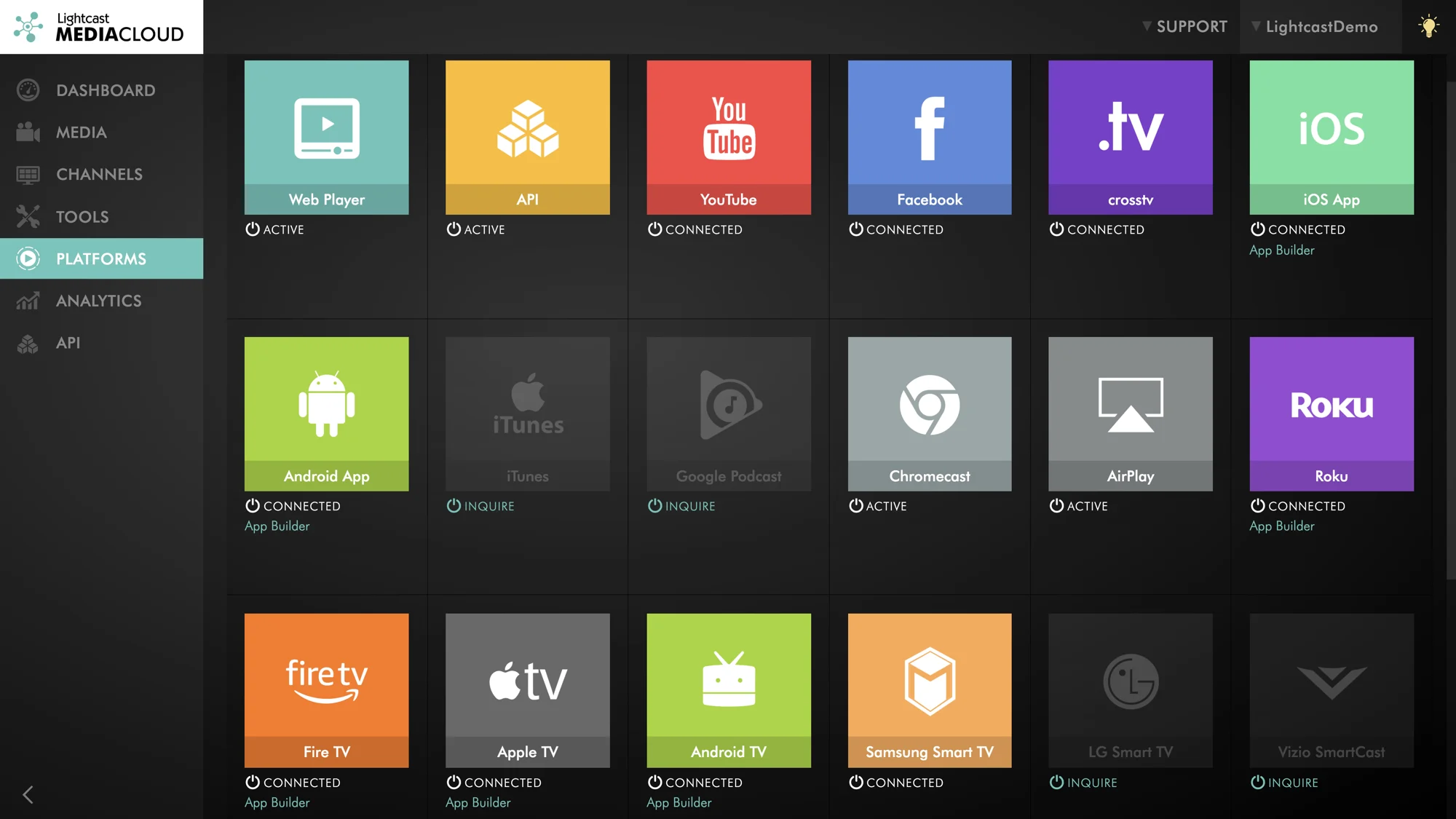
Your content, and the advertising within it, reaches Roku, Fire TV, Apple TV, iOS, Android, and web from one library through the Media Cloud OVP, so you are present on the connected TVs where the most valuable streaming ad inventory lives.
Ad-supported access does not have to stand alone. You can combine it with subscriptions and pay-per-view, with no revenue share taken by the platform, and let your audience and content decide the mix.
OTT advertising places video ads inside internet-delivered streaming content, and it is effective because it replaces the broad, unmeasurable nature of traditional TV with precise household targeting, full-screen non-skippable attention, and real measurement. It works through dynamic ad insertion, which places individually chosen ads into each viewer's stream, and it supports both familiar formats like pre-roll and mid-roll and newer interactive ones. For content owners, advertising is one way to fund a free, ad-supported service, and it works best on a platform that reaches every device and lets you own the audience data behind it.
If you are weighing how to monetize a streaming service, our buyer's guide to choosing an OTT platform is a useful next step.
To learn more or schedule a demonstration, visit lightcast.com.
Published: June 22, 2026
Category: Monetization
Tags: ott advertising, what is ott advertising, ott advertising platforms, how ott advertising works, ott advertising cost, dynamic ad insertion, avod, ctv advertising, targeted advertising for ott, streaming ads